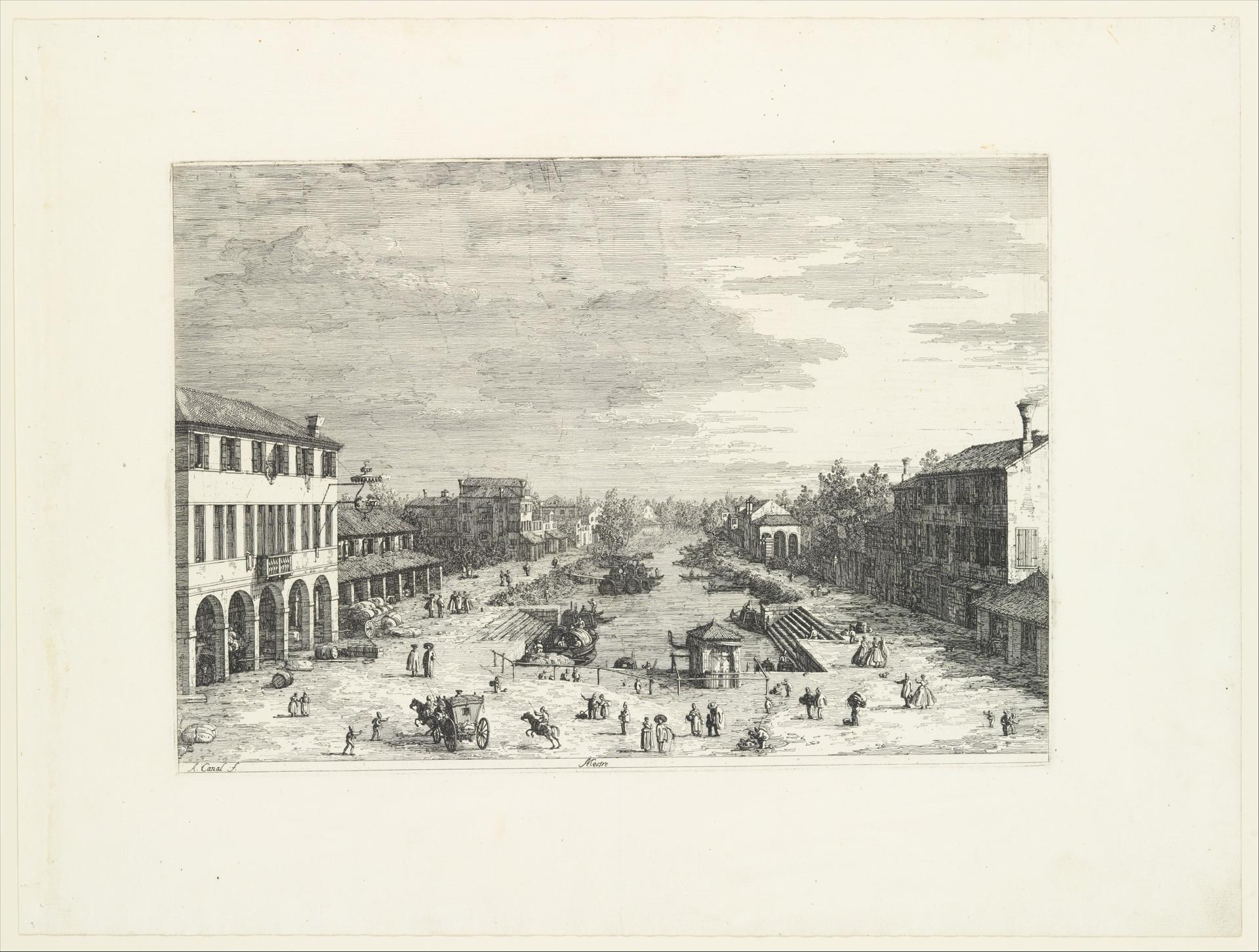
View of Mestre, an inn at left and other various buildings lining the canal, from "Views" (Vedute altre prese da i luoghi altre ideate da Antonio Canal)
Original title: View of Mestre, an inn at left and other various buildings lining the canal, from "Views" (Vedute altre prese da i luoghi altre ideate da Antonio Canal)
kurzbeschreibung
Canaletto's etching 'View of Mestre' (Giovanni Antonio Canal) was made between 1735 and 1746 and captures the Venetian mainland town of Mestre as a veduta. The print, executed in etching, presents a lively canal scene with buildings, people, and animals.
Description
A canal runs through the foreground and splits the image in two. On the left, a building with arcades lines the water; on the right, more houses follow. Behind them, additional structures and trees come into view. Many figures populate the scene: people move along the canal and on the bank, some linger, while horses and carts stand in the foreground. The light appears evenly diffuse, and the color remains monochrome.
Context
This etching belongs to Canaletto's series 'Vedute altre prese da i luoghi altre ideate', created between 1735 and 1746. Mestre was then an important trading place near Venice, and the artist recorded the everyday scene with topographical accuracy. The present example is the first state of two, suggesting careful printing.
Impact
The print radiates a calm, everyday mood of the Venetian mainland. The detailed rendering of architecture and figures produces a lively yet orderly feel, characteristic of Canaletto's vedute.
Technique
In etching, lines are bitten into a metal plate. This process allows fine, precise strokes that clearly outline architecture and figures. The print was pulled on paper, with the monochrome emphasizing the graphic quality of the sheet.
AI-generated description text
Source: Metropolitan Museum of Art · Public Domain (CC0 1.0)