Tomb of Julius Caesar
Original title: Tomb of Julius Caesar
kurzbeschreibung
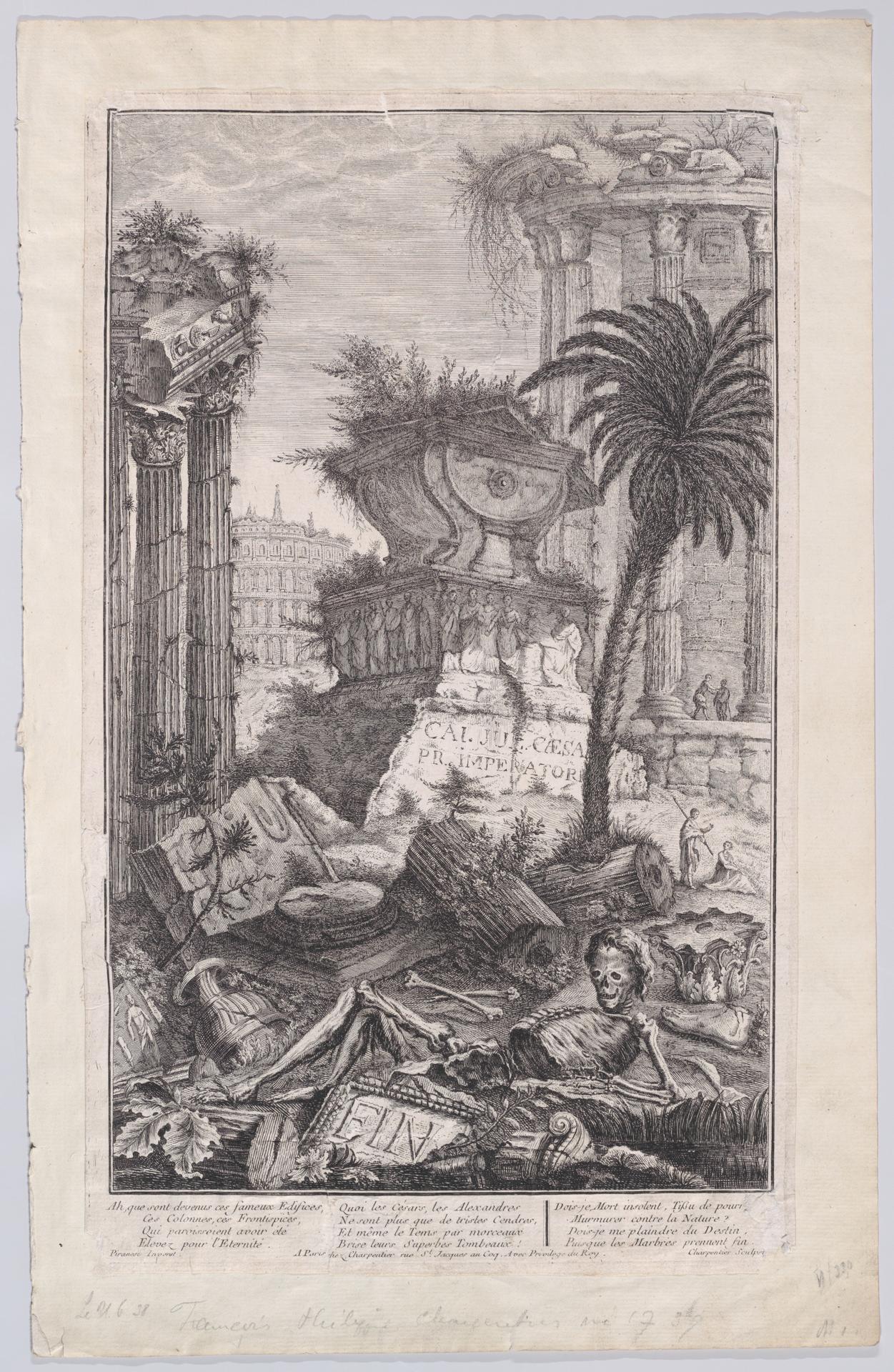
François Philippe Charpentier created the etching "Tomb of Julius Caesar" in 1765, presenting an ancient ruin overgrown with plants. A damaged column shaft with an inscription fragment referring to Caesar takes center stage. The sheet measures 35.9 × 21.8 cm and is executed as an etching.
Description
An ancient ruin landscape unfolds: broken columns and stone remains in the foreground, overgrown with plants and shrubs. A large, half-destroyed column shaft bears the inscription "CAL. JUL. CAESAR PR. IMPERATOR". To the left, more columns and debris; to the right in the distance, palm trees create a tropical atmosphere. Skeletons and human remains lie in the foreground, while distant buildings and a cityscape are hinted at. The layout is asymmetrical and focuses on the central column; diffuse light underscores the impression of decay.
Context
Charpentier, an 18th-century French artist, was known for his etchings. The depiction of Caesar's tomb was made in 1765, an era of great European interest in antiquity and its monuments. The print belongs to a group of works dealing with ancient ruins and their transience. Such motifs were highly popular in the Age of Enlightenment, combining historical interest with a melancholic aesthetic.
Impact
Melancholy and contemplation define the mood of this etching, evoked by decay and transience. Ruins, skeletons, and the inscription on the column shaft emphasize the historical significance of the site and the power of time. The monochrome gray tones and diffuse light reinforce the somber yet fascinating atmosphere.
Technique
In the etching, fine lines and hatching are used to work out tonal values and textures. The monochrome effect arises from printing with black ink on paper; varying gray tones result from the density of the lines. Details such as the inscription and the plants demonstrate the precision of the etching technique.
AI-generated description text
Source: Metropolitan Museum of Art · Public Domain (CC0 1.0)