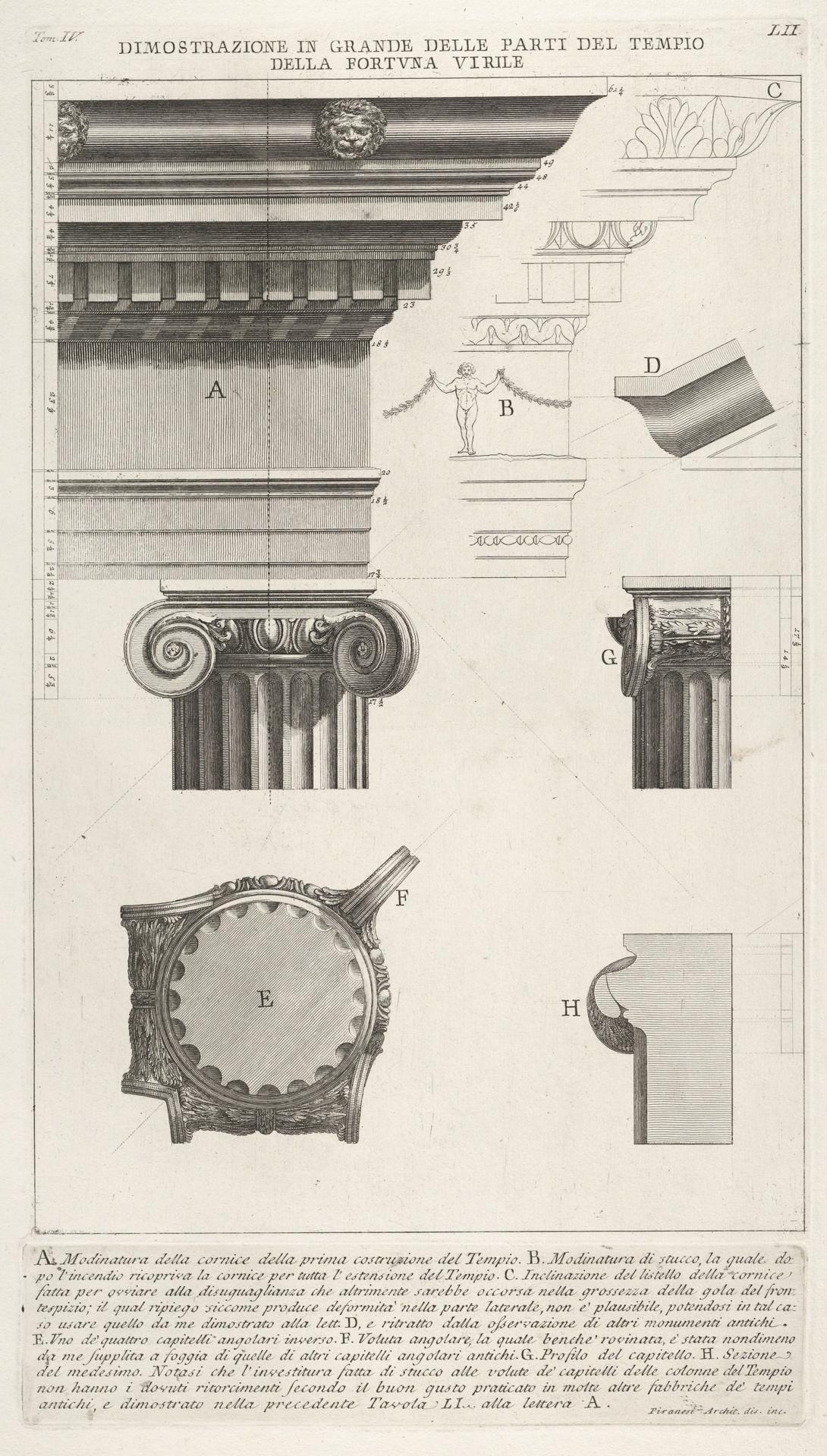
Cornice and column from the Temple of Fortuna Virilis (Tempio della Fortuna Virile), from "Le Antichità Romane"
Original title: Cornice and column from the Temple of Fortuna Virilis (Tempio della Fortuna Virile), from "Le Antichità Romane"
kurzbeschreibung
This sheet is given over to a meticulous drawn record of the cornice and column of the Temple of Fortuna Virilis in Rome. It comes from Giovanni Battista Piranesi's plate volume 'Le Antichità Romane' of 1756 and was executed as an etching.
Description
Stark black and white, the print lays out several views and sections of the architectural members: a coffered ceiling (A), a column (G), a view of a capital (F), a column base (H) and a further view of a column (E). These individual motifs are arranged with deliberate order so that the make-up and structure of each part can be followed. No human figures or incidental detail appear; only the architectural elements are shown.
Context
The etching was made in 1756 as part of Piranesi's four-volume 'Le Antichità Romane', which surveyed the ancient buildings of Rome. He developed it after several study trips, aiming to record Roman architecture on a scholarly footing. The precise reproductions were meant both as archaeological documentation and to spread knowledge of ancient building practice.
Impact
Clear lines and the orderly sequence of views strike the viewer as sober and technical, and ancient architecture comes across as something objectified. By limiting himself to essentials, Piranesi throws proportions and details into relief.
Technique
The plate was made as an etching: lines were cut into a copper plate and bitten with acid. Fine hatching and exact contours define Piranesi's style, which joins technical precision with artistic rendering.
AI-generated description text
Source: Metropolitan Museum of Art · Public Domain (CC0 1.0)