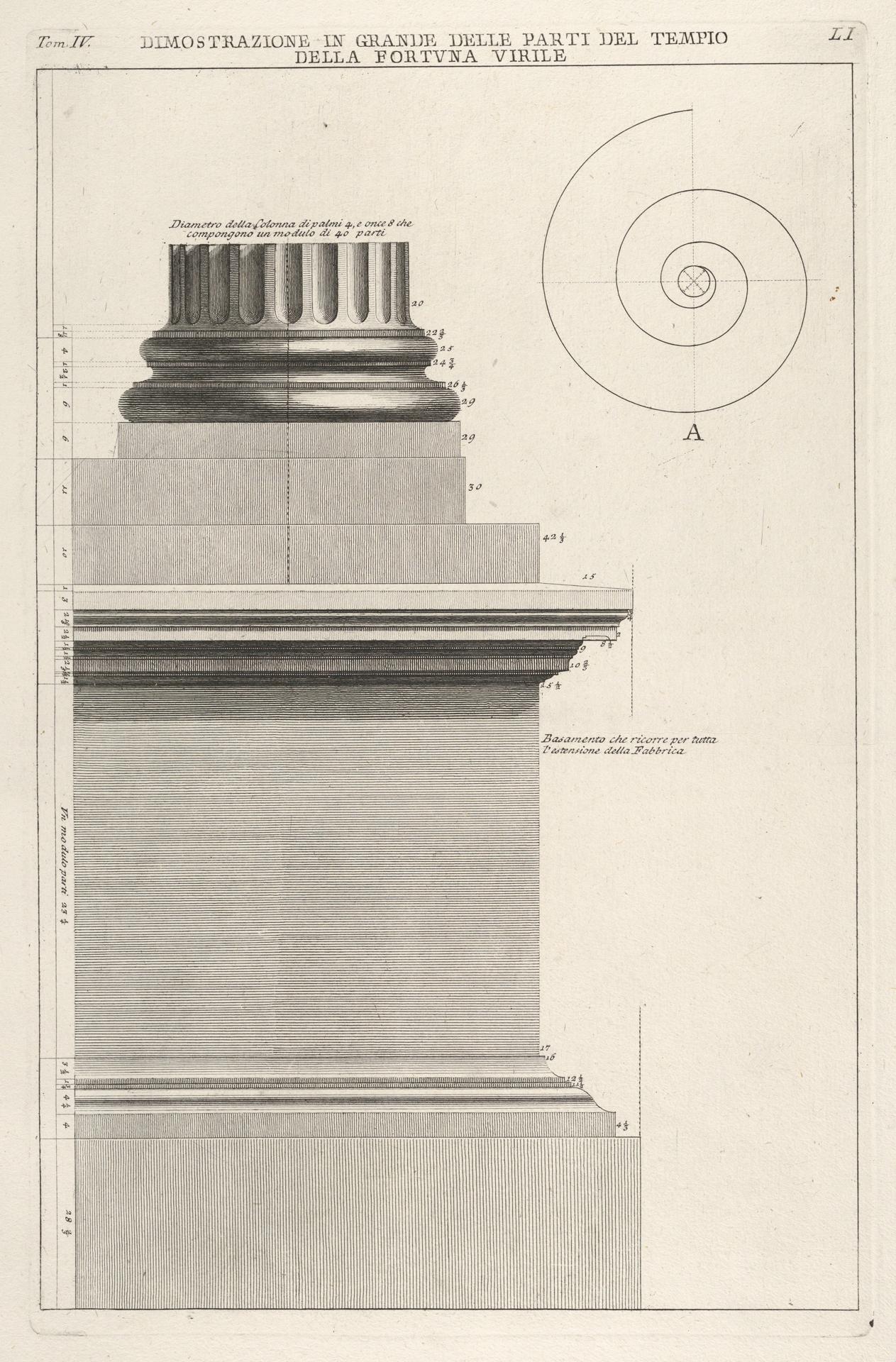
Section of column base from the Temple of Fortuna Virilis (Tempio della Fortuna Virile), from "Le Antichità Romane"
Original title: Section of column base from the Temple of Fortuna Virilis (Tempio della Fortuna Virile), from "Le Antichità Romane"
kurzbeschreibung
This etching by Giovanni Battista Piranesi dates from 1756. It presents a technical drawing of the column base and part of the shaft from the Temple of Fortuna Virilis in Rome, complete with detailed measurements and a cross-section diagram.
Description
A precise technical drawing of the column base and shaft of the Temple of Fortuna Virilis. At the top appear the fluted column and its capital; below, the podium and base. A diagram in the upper right corner illustrates the cross-sectional shape of the column. Measurements are given in palm units; varying line weights emphasize the structure of the components. The sheet is entirely black and white.
Context
The etching belongs to Piranesi's four-volume work 'Le Antichità Romane', published in Rome in 1756. In it, Piranesi systematically documented the ancient buildings of Rome to record architectural details and proportions. The Temple of Fortuna Virilis, now known as the Temple of Portunus, dates from the 1st century BC and is considered a well-preserved example of Roman temple architecture. Piranesi used precise surveys to give dimensions in the palm units customary at the time.
Impact
Clear lines and exact measurements give the sheet scientific precision. The factual impression allows the viewer to follow the architectural structure of the ancient temple. Image and diagram complement each other for didactic clarity.
Technique
Piranesi used etching: the drawing is scratched into a wax-coated copper plate and then etched. Different line weights result from varying etching times and allow fine gradation of shadows and contours. The sheet is part of a series printed in an edition of several hundred copies.
AI-generated description text
Source: Metropolitan Museum of Art · Public Domain (CC0 1.0)