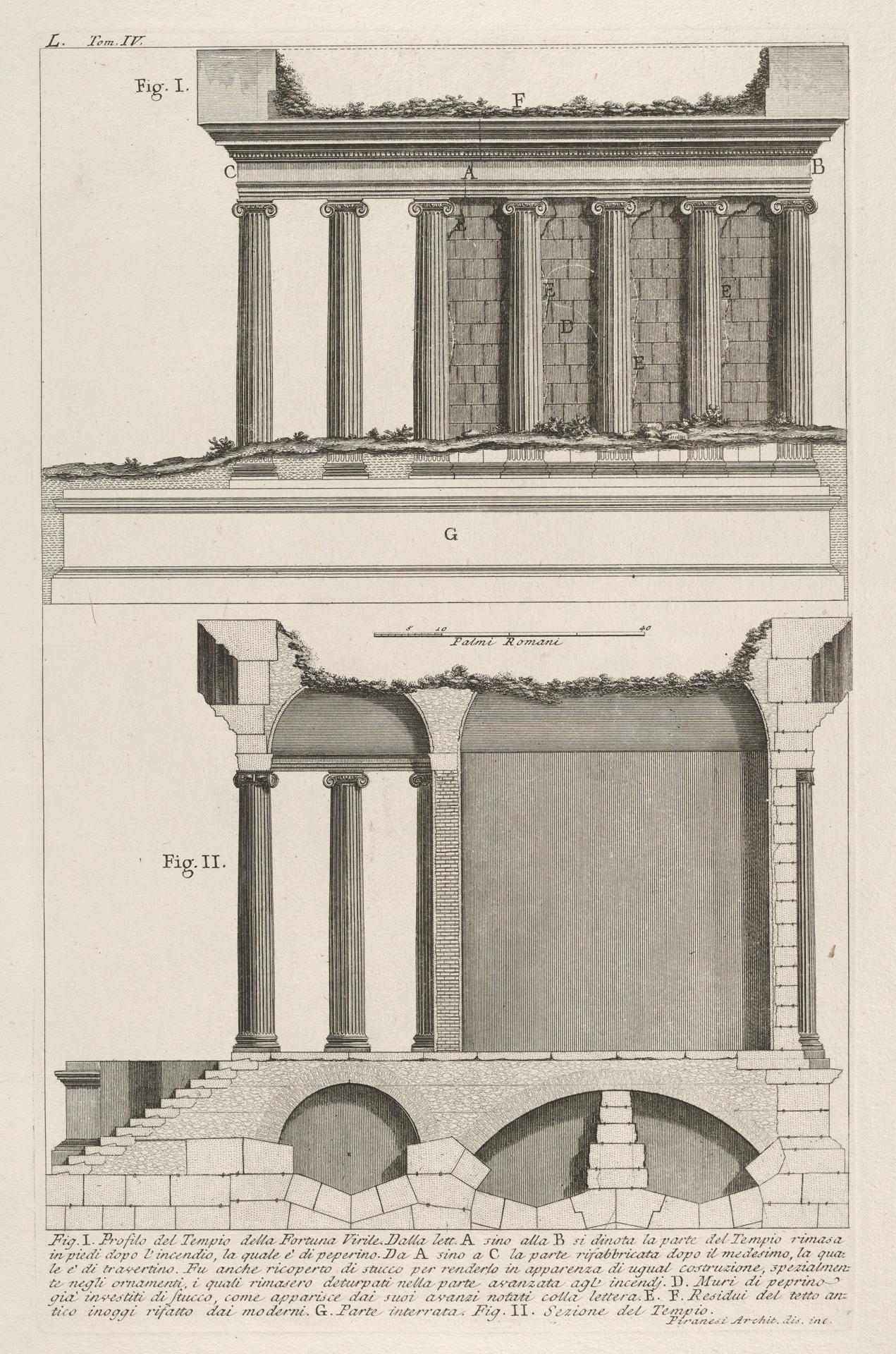
Profile of the Temple of Fortuna Virilis (Profilo del Tempio della Fortuna Virile), and section of the temple, from "Le Antichità Romane"
Original title: Profile of the Temple of Fortuna Virilis (Profilo del Tempio della Fortuna Virile), and section of the temple, from "Le Antichità Romane"
kurzbeschreibung
Two architectural drawings of the Temple of Fortuna Virilis in Rome, etched by Giovanni Battista Piranesi in 1756. The upper image shows the temple in profile with Corinthian columns; below is a cross-section through the interior. The sheet belongs to Piranesi's collection 'Le Antichità Romane'.
Description
Fig. I presents the temple in profile, with meticulously rendered Corinthian columns including base, capital, and entablature. Fig. II below opens the building as a section, revealing columns, architraves, and interior walls. Black and white with precise shadows that bring out depth and structure; the drawing remains factual and technical, without color or atmospheric effects.
Context
Piranesi published the four volumes of 'Le Antichità Romane' in Rome between 1756 and 1757. In them he systematically documented ancient Roman buildings, responding to the growing interest in Roman archaeology in the 18th century. The Temple of Fortuna Virilis, now known as the Temple of Portunus, dates to the 1st century BC and stands in the Forum Boarium in Rome. In his etchings, Piranesi combined archaeological accuracy with artistic design.
Impact
Clear lines and precise shading give the sheet a monumental and technical character. Because profile and section appear together, the building can be grasped spatially in full; the viewer is drawn into the structure of the ancient temple.
Technique
An etching on paper: in this intaglio process, the drawing is etched into a metal plate that has been treated with acid. Fine lines and hatching form the detailed architecture; varying line thickness creates a sculptural effect. The sheet measures 51.8 x 37.6 cm, offering ample space for the architectural details.
AI-generated description text
Source: Metropolitan Museum of Art · Public Domain (CC0 1.0)