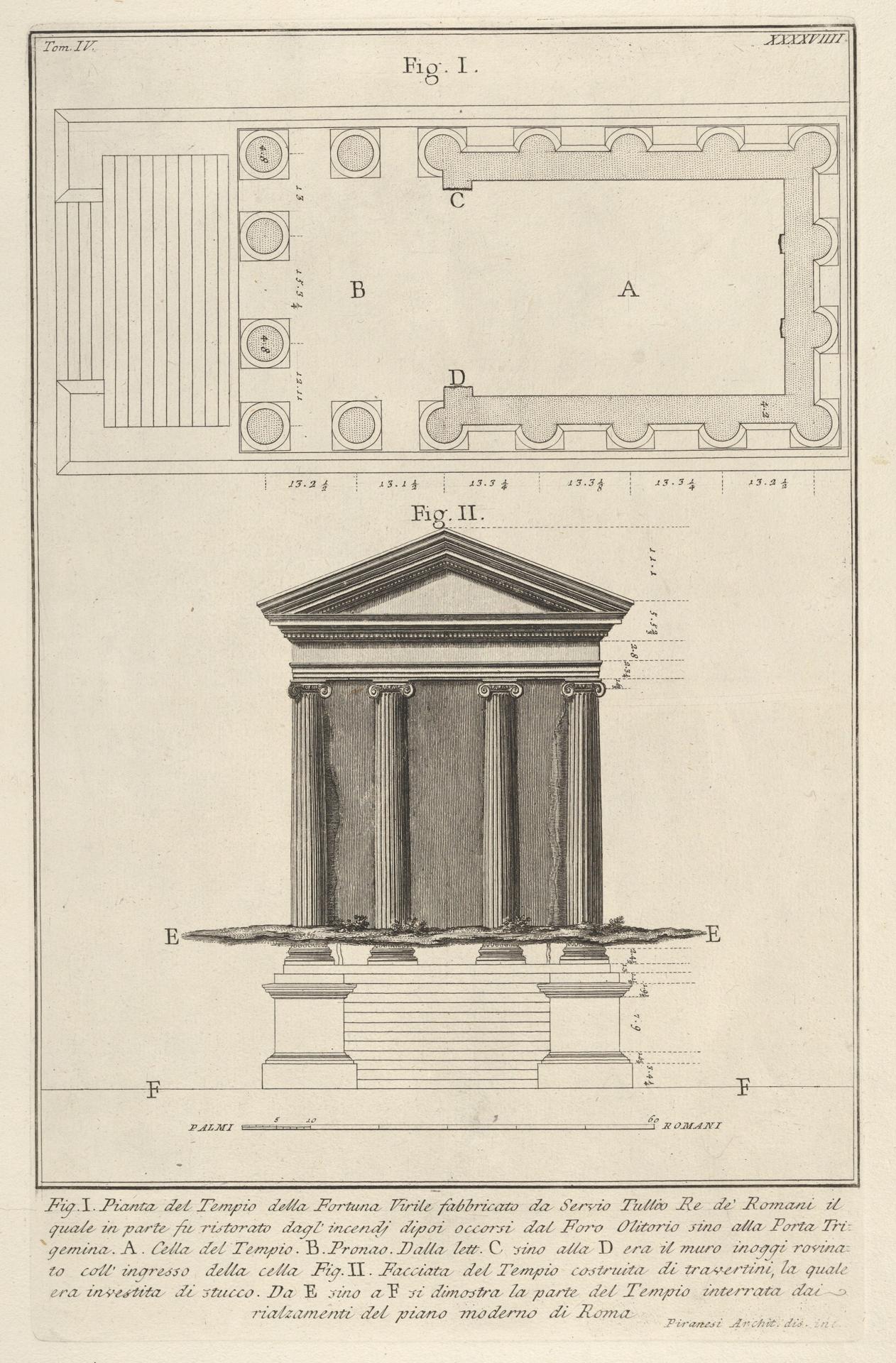
Plan and facade of the Temple of Fortuna Virilis (Tempio della Fortuna Virile), from "Le Antichità Romane"
Original title: Plan and facade of the Temple of Fortuna Virilis (Tempio della Fortuna Virile), from "Le Antichità Romane"
kurzbeschreibung
Unlike the usual vedute of the period, this print presents the Temple of Fortuna Virilis not as a single view but as a pairing of ground plan (Fig. I) and facade (Fig. II). It belongs to Giovanni Battista Piranesi's 'Le Antichità Romane', published in 1756. The etching records the ancient building's structure and proportions in two complementary drawings.
Description
Two figures share the sheet: Fig. I gives the ground plan with measurements and structural details, while Fig. II shows the facade with its colonnade, podium and large triangular pediment. The layout feels sober and technically precise. Crisp, sharp lines bring out the architectural elements. Everything stays monochrome black and white; shading comes only from varying line weight and density, with no visible cast shadows.
Context
Piranesi's 'Le Antichità Romane' runs to four volumes and documents the ancient buildings of Rome. The Temple of Fortuna Virilis, now known as the Temple of Portunus, dates to the 1st century BC and ranks among the best-preserved examples of Roman temple architecture. The etchings served both scholarly recording and artistic dissemination of the ancient heritage.
Impact
Archaeological accuracy and aesthetic clarity meet here. Because ground plan and facade stand side by side, the building can be grasped directly. The delicate linework creates a calm, contemplative mood. The sheet presents itself as a factual record of ancient architecture and invites close looking.
Technique
The print is an etching, in which lines are scratched into a metal plate and then transferred to paper. Piranesi's fine, precise linework defines all his printed work. As part of a widely circulated series, it helped spread knowledge of Roman antiquity across Europe.
AI-generated description text
Source: Metropolitan Museum of Art · Public Domain (CC0 1.0)