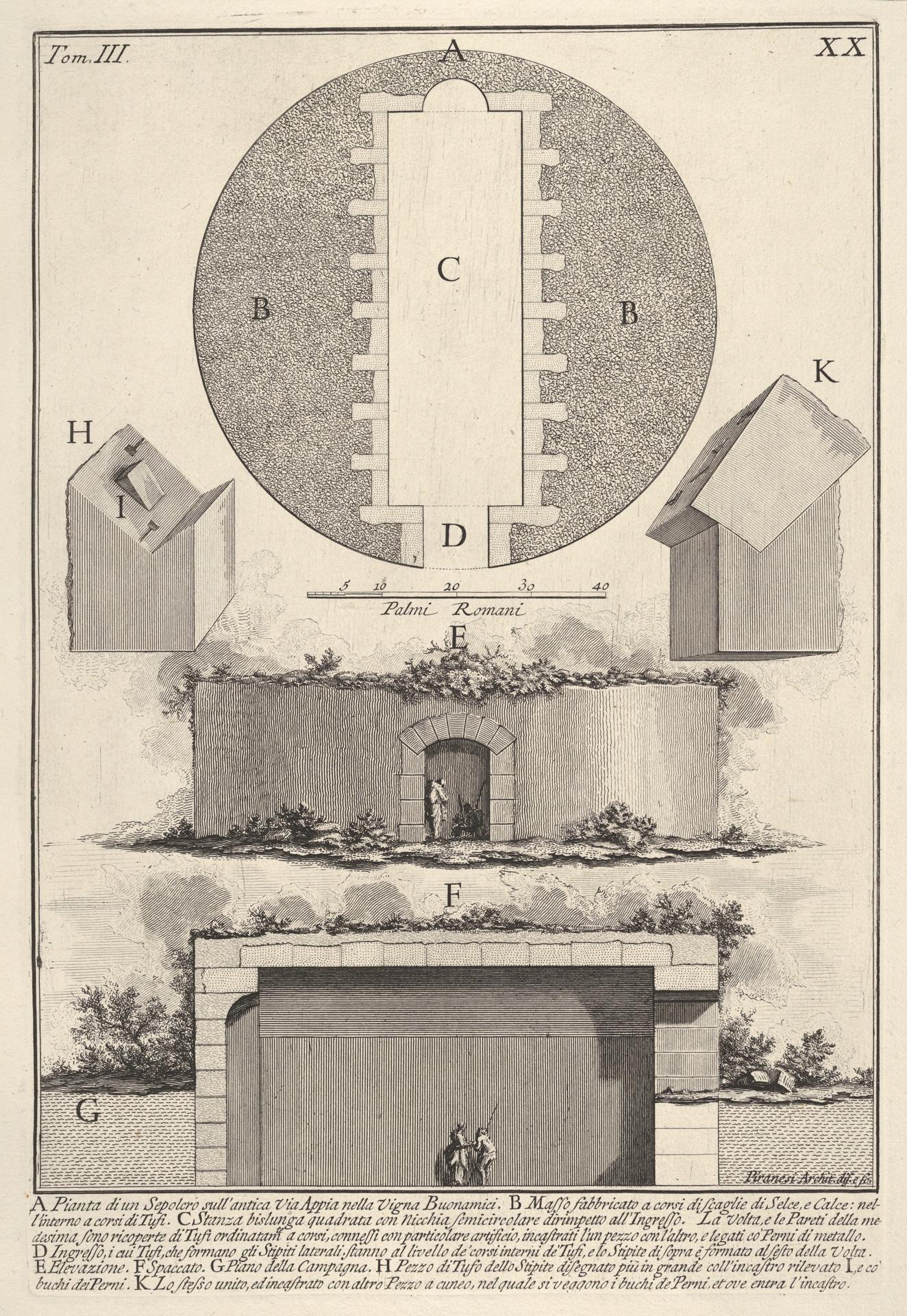
Plan of a tomb on the Appian Way in Vigna Buonamici (Pianta di un sepolcro sull'antica Via Appia nella Vigna Buonamici), from "Le Antichità Romane"
Original title: Plan of a tomb on the Appian Way in Vigna Buonamici (Pianta di un sepolcro sull'antica Via Appia nella Vigna Buonamici), from "Le Antichità Romane"
kurzbeschreibung
With this 1756 etching, Giovanni Battista Piranesi presents the ground plan and two views of an ancient tomb on the Via Appia. The sheet belongs to his four-part publication 'Le Antichità Romane' and was produced as an etching.
Description
The layout follows a clear order. Across the top, the plan of the tomb takes up the most space; the letters A, B, C and D are marked within it, making the arrangement of the structure legible. Beneath it sit two side views, presenting the elevation, the entrances and the internal division on the left and right. Everything is drawn in shades of grey, with evenly spaced lines and no shading. The measurements given in Roman palmi point to the technical purpose of the sheet.
Context
'Le Antichità Romane' appeared in Rome between 1756 and 1757 and runs to four volumes. In it Piranesi recorded ancient Roman buildings and monuments systematically, in order to preserve and pass on knowledge of them. The Vigna Buonamici lay on the Via Appia, one of Rome's most important consular roads, known for its tomb monuments. The publication was intended for scholars, architects and lovers of art, and helped revive interest in Roman antiquity.
Impact
The precision of the etching technique and the sober, clearly ordered sequence of plan and views define the sheet. The viewer gains a reliable impression of how ancient tombs were built and is prompted to look closely at the architectural details. The restrained graphic work remains documentary and carries the scholarly ambition of the publication.
Technique
For the etching, the drawing was scratched with a needle into an acid-resistant ground on the copper plate and then bitten with acid. Etching produces fine, even lines; the plate is inked for printing and the image transferred to paper. The plate measures 34.9 x 23.2 cm, while the sheet format is somewhat larger at 52 x 37.5 cm.
AI-generated description text
Source: Metropolitan Museum of Art · Public Domain (CC0 1.0)