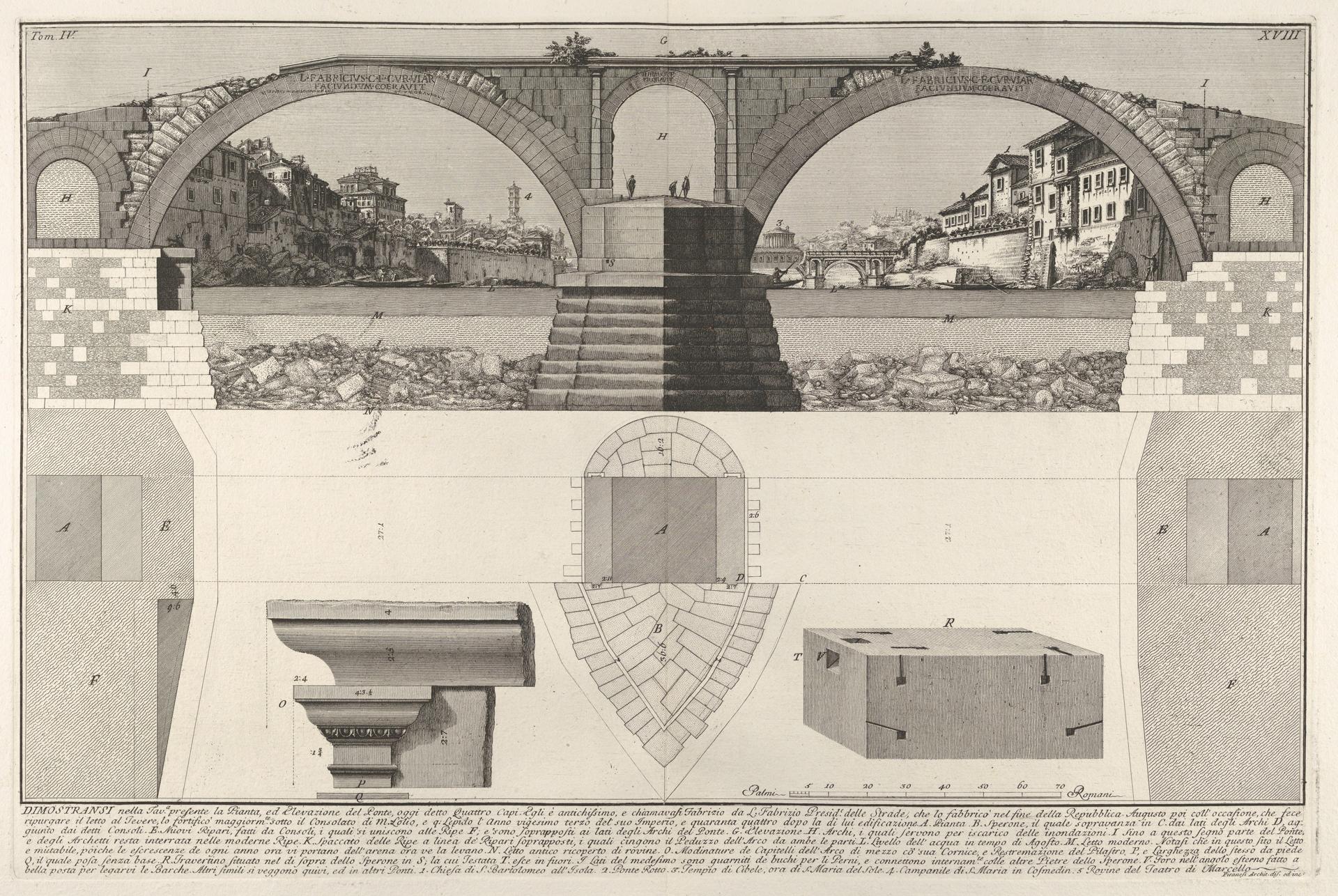
Plan and elevation of the Pons Fabricius (also known as the Quattro Capi Bridge), Rome, from "Le Antichità Romane"
Original title: Plan and elevation of the Pons Fabricius (also known as the Quattro Capi Bridge), Rome, from "Le Antichità Romane"
kurzbeschreibung
This 1756 etching by Giovanni Battista Piranesi presents the Pons Fabricius, also known as the Quattro Capi bridge, in Rome. A plan and an elevation of the bridge appear together on the sheet, making its architectural structure and construction legible. The print belongs to the series 'Le Antichità Romane'.
Description
A technical sheet unfolds before the eye: the Ponte Fabricio appears as a combination of overhead view and section. Separate passages of the bridge are set apart, bringing the architecture and individual structural elements to the fore. Measurements and notes on materials are inscribed into the drawing. The layout reads as clear and orderly, with numerous architectural details precisely recorded. Because this is a single-color etching, color and light play no part.
Context
Piranesi published 'Le Antichità Romane' in four volumes issued in Rome in 1756 and 1757. It systematically documented the ancient buildings of Rome, including bridges such as the Pons Fabricius, which dates back to 62 BC. Piranesi combined archaeological accuracy with artistic design in order to bring the achievement of Roman engineering to life.
Impact
The viewer is first guided by the technical precision and clear organization of the sheet. The etching opens a detailed view into how the ancient bridge was built, without giving up aesthetic qualities along the way.
Technique
For this etching, an intaglio process, the drawing was incised into an acid-resistant layer on a copper plate and then bitten with acid. The precise rendering of the architecture and the varied linework are characteristic of Piranesi, who is known for his richly detailed prints.
AI-generated description text
Source: Metropolitan Museum of Art · Public Domain (CC0 1.0)