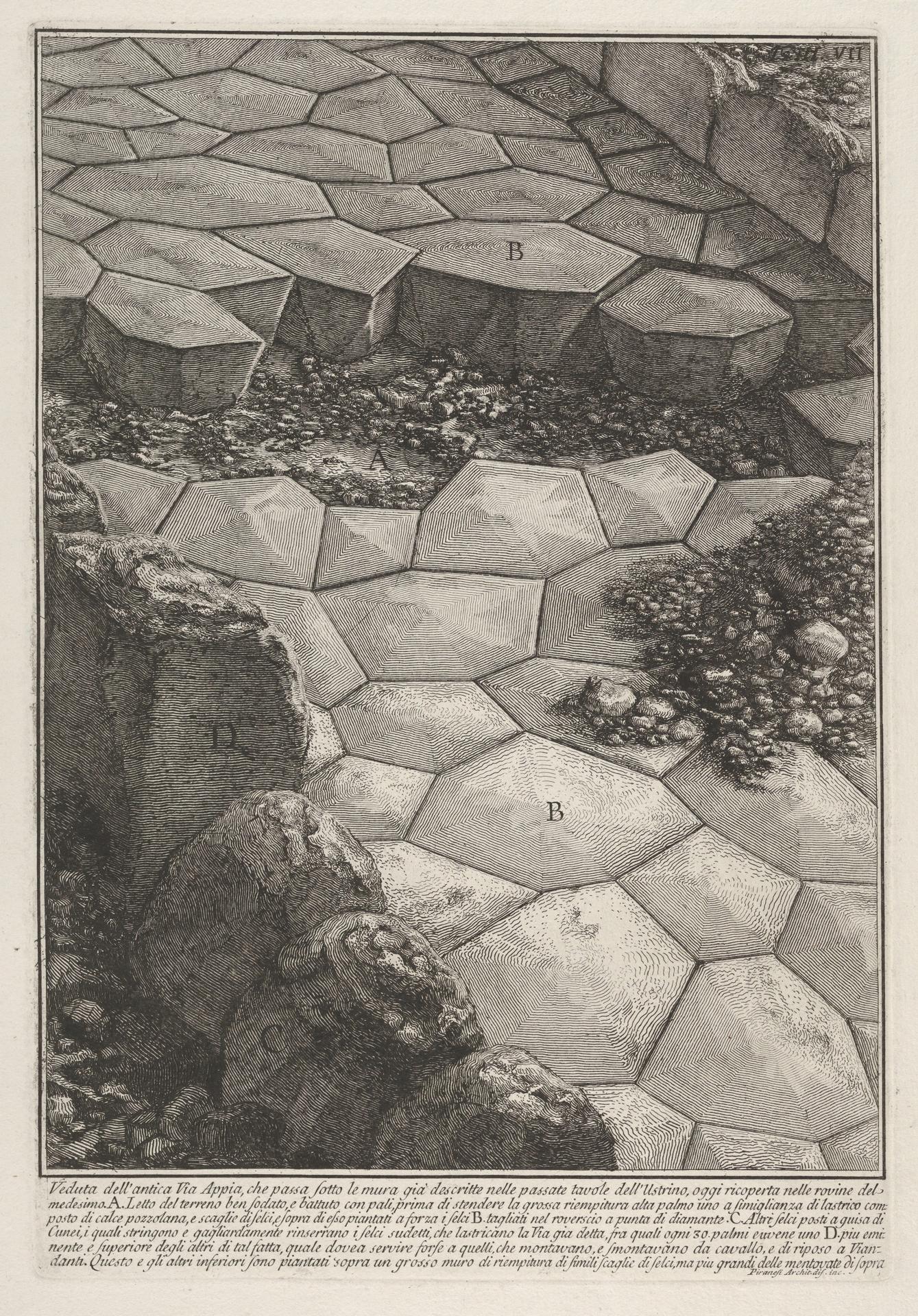
View of the stone pavement of the Appian Way (Veduta dell'antica Via Appia), from "Le Antichità Romane"
Original title: View of the stone pavement of the Appian Way (Veduta dell'antica Via Appia), from "Le Antichità Romane"
kurzbeschreibung
Dating from 1756, Giovanni Battista Piranesi's etching records the ancient stone paving of the Via Appia. The sheet belongs to the series 'Le Antichità Romane' and was executed as an etching. At its heart lies the road's regular hexagonal paving, framed by rock and vegetation.
Description
Symmetrical and centred, the layout is given over entirely to paving made of regular hexagonal stone slabs. On several of the slabs the letter 'B' appears more than once. Rock and vegetation border the paving and reinforce its historical setting. The whole view stays black and white, with light and shadow bringing out the structure of the stones. No figures or other objects appear.
Context
Between 1756 and 1757 Piranesi published 'Le Antichità Romane', a four-part collection of etchings documenting the buildings and infrastructure of ancient Rome. The Via Appia, one of Rome's oldest and longest roads, was laid out in the 4th century BC and was known for its careful paving. The Venetian architect and printmaker had lived in Rome since 1740, devoting himself to studying and depicting Roman antiquity. His work shaped neoclassical architecture and 18th-century understanding of the Roman ruins.
Impact
A quiet, almost archaeological precision emanates from the print, inviting the viewer to examine ancient road-building closely. The symmetrical arrangement and clear linework give the subject a monumental dignity that underscores Roman engineering. The view reads as factual and documentary, without romantic embellishment.
Technique
Etching is an intaglio process: the drawing is scratched into a wax layer on a copper plate and then bitten with acid. Piranesi used fine lines and hatching to model light and shadow and to convey the texture of the stones. High technical precision distinguishes the sheet, as is characteristic of his archaeological subjects.
AI-generated description text
Source: Metropolitan Museum of Art · Public Domain (CC0 1.0)