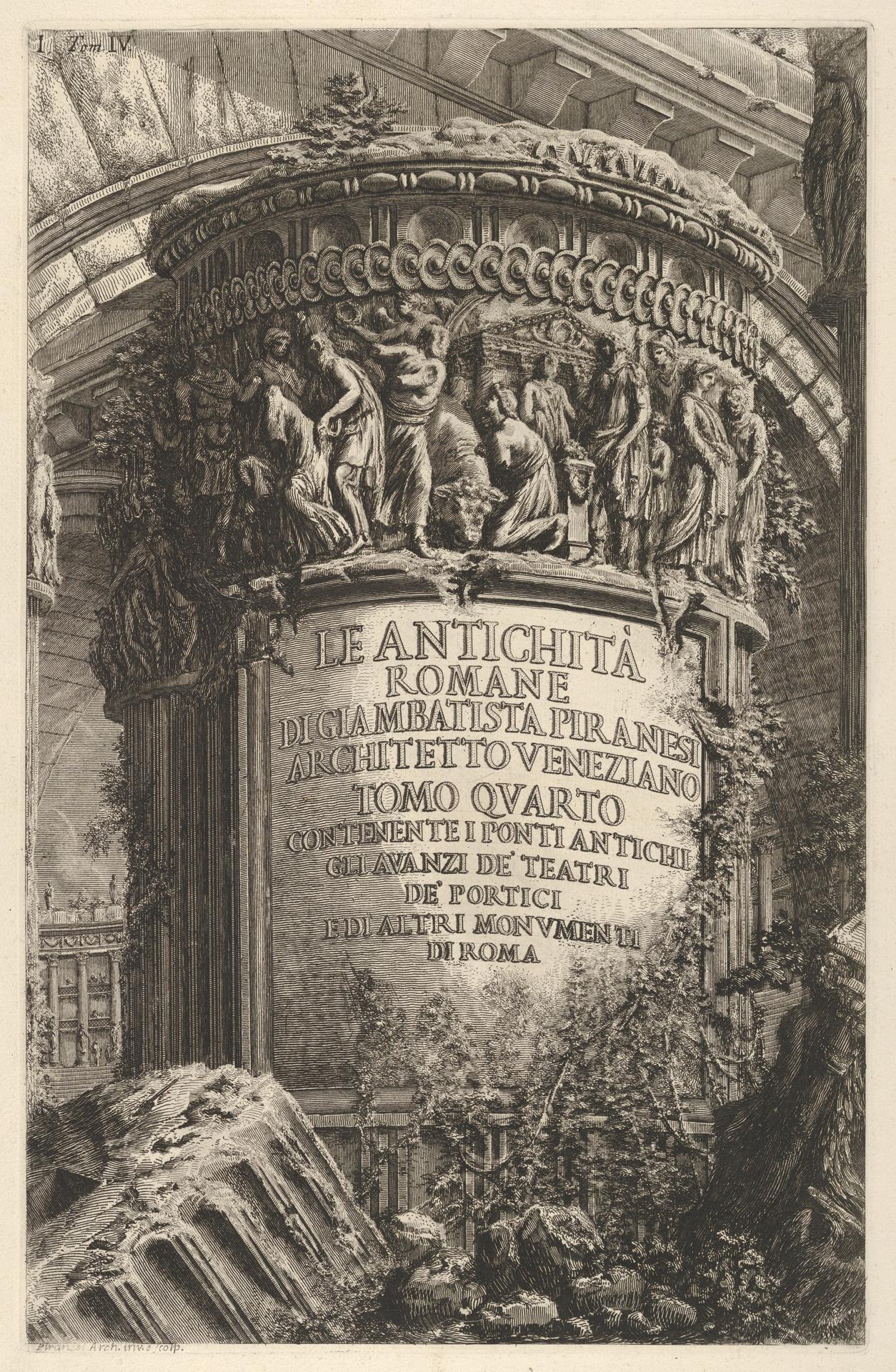
Title page: Volume IV, 'The Antiquities of Rome by Giambatista Piranesi, Venetian Architect (...), from 'Roman Antiquities' (Le Antichità Romane)
Original title: Title page: Volume IV, "The Antiquities of Rome by Giambatista Piranesi, Venetian Architect (...), from "Roman Antiquities" (Le Antichità Romane)
kurzbeschreibung
This etching from 1756 serves as the title page for the fourth volume of Piranesi's 'Le Antichità Romane'. It presents a large relief with a figural scene, framed by foliage and tendrils, thus visually introducing the depiction of Rome's ancient buildings.
Description
A massive column shaft dominates the image; its relief shows a group of figures in ancient dress in a dynamic scene. Leaves and tendrils form a wreath around this relief. Below, the title and volume number appear in Latin. Trees and rocks frame the action, reinforcing the antique character; further architecture and figures are hinted at in the distance.
Context
Between 1756 and 1757, Piranesi's four-volume work 'Le Antichità Romane' was published in Rome, systematically documenting the city's ancient remains and leaving a lasting mark on 18th-century architectural and artistic thought. The title page of the fourth volume refers to its content—bridges, parts of theaters and porticoes—and shows Piranesi as an architect engaging with Roman building art.
Impact
The precise rendering and the powerful form of the column shaft evoke a sublime, history-laden atmosphere. Nature and architecture are interwoven, making the transience and ruinous charm of ancient Rome palpable.
Technique
An etching that uses fine lines and graduated shading to bring out textures and details. The sheet measures 52.1 x 34.9 cm, the plate 40.1 x 25.7 cm, allowing for a detailed reproduction.
AI-generated description text
Source: Metropolitan Museum of Art · Public Domain (CC0 1.0)