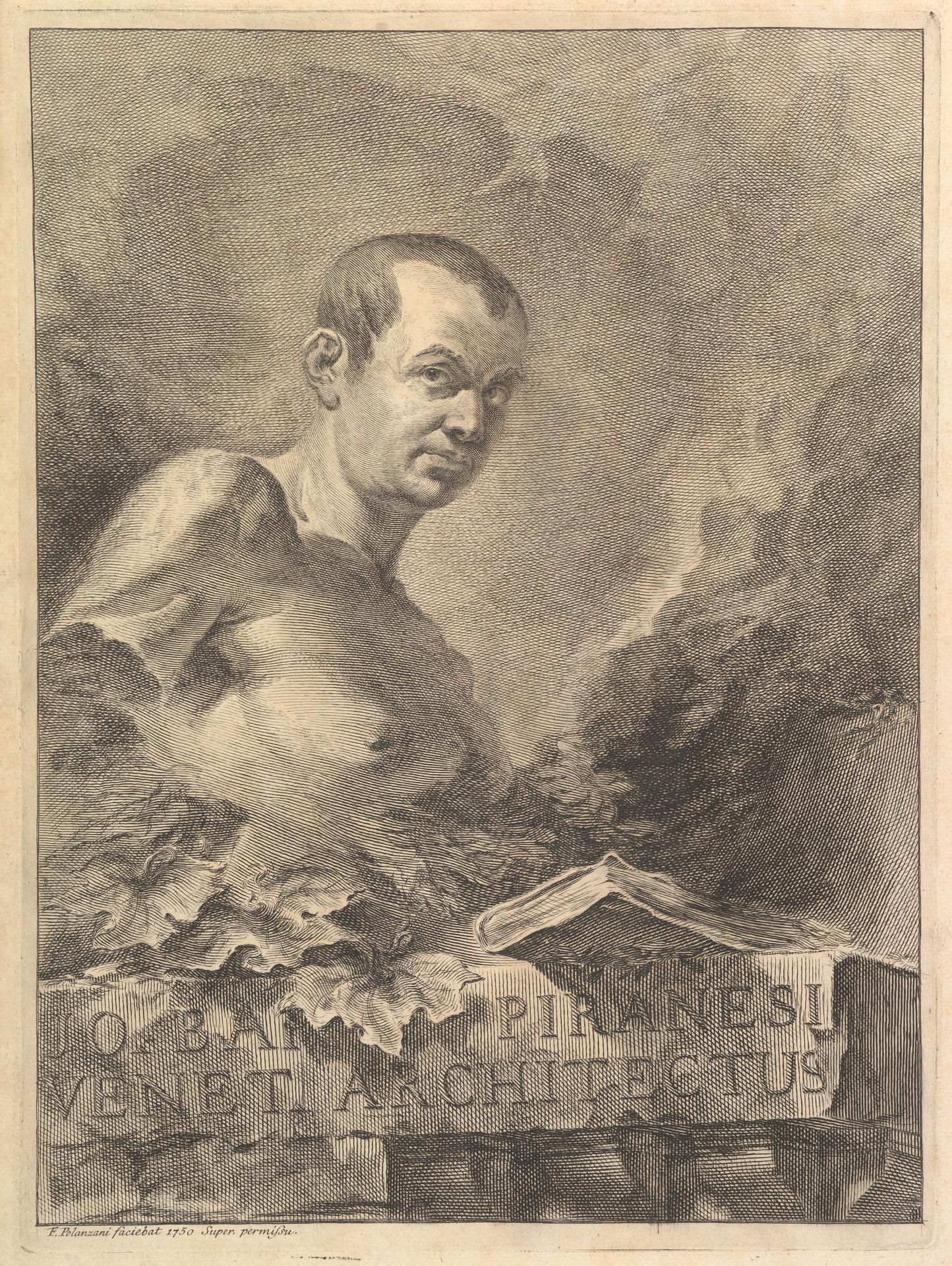
Portrait of G.B. Piranesi in imitation of an antique bust, from "Opere varie di Architettura, prospetive, grotteschi, antichità; inventate, ed incise da Giambattista Piranesi Architetto Veneziano"
Original title: Portrait of G.B. Piranesi in imitation of an antique bust, from "Opere varie di Architettura, prospetive, grotteschi, antichità; inventate, ed incise da Giambattista Piranesi Architetto Veneziano" (Various Works of Architecture, perspectives, grotesques, and antiquities, designed and etched by Giambattista Piranesi, Venetian Architect)
kurzbeschreibung
Francesco Polanzani made this portrait in 1750, presenting the architect Giovanni Battista Piranesi as an antique bust. Executed as an etching, the print served as the frontispiece to the collected edition 'Opere varie di Architettura'. A contemporary portrait and Roman antiquity thus come together here.
Description
The viewer's gaze is drawn first to the serious, pensive face, turned slightly to the left. A half-naked man with an open shirt exposing his shoulders and chest steps forward. Dark, rocky structures behind him recall an ancient landscape. Beneath the head lies a stone block inscribed 'JO. BAP. PIRANESI VENET. ARCHITECTUS'. Fine lines and hatching model contours and textures.
Context
The print was part of the 'Opere varie di Architettura', published in Rome in 1750, a collection of Piranesi's own works. Polanzani, an Italian engraver, contributed the portrait as a frontispiece. The antiquizing bust form underscores Piranesi's self-image as heir to Roman architecture. The inscription on the stone block refers to his Venetian origin and his profession as an architect.
Impact
A timeless, monumental aura surrounds this portrait through its staging as an antique bust. Realistic rendering and classicizing idealization combine into a dignified, almost heroic presence. The dark background directs attention to the face and inscription, emphasizing the sitter's significance.
Technique
In this etching, lines were bitten into a metal plate. Subtle tonal values and a sculptural effect arise from fine hatching and cross-hatching. The plate measures 13.3 x 27 cm and is printed on a larger sheet of 32.5 x 48 cm.
AI-generated description text
Source: Metropolitan Museum of Art · Public Domain (CC0 1.0)