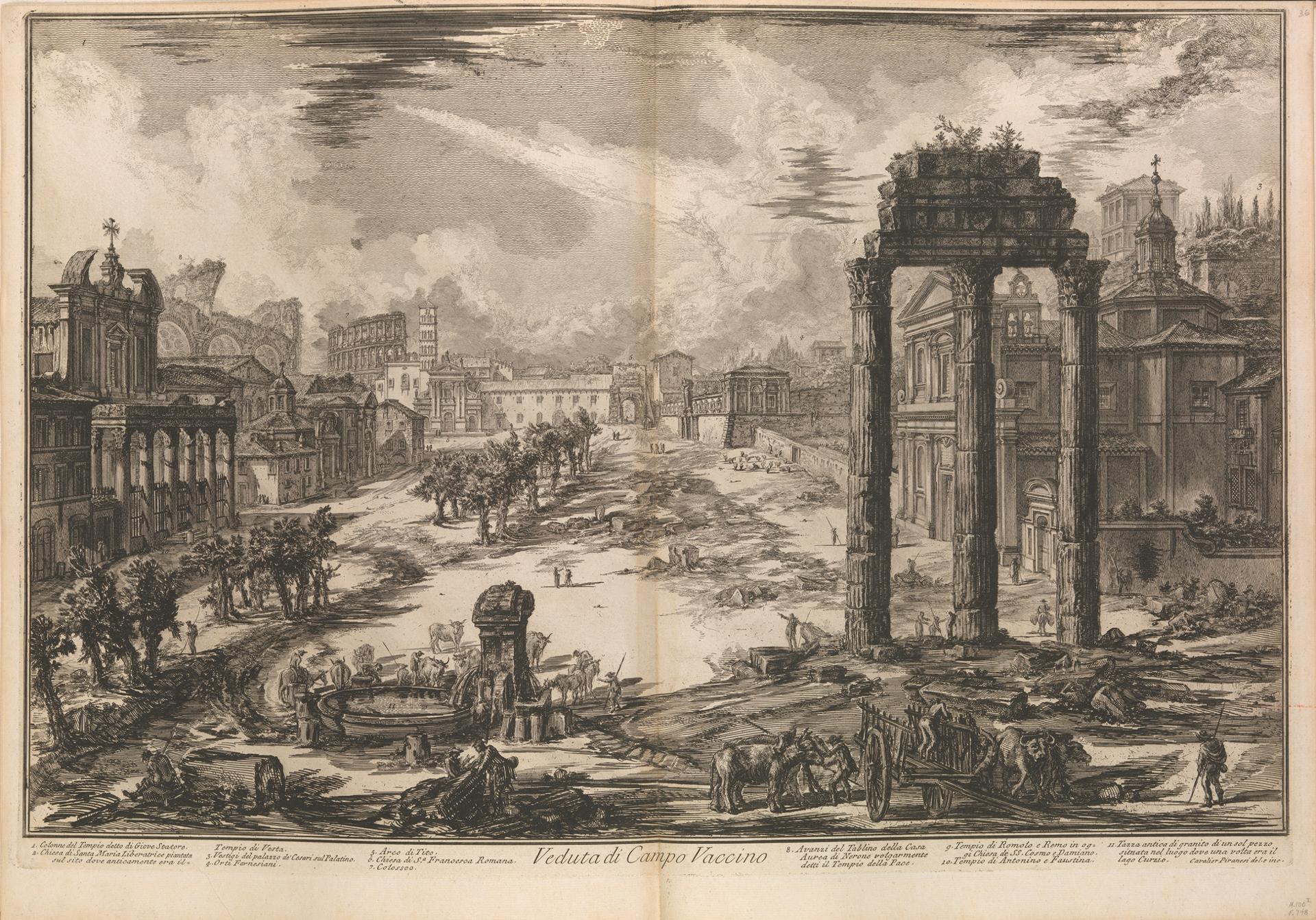
View of the Flavian Amphitheater, called the Colosseum, from "Vedute di Roma" (Roman Views), part II
Original title: View of the Flavian Amphitheater, called the Colosseum, from "Vedute di Roma" (Roman Views), part II
kurzbeschreibung
Giovanni Battista Piranesi made this etching between about 1750 and 1778; it depicts the Colosseum in Rome. The print belongs to the series 'Vedute di Roma' and is the second of four states (after Hind). The monumental ruin appears together with everyday life in its surroundings.
Description
Ruins and column remains of the amphitheater fill the foreground. Behind them, the Colosseum rises and dominates the center of the image. People and animals animate the space between the debris and the structure. Trees and shrubs line the architecture and frame it. The rendering remains monochrome with soft light, as is characteristic of an etching.
Context
Piranesi published the 'Vedute di Roma' as a series of views of Roman buildings from the 1740s onward. The etchings were aimed at Grand Tour travelers and collectors who wanted ancient Rome documented. The artist combined archaeological accuracy with artistic staging to emphasize the grandeur of ancient architecture. In the second state, there are revisions that Piranesi made over time.
Impact
Sublimity and decay interpenetrate in this print and transport the viewer into the past. The precise rendition of the architecture feels documentary, while the staffage figures bring liveliness to the image.
Technique
An etching on paper, whose plate was printed in several states. In the second state, fine lines and hatching emerge that capture the texture of stone and ruins. The technique enables the high level of detail typical of Piranesi.
AI-generated description text
Source: Metropolitan Museum of Art · Public Domain (CC0 1.0)