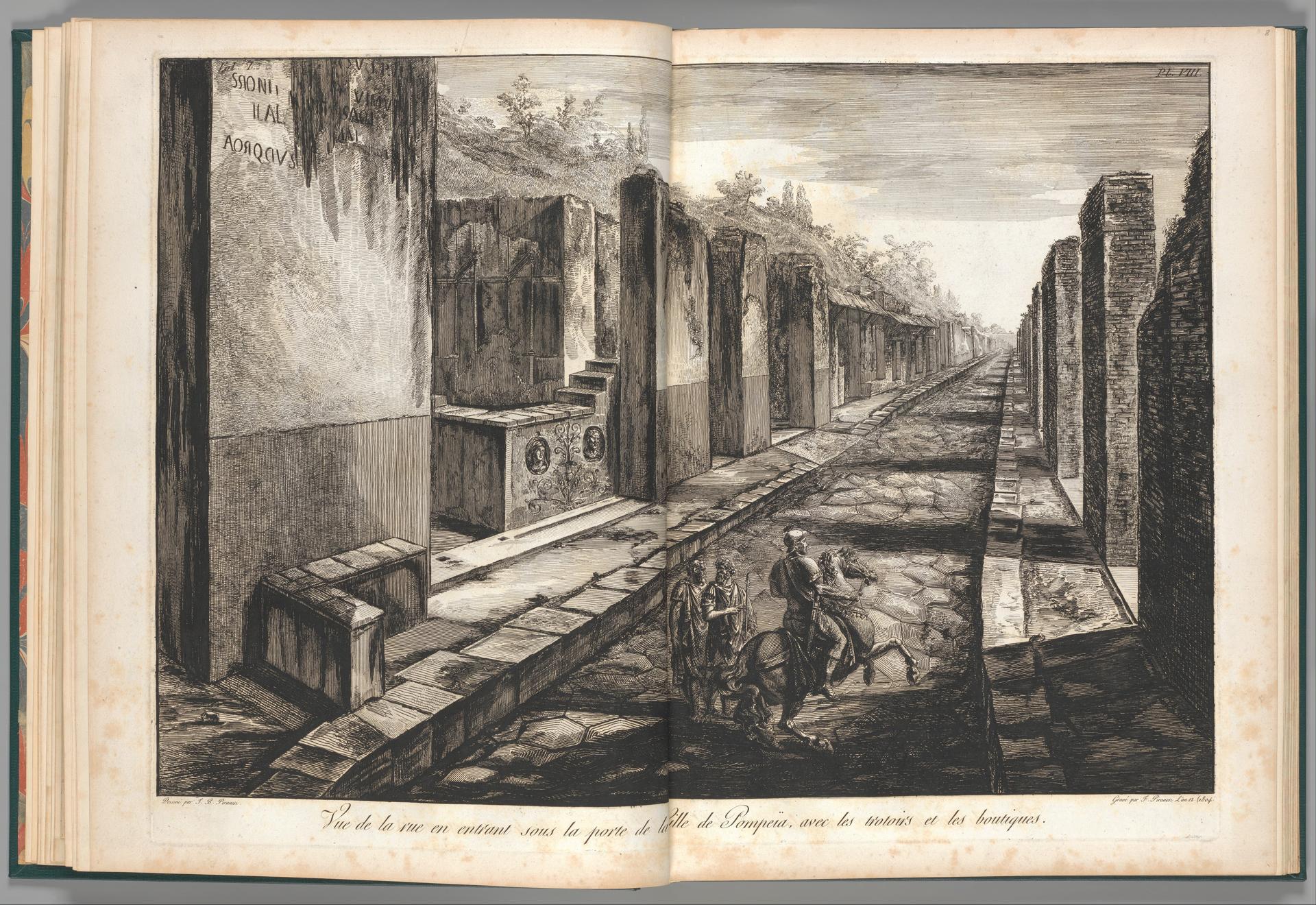
View from the street entering beneath the gateway to the city of Pompeii, with the foot paths and the shops, from "Antiquités de Pompeïa, tome premier, Antiquités de la Grande Grèce..." (Antiquities of Pompeii, volume one, Antiquities of Great Greece...), volume 1, plate 8
Original title: View from the street entering beneath the gateway to the city of Pompeii, with the foot paths and the shops, from "Antiquités de Pompeïa, tome premier, Antiquités de la Grande Grèce..." (Antiquities of Pompeii, volume one, Antiquities of Great Greece...), volume 1, plate 8
kurzbeschreibung
Francesco Piranesi published this etching in 1804, showing a street in Pompeii that runs beneath a city gate. It belongs to the first volume of the series 'Antiquités de Pompeïa'. The image presents the ancient city with its ruins, sidewalks, and shops.
Description
A street in Pompeii, spanned by a city wall with a gate, forms the subject. On the left stand the remains of ancient buildings, including a column with inscriptions and a wall with a niche. To the right, the paved lane runs alongside a colonnade toward the houses. Two riders and two companions on foot move through the middle. Trees and a cloudy sky hint at the background; the view remains in shades of gray.
Context
As the son of the famous Giovanni Battista Piranesi, Francesco Piranesi devoted himself to documenting the excavations at Pompeii around 1800. His five-volume work 'Antiquités de Pompeïa' of 1804 recorded the ancient sites of southern Italy with both scholarly and artistic intent. This plate captures the state of the excavation site, which at the time was only partly uncovered.
Impact
A calm, factual mood emanates from the etching, transporting the viewer into the ancient city. The precise linework and graduated shading create a sense of authenticity and historical distance.
Technique
The etching is an intaglio process: the drawing is scratched into a metal plate, which is then etched with acid. Varying etch times and the printing process produce the fine lines and gray tones. It was printed on paper; the plate measures 51 x 72 cm.
AI-generated description text
Source: Metropolitan Museum of Art · Public Domain (CC0 1.0)