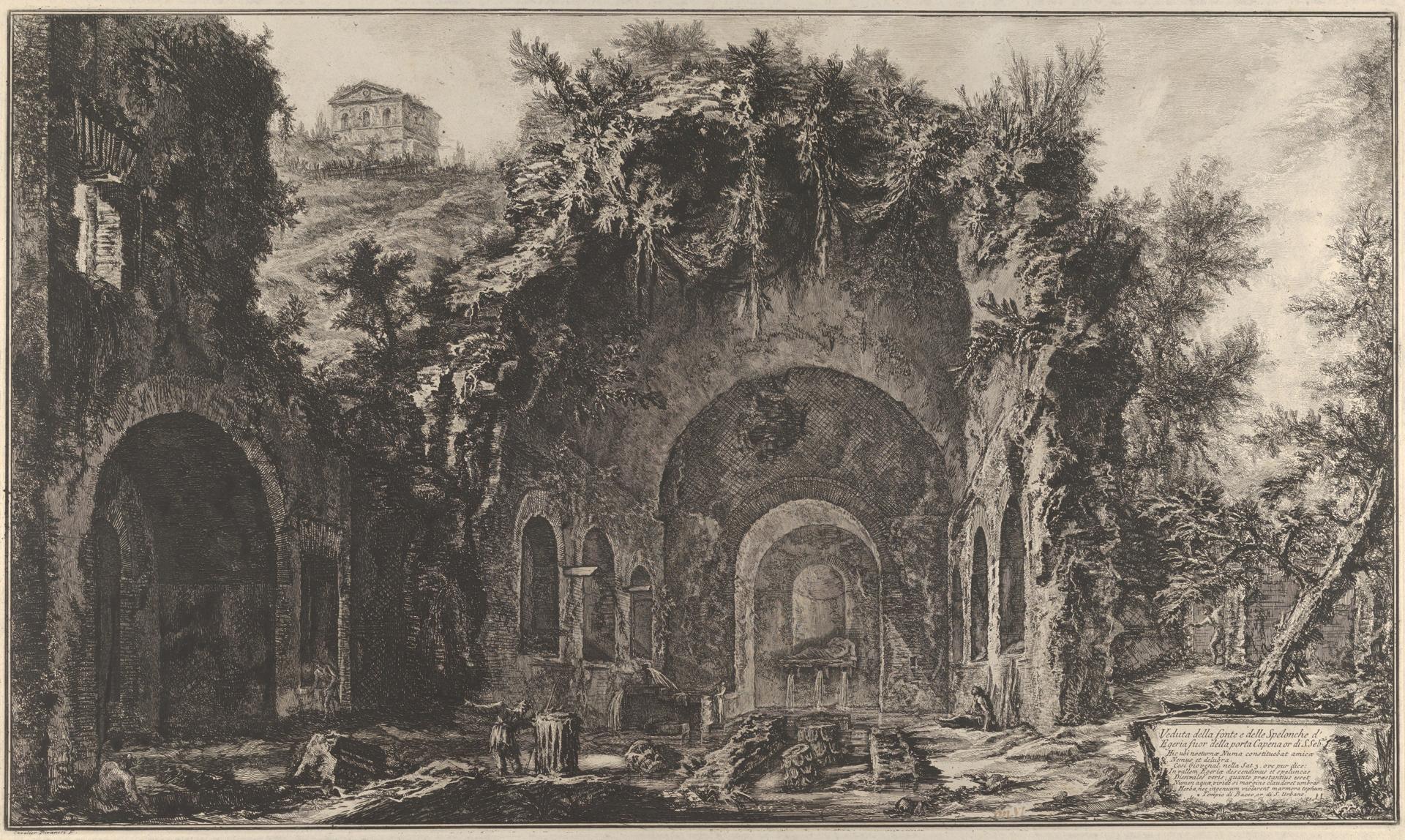
View of the fountainhead and the Grotto of Egiria outside the Porta Capena, from "Vedute di Roma"
Original title: View of the fountainhead and the Grotto of Egiria outside the Porta Capena, from "Vedute di Roma"
kurzbeschreibung
Giovanni Battista Piranesi devotes this etching, made between 1760 and 1778, to the spring head and the Grotto of Egeria outside the Porta Capena in Rome. It belongs to his series 'Vedute di Roma' and is represented here by the second of five states. Densely laid lines and graded shading fix the ancient site onto the plate.
Description
Overgrown arches and columns fill the foreground, making the decay of the architecture plain to see. A fountain with a base and jet stands at the centre. To the left a building rises on a knoll, surrounded by trees and shrubs, while further planting on the right encloses the view. Clouds spread a soft, diffused light over the scene. Fine hatching and carefully placed shadows convey the surfaces of stone and vegetation in this monochrome etching.
Context
The 'Vedute di Roma' appeared between 1748 and 1778 as a series of views of Roman monuments. The Grotto of Egeria was an ancient sanctuary associated with the nymph Egeria and was regarded in the eighteenth century as a picturesque ruin. Piranesi did not record such places in purely topographic terms; he heightened them romantically and made decay itself an aesthetic motif. His work falls in a period when Rome, as the centre of the Grand Tour, drew artists who recorded ancient sites for a European public.
Impact
Documentary precision and atmospheric mood merge here, carrying the viewer back into the past. Overgrown ruins and the soft light produce a melancholy, sublime effect that is characteristic of Piranesi.
Technique
For the etching, the drawing was scratched into an acid-resistant layer on the copper plate and then bitten. The second state shows reworking compared with the first, through which fine details and contrasts gain in sharpness. The impression was pulled on laid paper; the plate mark measures 40.2 x 68.9 cm.
AI-generated description text
Source: Metropolitan Museum of Art · Public Domain (CC0 1.0)