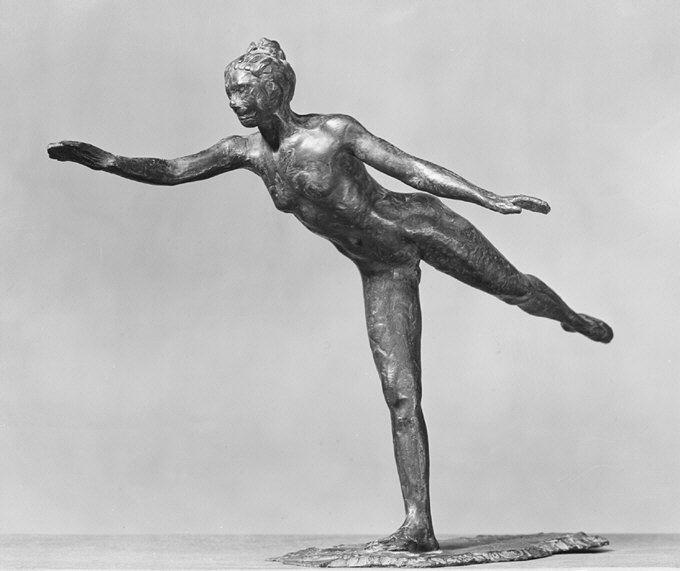
First Arabesque
Original title: First Arabesque
kurzbeschreibung
The bronze figure 'First Arabesque' by Edgar Degas was modeled probably before 1890 and cast in bronze in 1920. It depicts a dancer in an energetic arabesque, a classic ballet step.
Description
A male body stretches its arms wide while one leg extends backward. The slender, well-trained legs hint at physical tension. The pose appears graceful and full of movement, as if from a dance or athletic exercise. The bronze shows an even color without noticeable transitions, and the muscles stand out clearly. A flat base slightly lifts the figure.
Context
Degas likely modeled the figure before 1890, but it was cast only in 1920, after his death. The artist created numerous dancer figures, often studies of movement. The arabesque is a cornerstone of classical ballet and appears repeatedly in Degas's oeuvre.
Impact
The sculpture strikes the viewer with a tense blend of grace and strength. The dynamic pose seems to capture movement and pause at once. The uniform bronze surface radiates a timeless calm, drawing the eye entirely to the body's posture.
Technique
The bronze was cast using the lost-wax method. The surface shows fine modeling that precisely renders the figure's musculature and movement. An even patina emphasizes the detailed form.
AI-generated description text
Source: Metropolitan Museum of Art · Public Domain (CC0 1.0)