View of the so-called Temple of Concord with the Temple of Saturn, on the right the Arch of Septimius Severus
Original title: View of the so-called Temple of Concord with the Temple of Saturn, on the right the Arch of Septimius Severus
kurzbeschreibung
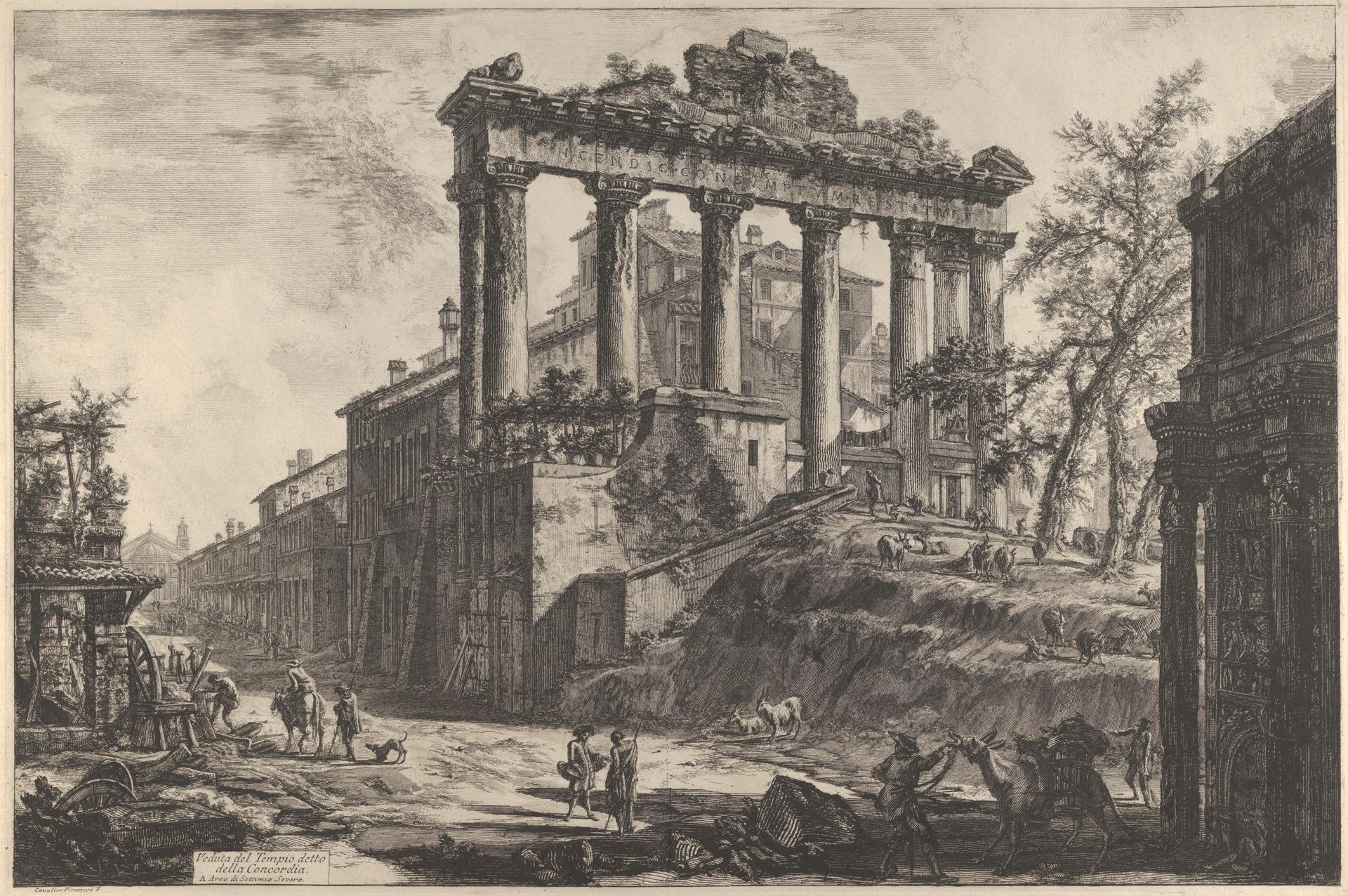
People and animals crowd a road in the foreground, and behind them the so-called Temple of Concordia, the Temple of Saturn and, on the right, the Arch of Septimius Severus rise in receding tiers. Giovanni Battista Piranesi made this etching between 1760 and 1778; it measures 53.8 by 79.2 cm in landscape format. The print presents ancient Rome in the classic manner of the veduta.
Description
Bustling activity along the road before the ruins fills the lower band of the image, while above it the buildings arrange themselves symmetrically around the Temple of Concordia at the centre. Trees and further structures close off the space behind. The layout draws its life from the fine hatching of the etching, which produces the subtlest gradations of light in monochrome greys. Light falls from above, drawing out the shadows and the tectonic structure of the walls.
Context
This etching dates from the second half of the eighteenth century, when Rome was being studied intensively by archaeologists. Piranesi was regarded as a master of the veduta, staging ancient ruins with great precision and to powerful effect at the same time. This sheet belongs among his later works, in which he combined real topography with an idealised perspective.
Impact
The assured draughtsmanship and strong contrasts of shadow give the ancient buildings something monumental. A calm, almost ceremonial mood lies over the print and carries the viewer back into Rome's past.
Technique
In etching, the drawing is incised into a copper plate, which is then bitten with acid. The dense hatching and lines create graduated grey values and reproduce architecture and figures alike in precise detail.
AI-generated description text
Source: Metropolitan Museum of Art · Public Domain (CC0 1.0)