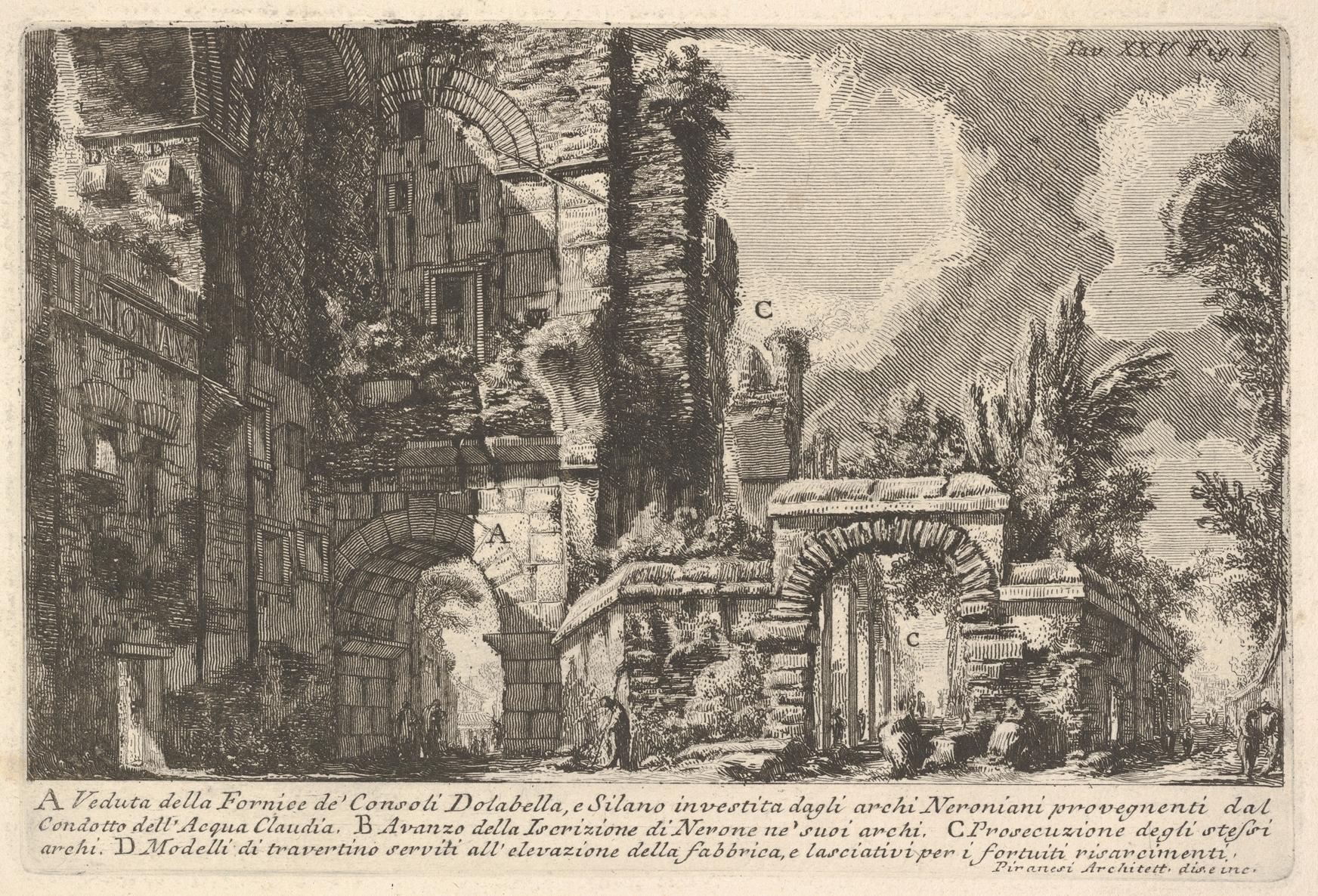
View of the arches of the consuls Dolabella and Silanus enclosed within the Neronian arches of the Acqua Claudia, from "Roman Antiquities" (Le Antichità Romane)
Original title: View of the arches of the consuls Dolabella and Silanus enclosed within the Neronian arches of the Acqua Claudia, from "Roman Antiquities" (Le Antichità Romane)
kurzbeschreibung
Made in 1756 for the series "Le Antichità Romane", this etching by Giovanni Battista Piranesi records the arches of the consuls Dolabella and Silanus, which are set within the Neronian arches of the Acqua Claudia. The black-and-white print belongs to his documentary survey of ancient Roman architecture and is distinguished by its close attention to detail.
Description
The arches of the consuls Dolabella and Silanus fill the foreground, framed by the Neronian arches of the Acqua Claudia. Columns and individual architectural elements stand out clearly. Trees and a patch of sky appear toward the rear, giving the picture space depth. Latin inscriptions on the etching give information about the arches and the travertine used to build them. The arrangement feels orderly and draws the eye to the structural details.
Context
Piranesi produced this etching for "Le Antichità Romane", a four-part work published in Rome in 1756. The publication set out to record Rome's ancient buildings comprehensively, documenting them in scholarly fashion while also conveying them as art. Piranesi was known as a connoisseur of Roman architecture who combined precise study with a sense of the grandeur of antiquity.
Impact
The print makes the monumental force of Roman engineering and architecture tangible. Its clear layout and exact rendering leave a sober yet lasting impression that brings the historical significance of the structures before the viewer.
Technique
An etching on paper, plate size 13.5 x 20 cm, sheet size 19.6 x 25.4 cm. With the etching technique Piranesi produced fine lines and shading that capture architectural details precisely. The black-and-white rendering emphasizes the graphic structure and the material character of the buildings shown.
AI-generated description text
Source: Metropolitan Museum of Art · Public Domain (CC0 1.0)