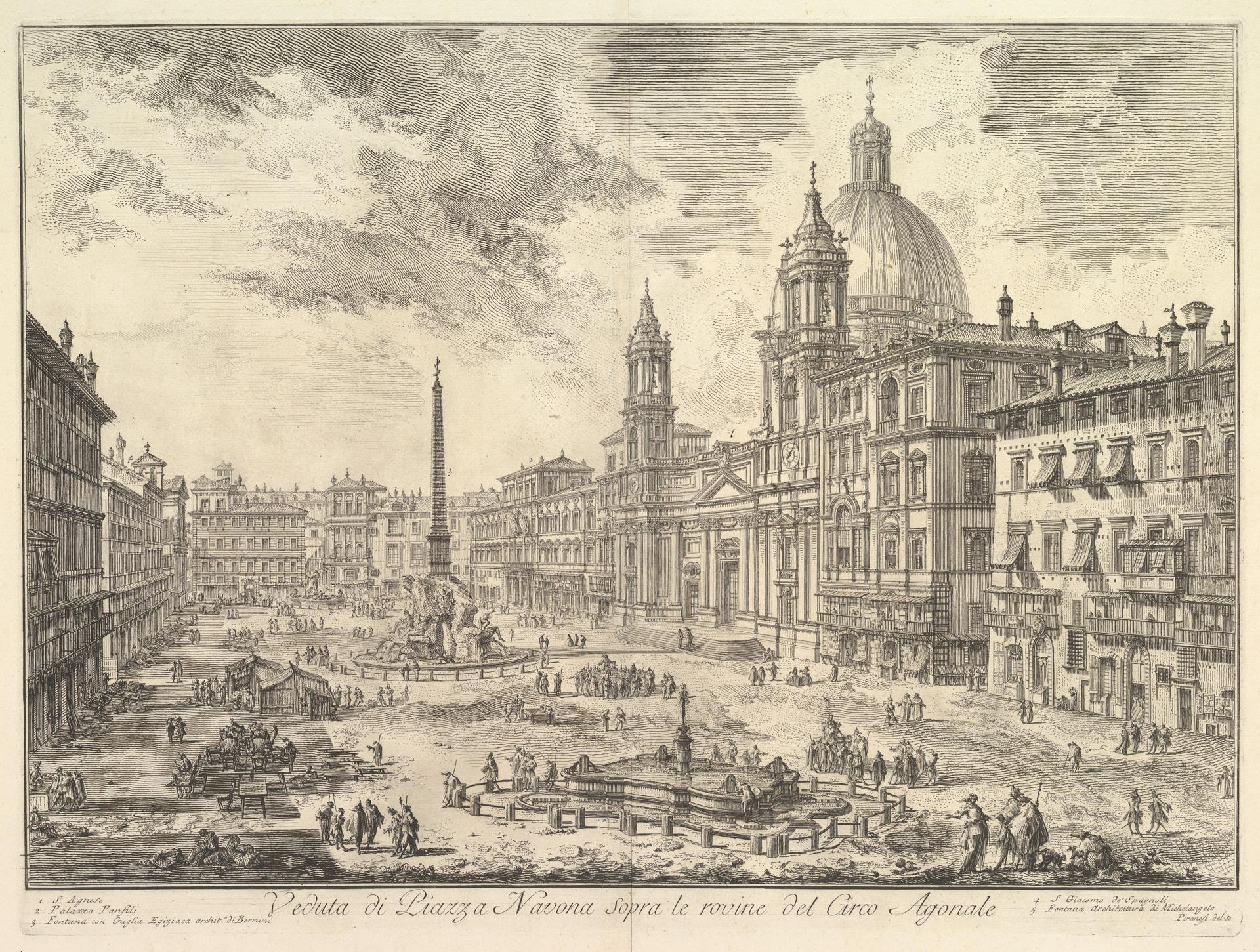
The Piazza Navona, Rome, above the ruins of the Circus of Domitian, the Church of Sant Agnese to the right, Bernini's fountain in the center, from 'Vedute di Roma'
Original title: The Piazza Navona, Rome, above the ruins of the Circus of Domitian, the Church of Sant Agnese to the right, Bernini's fountain in the center, from "Vedute di Roma"
kurzbeschreibung
Giovanni Battista Piranesi etched this view of Piazza Navona in Rome for his series 'Vedute di Roma'; the print was made between 1760 and 78. It shows the square that lies over the ruins of the Circus of Domitian, with the church of Sant'Agnese on the right and Bernini's fountain at the center. In the foreground, figures crowd around the Fontana del Nettuno, while the eye is led rightward into the depth toward the church.
Description
A symmetrical layout places the fountain in the middle, with a cluster of people gathered around it. On the right, Sant'Agnese rises, flanked by other buildings that step back and recede. An obelisk extends the line of sight in the distance. Black-and-white tones with graduated hatching give the architecture body and depth; light and shadow are set so that the spatial relationships of the square stand out clearly.
Context
With the 'Vedute di Roma', Piranesi produced an extensive series of etchings that recorded Rome's ancient and modern monuments. The title itself notes that Piazza Navona was built over the ruins of the Circus of Domitian. The church of Sant'Agnese in Agone derives from a design by Francesco Borromini, the central fountain from Gian Lorenzo Bernini. The print was made in the second half of the 18th century, when the Grand Tour made Rome a much-visited destination.
Impact
Precise lines and nuanced shading create a depth that draws the eye into the print. The symmetrical arrangement and the realistic lighting give the view a calm, monumental mood characteristic of Piranesi's vedute.
Technique
For the etching, a copper plate was bitten with acid; with fine lines and cross-hatching, Piranesi modeled light and shadow. The print is on laid paper; the plate measures 41 × 54.5 cm, the sheet 49.5 × 59 cm.
AI-generated description text
Source: Metropolitan Museum of Art · Public Domain (CC0 1.0)