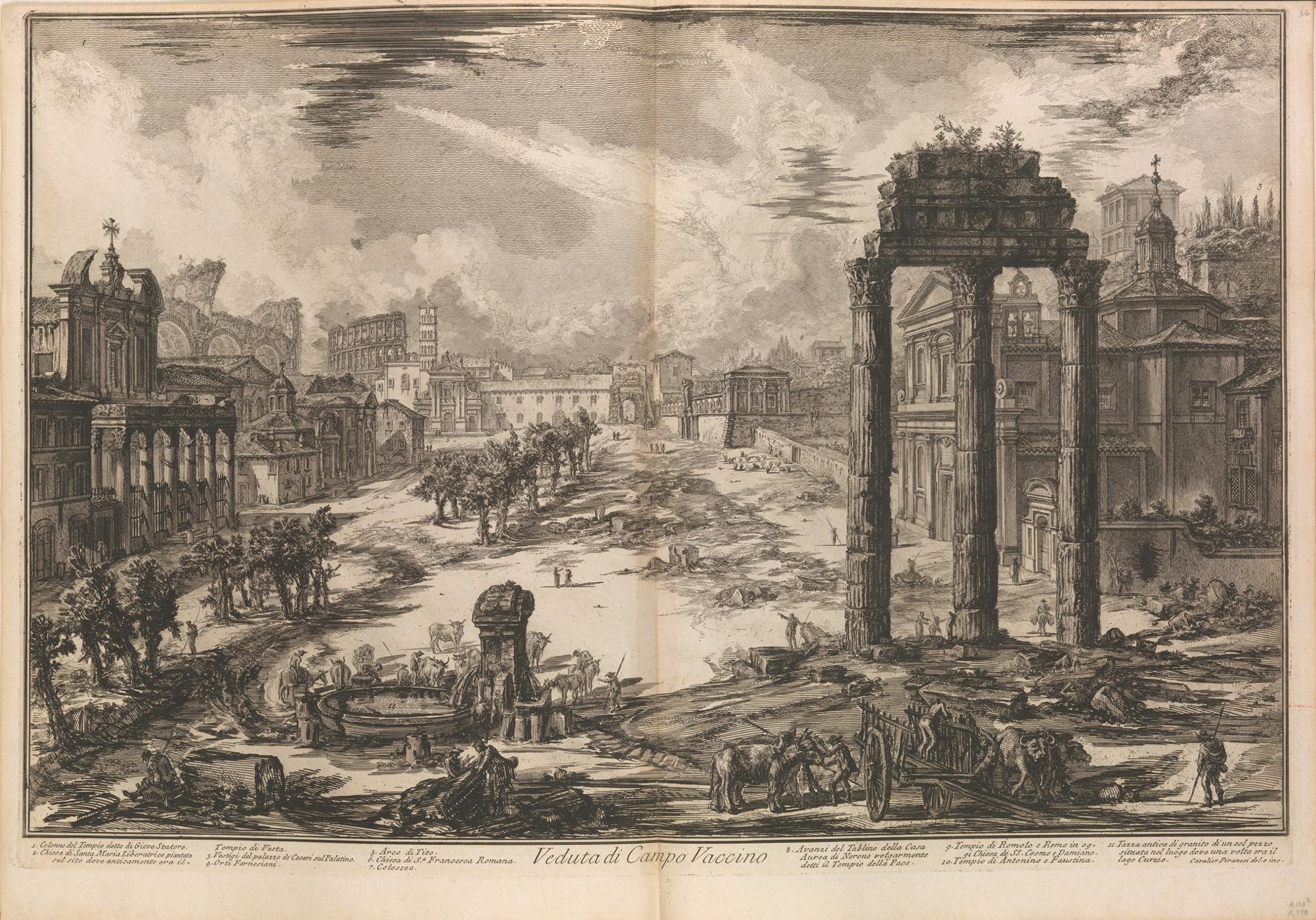
View of the Campo Vaccino (Roman Forum with the Temple of Castor and Pollux to right), from "Vedute di Roma" (Roman Views), part II
Original title: View of the Campo Vaccino (Roman Forum with the Temple of Castor and Pollux to right), from "Vedute di Roma" (Roman Views), part II
kurzbeschreibung
Giovanni Battista Piranesi made this etching, Blick auf den Campo Vaccino, between about 1750 and 1778. It shows the Roman Forum with the Temple of Castor and Pollux on the right. The print belongs to the series Vedute di Roma and demonstrates how Piranesi captured ancient buildings with great precision and rich detail.
Description
Ruins and columns dominate the foreground of the view, with the Temple of Castor and Pollux rising on the right. A fountain with figures and animals sits at the center of the foreground, surrounded by people engaged in various activities. Further back, other ancient structures and the ruins of the Colosseum can be made out. The monochromatic image is built on shades of gray, with clouds and buildings defining light and shadow.
Context
From the 1740s onward, Piranesi worked on the Vedute di Roma, a series of etchings in which he recorded both ancient and contemporary buildings of Rome. At the time this print was made, the Roman Forum served as the Campo Vaccino, a cow pasture, which explains the animals and scenes of daily life in the image. The etching was printed in several states; this impression is from the first state. Grand Tour travelers prized Piranesi's vedute, and they did much to shape the eighteenth-century image of Rome.
Impact
Because the ancient architecture is rendered so precisely and the layout extends so broadly, the print feels monumental. Ruins and lively everyday activity stand in contrast, joining past and present into a striking constellation. Piranesi's dense linework creates documentary clarity that is at the same time artistically heightened.
Technique
The drawing was incised into a copper plate and then bitten with acid to produce the etching. Fine lines and hatching yield graduated gray tones and a sense of plasticity. This impression comes from the first of four states, indicating an early phase of the printing process.
AI-generated description text
Source: Metropolitan Museum of Art · Public Domain (CC0 1.0)