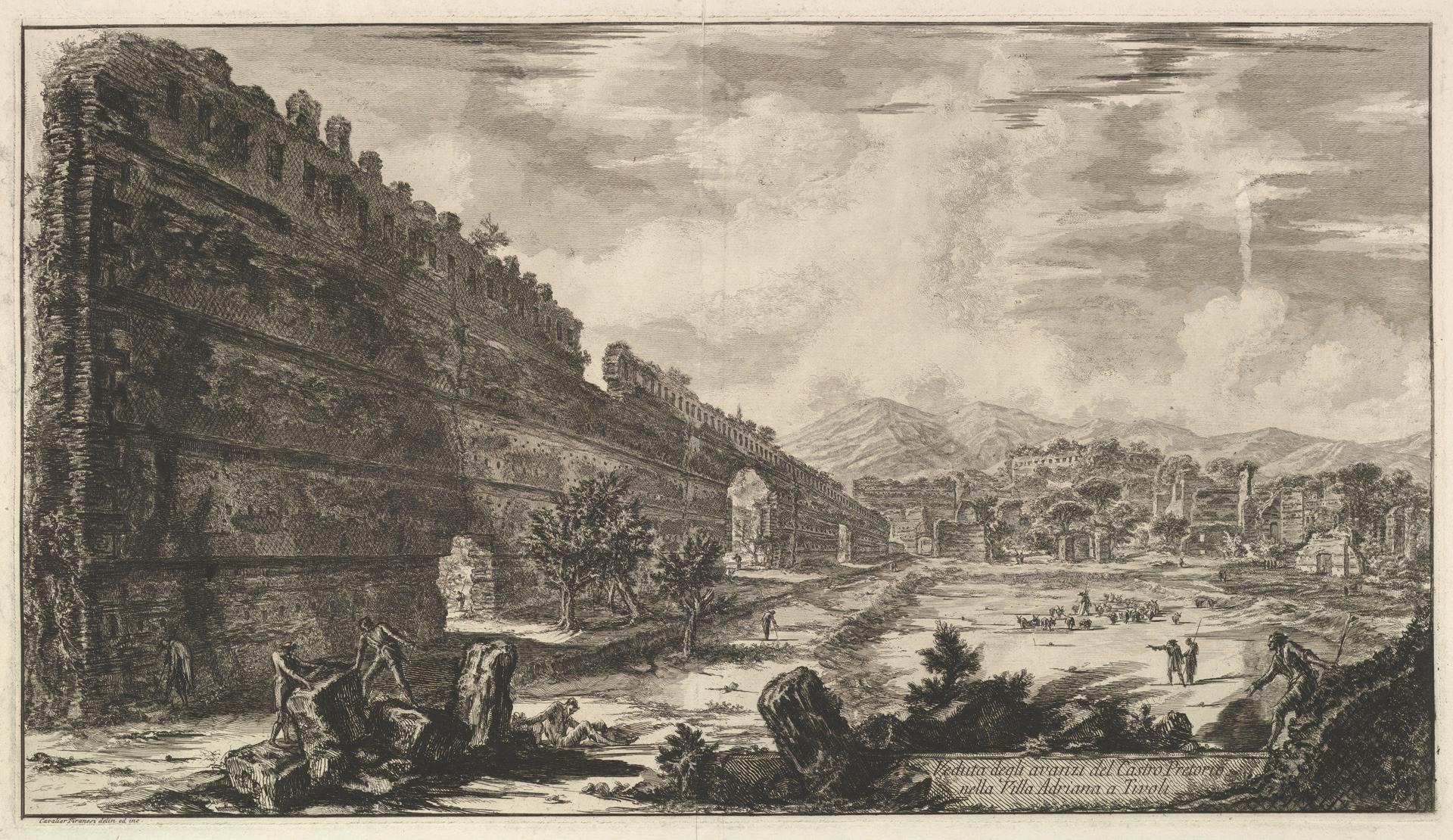
Veduta degli avanzi del Castro Pretorio nella Villa Adriana a Tivoli (View of the Remains of the Praetorian Fort [the Poecile], Hadrian's Villa, Tivoli)
Original title: Veduta degli avanzi del Castro Pretorio nella Villa Adriana a Tivoli (View of the Remains of the Praetorian Fort [the Poecile], Hadrian's Villa, Tivoli)
kurzbeschreibung
Giovanni Battista Piranesi devoted this 1770 etching to the remains of the Praetorian camp at Hadrian's Villa near Tivoli. The print belongs to his series of views of ancient sites. Weathered walls and towers dominate the foreground, with further ruins and a multi-arched bridge emerging behind them.
Description
The crumbling walls and towers of the complex rise steeply. On a rock to the left, a man has lain down, while another stands beside him holding an object. Beyond the ruins stretches a bridge with several arches, interspersed with trees and bushes, and mountains rise on the horizon. Under a cloudy sky, the light remains soft and diffuse, giving the image a quiet mood.
Context
Around 1770, this etching was created during a phase in which Piranesi was deeply engaged with Roman antiquity. Hadrian's Villa, the vast palace complex of Emperor Hadrian, was regarded by 18th-century artists and archaeologists as an important source of inspiration. Piranesi did not merely record the ruins but allowed their monumental character to emerge in his rendering. The Praetorian camp, also known as the Poecile, was part of the imperial complex and appears in several of his vedute.
Impact
From the soft light and the expanse of the landscape arises a calm yet sublime mood. The ruins seem monumental and timeless, prompting the viewer to reflect on transience and history. Finely placed lines and hatching give the print a high graphic quality.
Technique
For this etching, the drawing was scratched into a wax layer on a copper plate, and the metal was then etched. With fine lines and dense hatching, Piranesi conveyed the surface of the stones and the depth of the landscape. Printing with black ink on paper produces the monochrome gray tonality of the sheet.
AI-generated description text
Source: Metropolitan Museum of Art · Public Domain (CC0 1.0)