Prison Scene
Original title: Prison Scene
kurzbeschreibung
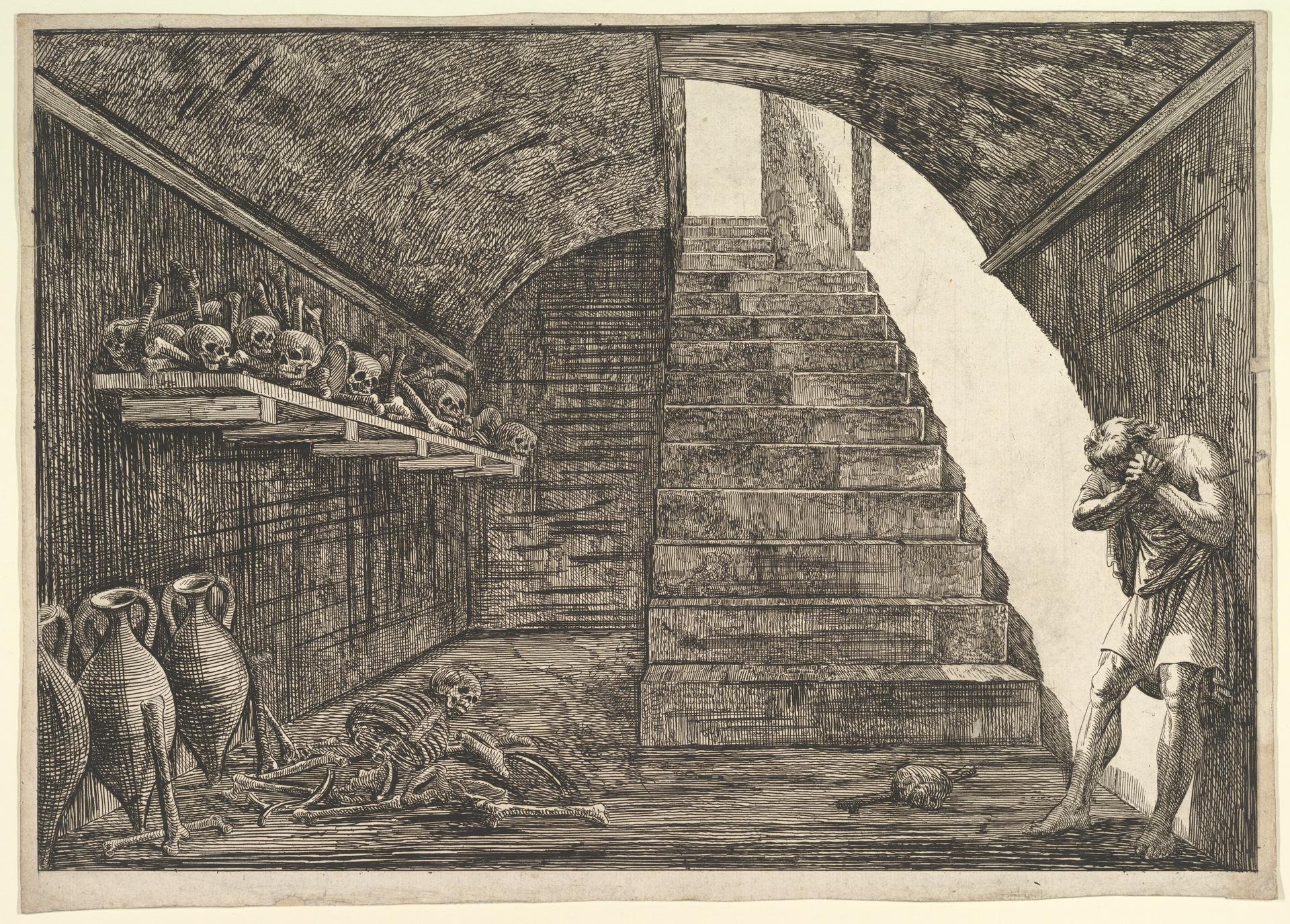
A skeleton sprawled among amphorae on the floor, shelves of skulls and bones lining the left, and a man in antique dress hiding his face behind his hand on the right: Francesco Piranesi sets this scene in a gloomy underground room that recalls a chapel or a tomb. At the back, a staircase climbs upward beneath an arch. The etching ties funerary motifs to a figure whose posture betrays shock or grief.
Description
A reclining skeleton surrounded by amphorae anchors the foreground of this subterranean space, which is laid out like a chapel or a cemetery. On the left, skulls and bones pile up across several shelves. Farther back, the eye is drawn to a stairway rising under an arch, while on the right a man in antique garb stands with his eyes covered; his stance suggests fright or sorrow. The layout is unevenly distributed, with the stairs and the man pulling the gaze, and light falling from above picks out the textures of the walls.
Context
Francesco Piranesi, son of the well-known Giovanni Battista Piranesi, also worked as an engraver and architect. The etching was probably made in the late eighteenth century, when the Piranesi family was valued for architectural fantasies and vedute. With its prison motif, the print echoes the father's famous Carceri etchings, which likewise present dark, vast dungeons. Francesco created this work within his own oeuvre, which shows a related leaning toward dramatic architecture and ancient ruins.
Impact
The underground setting and the skeleton in the foreground produce an oppressed, melancholy mood. Sacred and macabre traits, brought by the chapel- or cemetery-like atmosphere, heighten the sense of transience and death. The man's gesture of covering his eyes adds an emotional layer and speaks directly to the viewer.
Technique
Executed as an etching, as the delicate lines and graduated shading reveal, with contours and surfaces worked out through those means. The process allows light and shadow to be rendered precisely, which carries the somber mood. The black-and-white effect comes from the linework and varying degrees of etching that bring out the structure of walls and objects.
AI-generated description text
Source: Metropolitan Museum of Art · Public Domain (CC0 1.0)