First Arabesque Penché
Original title: First Arabesque Penché
kurzbeschreibung
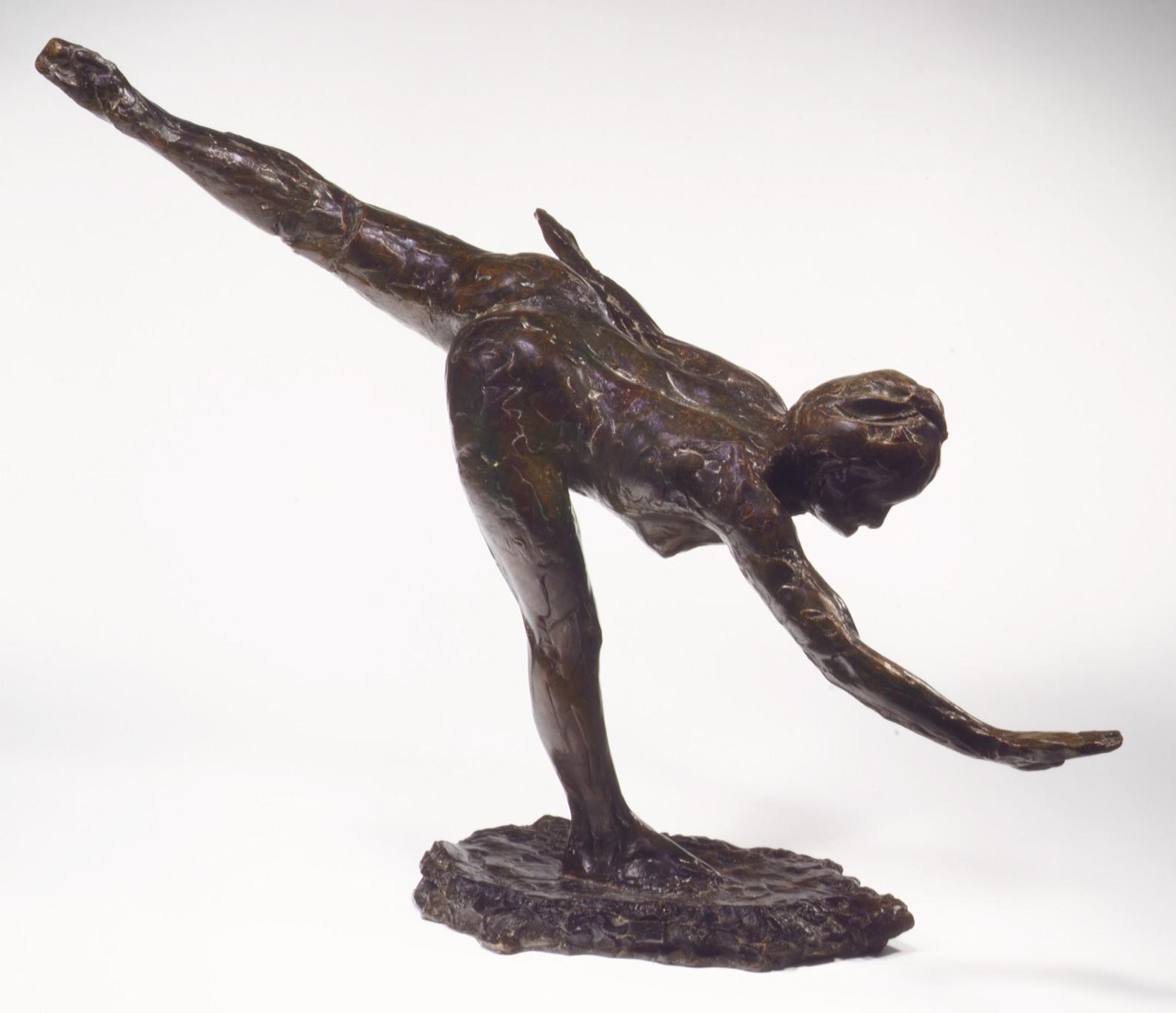
Edgar Degas modeled "Erste Arabeske penché" probably between 1892 and 1896; the bronze cast was made in 1920, after his death. The sculpture belongs to his series of dancer figures and measures 43.8 x 54.6 x 24.4 cm. It shows a dancer in an expansive arabesque.
Description
The dancer leans far forward, legs extended, one arm pointing up, the other down. This uneven arrangement emphasizes the flowing movement. The figure rests on an irregular, rock-like surface that serves as a base and provides support. The bronze surface shows patina in places; light falling from the side reveals contours and structures.
Context
In his later years, Degas devoted himself increasingly to dance. "Erste Arabeske penché" was probably created in 1892–96 as a wax model, but was only cast in bronze in 1920. During the artist's lifetime, his sculptures remained largely unknown; only after his death were they circulated in a series of casts.
Impact
The figure appears light and graceful, as if a moment of movement has been captured. Realistic form and dynamic pose create a tension that holds the viewer's gaze.
Technique
The cast was made using the lost-wax method, which preserves fine details of musculature and surface. The natural patina, resulting from aging and environmental influences, gives the bronze a warm, lively depth.
AI-generated description text
Source: Metropolitan Museum of Art · Public Domain (CC0 1.0)