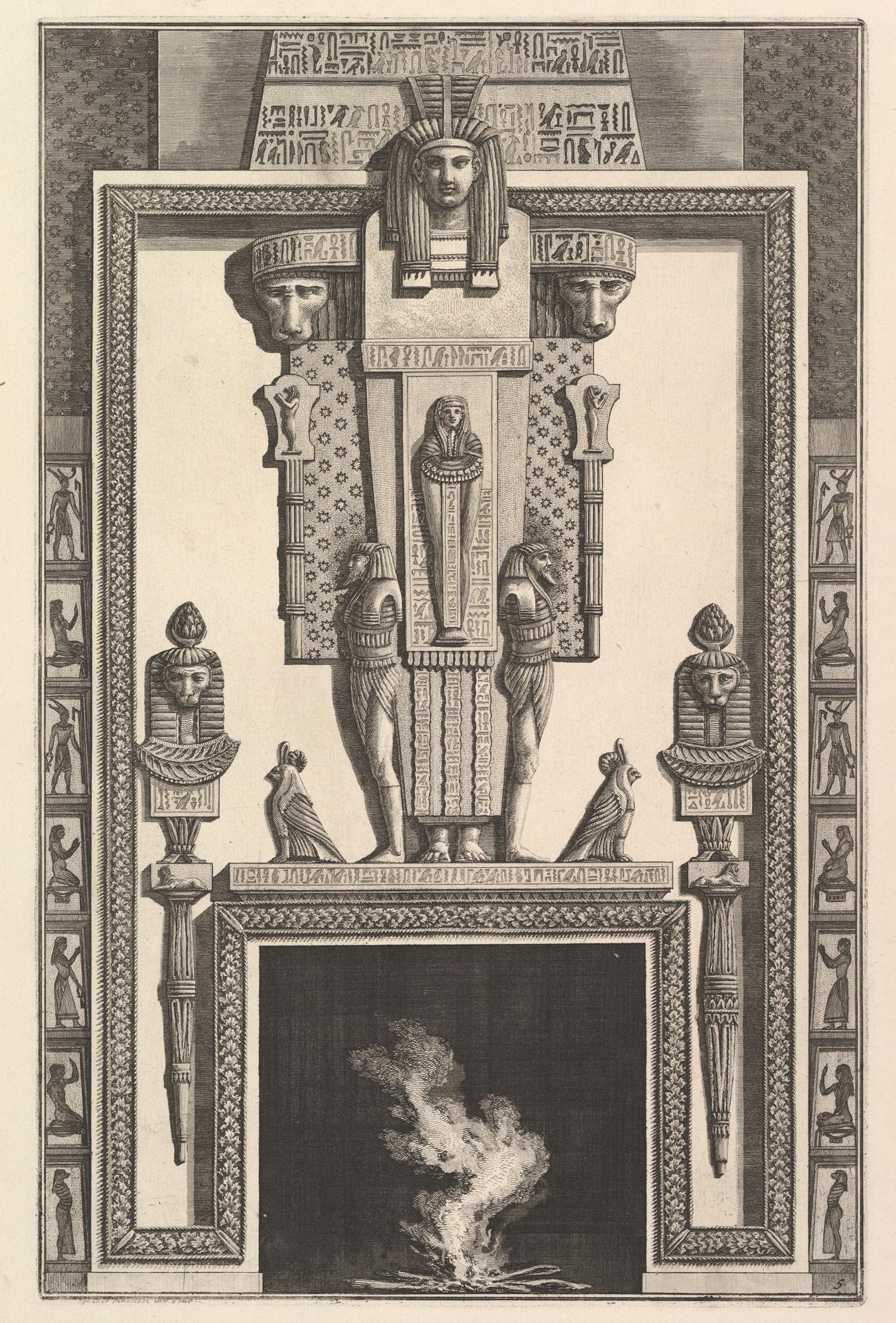
Chimneypiece in the Egyptian style: Mummy superimposed on a large caryatid above the lintel (Ch. à l'égyptiennne surmontée d'une grande cariatide contre laquelle s'applique une momie), from Diverse Maniere d'adornare i cammini ed ogni altra parte degli edifizi...(Different Ways of ornamenting chimneypieces and all other parts of houses)
Original title: Chimneypiece in the Egyptian style: Mummy superimposed on a large caryatid above the lintel (Ch. à l'égyptiennne surmontée d'une grande cariatide contre laquelle s'applique une momie), from Diverse Maniere d'adornare i cammini ed ogni altra parte degli edifizi...(Different Ways of ornamenting chimneypieces and all other parts of houses)
kurzbeschreibung
Giovanni Battista Piranesi made this etching in 1769, titled Chimneypiece in the Egyptian style: Mummy superimposed on a large caryatid above the lintel. It belongs to the series Diverse Maniere d'adornare i cammini ed ogni altra parte degli edifizi and shows an elaborately designed chimneypiece in the Egyptian style. The sheet measures 54.8 x 39 cm, the plate 39 x 25.2 cm.
Description
A large caryatid dominates the chimneypiece, with a mummy in a hieroglyph-covered sarcophagus superimposed above it. A relief showing a figure wearing a headdress sits above the sarcophagus. Two further figures in Egyptian headgear and dress flank the caryatid. Columns with hieroglyphs and Egyptian motifs stand at the sides of the chimneypiece, and below, the fireplace opens with smoke rising. The black-and-white monochrome creates light and shadow through fine lines and contours.
Context
In 1769 Piranesi published this etching within his collection Diverse Maniere d'adornare i cammini, dedicated to the decoration of chimneypieces and other architectural elements. At that time, interest in Egyptian art and culture was growing in Europe, fed by archaeological finds and travel accounts. Piranesi, otherwise known for vedute and architectural views, here combined ancient Egyptian elements with European forms. The volume served architects and decorators as a pattern book and documents Piranesi's engagement with antiquity.
Impact
The etching has a monumental and at the same time exotic effect, as Egyptian symbols and Baroque formal language interlock. Dense ornamentation and precise lines give the sheet something decorative and at the same time instructive. The viewer is transported into a fantastic, historicizing world that reflects Piranesi's idea of an ideal antiquity.
Technique
Etching: the drawing was etched into a copper plate treated with acid. The fine lines and hatching reveal Piranesi's skill in the etching technique, which allowed for complex details and textures. The monochrome emphasizes the graphic clarity and the ornamental structure of the motif.
AI-generated description text
Source: Metropolitan Museum of Art · Public Domain (CC0 1.0)