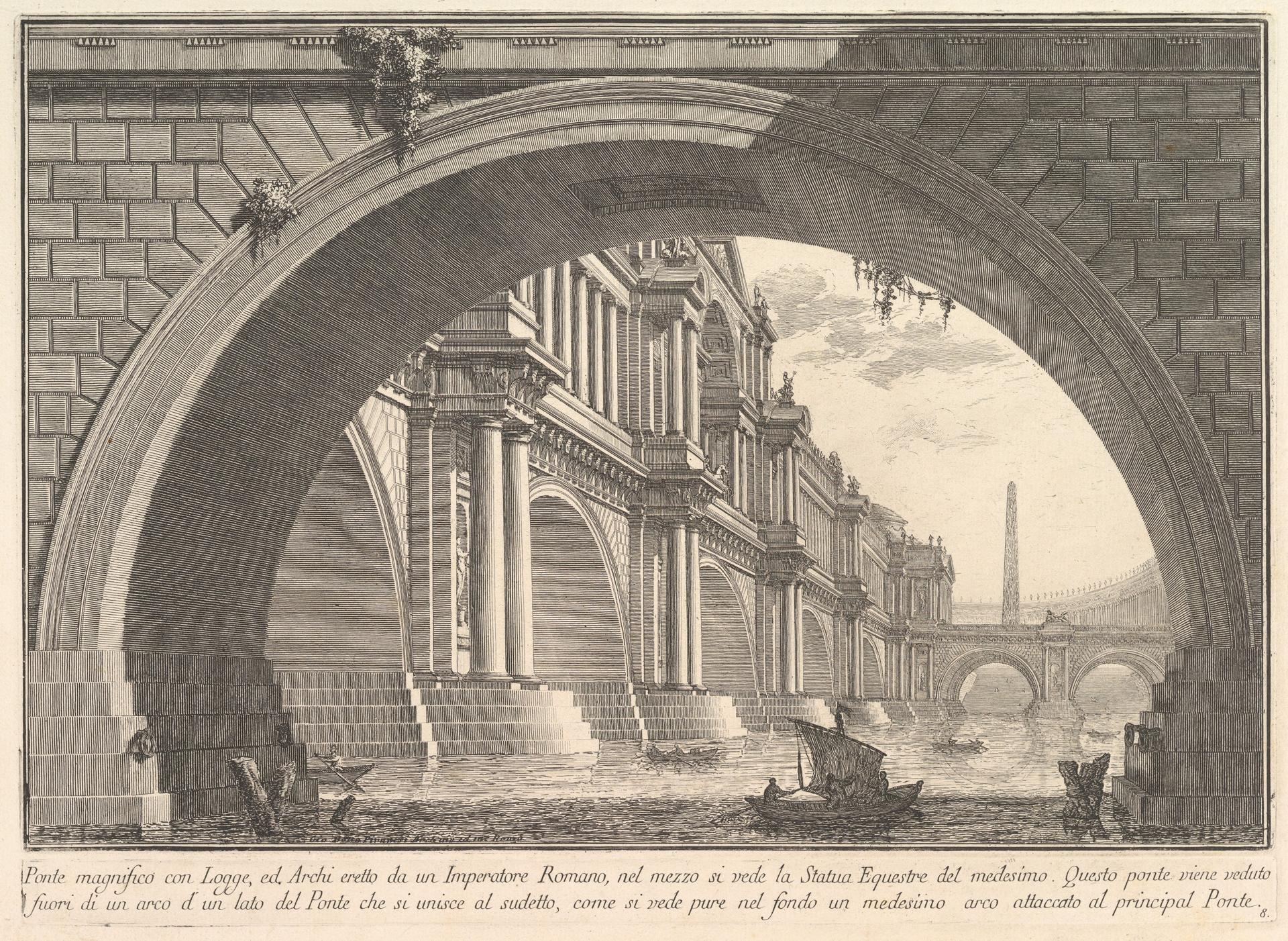
Magnificent bridge with loggias, and arches erected by a Roman Emperor... (Ponte magnfiico con Logge, ed Archi erretto da un Imperatore Romane...)
Original title: Magnificent bridge with loggias, and arches erected by a Roman Emperor... (Ponte magnfiico con Logge, ed Archi erretto da un Imperatore Romane...), from "Prima Parte di Architettura, e Prospettive"
kurzbeschreibung
Giovanni Battista Piranesi made this etching around 1750 as part of his series 'Prima Parte di Architettura, e Prospettive'. It presents a vast bridge structure with an equestrian statue at its heart — one of the artist's early architectural inventions.
Description
The layout is strictly symmetrical, organised around the emperor's equestrian statue, which commands attention. Rows of columns and arched openings frame the bridge and lead the eye into depth. A second bridge with an obelisk appears in the distance; below the arches, boats and fish animate the water. Light falls from above, clarifying the architectural forms and the sense of space.
Context
This etching belongs to Piranesi's first published series, 'Prima Parte di Architettura, e Prospettive', with which he presented his architectural fantasies and perspective studies around 1750. It was made in Rome, where he engaged closely with ancient ruins and buildings. The idealised Roman bridge reflects his interest in the grandeur and construction techniques of antiquity.
Impact
The monumental, symmetrical arrangement produces an impression of sublimity and order. Precise perspective and deliberate lighting create spatial depth and draw the viewer into the imagined architecture.
Technique
The image was produced as an etching, an intaglio process in which the drawing is scratched into an acid-resistant layer on a copper plate and then bitten by acid. Crisp lines and fine hatching yield strong contrasts of light and shadow. The plate measures 23.8 × 35.8 cm.
AI-generated description text
Source: Metropolitan Museum of Art · Public Domain (CC0 1.0)