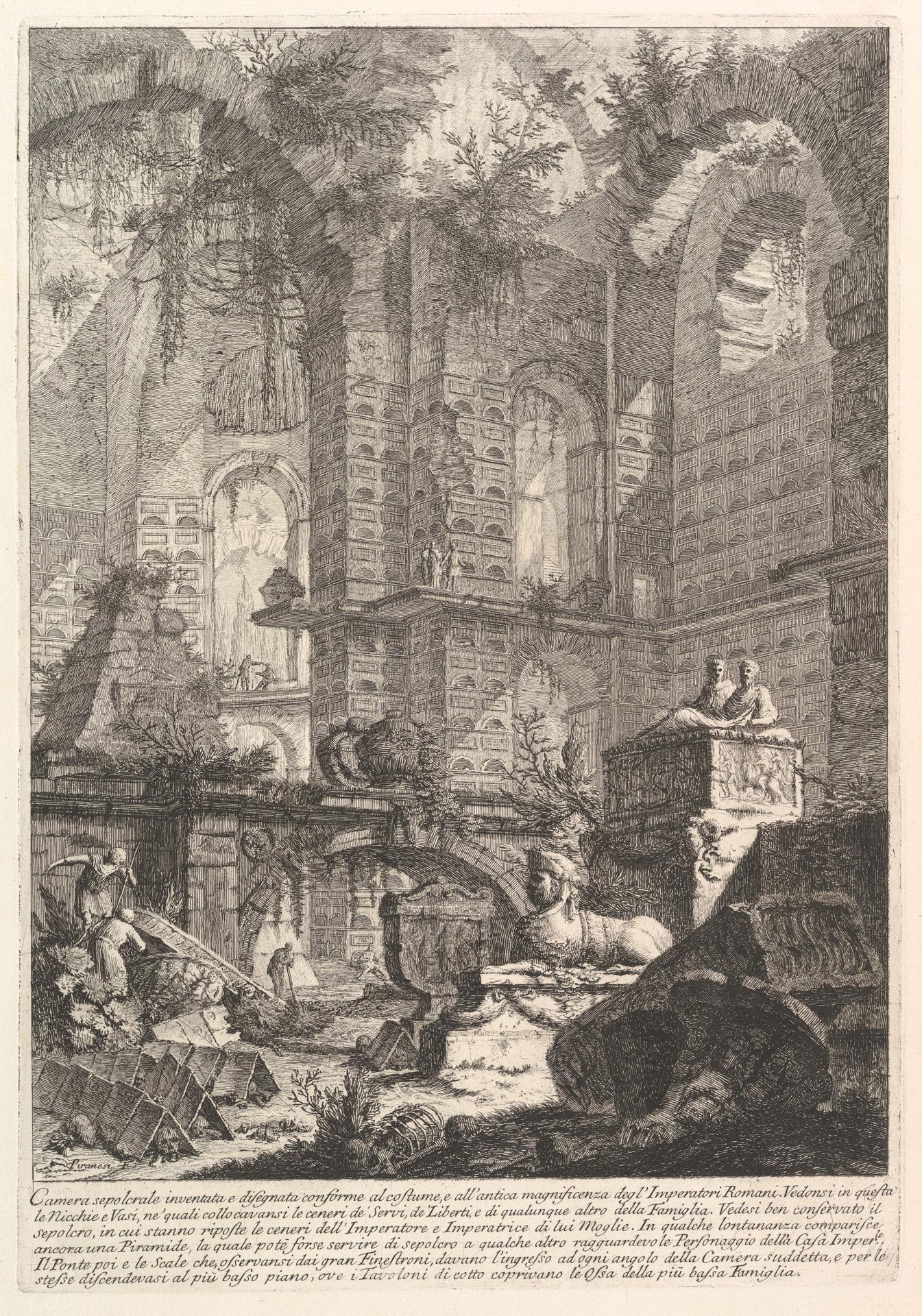
Camera sepolcrale inventata e disegnata conforme al costume, e all'antica magnificenza degl'Imperatori Romani... (Imaginary sepulcral chamber designed according to the fashion and ancient magnificence of the Roman Emperors...), from "Prima Parte di Architettura, e Prospettive"
Original title: Camera sepolcrale inventata e disegnata conforme al costume, e all'antica magnificenza degl'Imperatori Romani... (Imaginary sepulcral chamber designed according to the fashion and ancient magnficence of the Roman Emperors...), from "Prima Parte di Architettura, e Prospettive"
kurzbeschreibung
Around 1750, Giovanni Battista Piranesi created the etching 'Erfundene Grabkammer' (Invented Burial Chamber), which presents a freely imagined tomb in the spirit of the Roman imperial era. The print belongs to the series 'Prima Parte di Architettura, e Prospettive' and intertwines architectural invention with motifs from antiquarian studies.
Description
Columns, arches, and walls with ornate capitals and ornamental details dominate the foreground. Plants and trees grow over the structures, obscuring parts of them. The view is closed by a pyramid and a bridge on columns. Through the distribution of architectural elements and soft lighting, the layout feels calm and balanced.
Context
The etching was made around 1750, when Piranesi was deeply engaged with Roman antiquity. After studies in Rome and Venice, he created the 'Prima Parte' series, which established his reputation as an architectural draughtsman. His work intervened in the contemporary debate over whether Roman or Greek architecture should take precedence.
Impact
A solemn, almost wistful mood emanates from the print, carried by the overgrown architecture and the calm arrangement. Monumental architecture and natural decay meet, hinting at transience without the view being dramatically exaggerated.
Technique
For the etching, lines were bitten into a copper plate. Fine hatching and gradations of shading produce the grey tones and the sculptural appearance of the architectural forms. The plate measures 40.2 × 27.8 cm, the sheet somewhat more at 49.5 × 34 cm.
AI-generated description text
Source: Metropolitan Museum of Art · Public Domain (CC0 1.0)