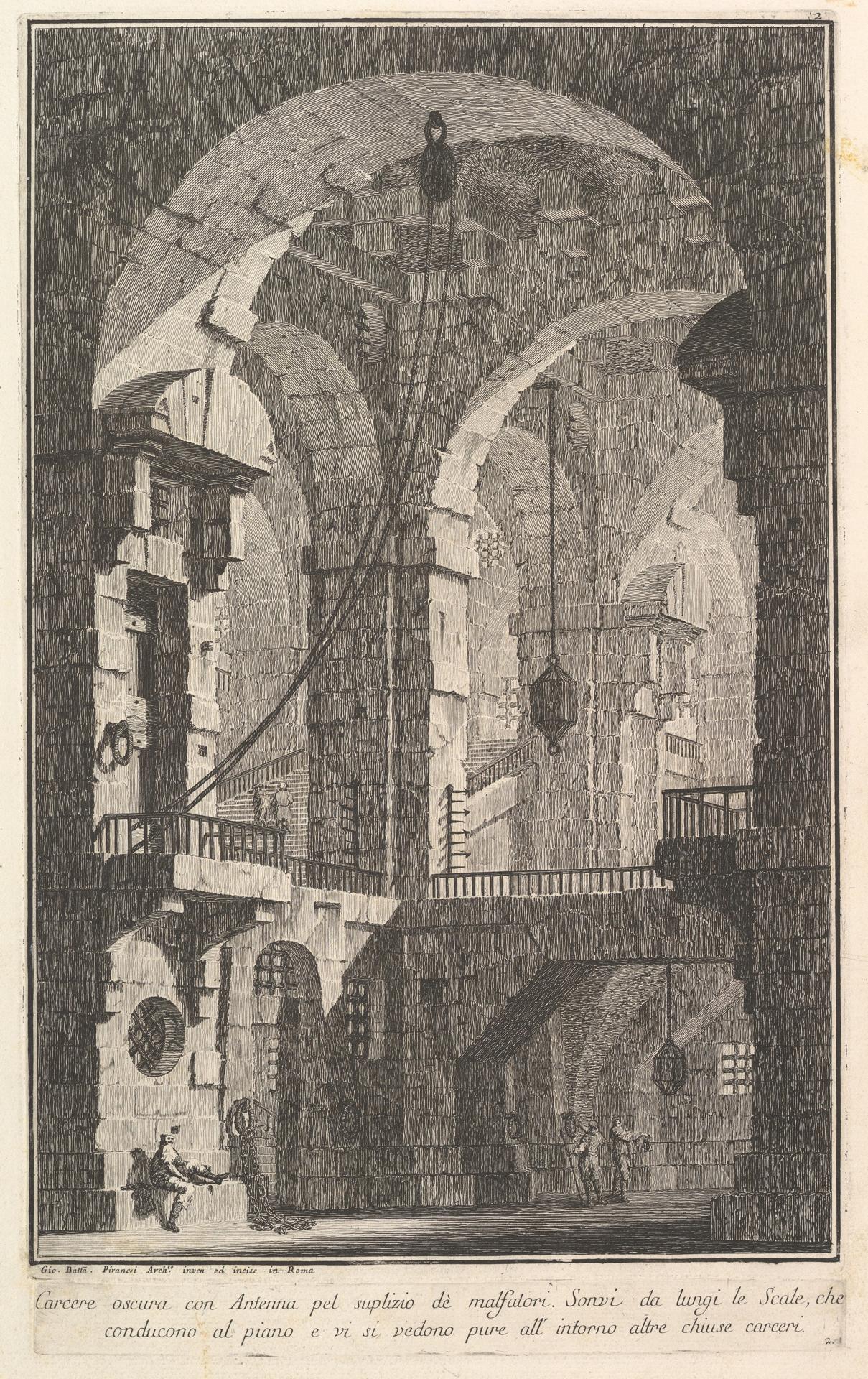
Dark prison with a courtyard for the punishment of criminals... (Carcere oscura con Antenna pel suplizio dè malfatori...)
Original title: Dark prison with a courtyard for the punishment of criminals... (Carcere oscura con Antenna pel suplizio dè malfatori...), from "Prima Parte di Architettura, e Prospettive"
kurzbeschreibung
Giovanni Battista Piranesi made this etching around 1750 as part of his series Prima Parte di Architettura, e Prospettive. The print presents a grim architectural vision: a condemned man hangs from a hook while figures on balconies and in the courtyard watch the scene.
Description
A large semicircular arch dominates the center and opens onto an inner courtyard. At the very top of the arch, a prisoner is suspended from a hook; a figure on a raised platform holds a rope. To the left and right of the arch, people look down from balconies, and below, more figures stand or sit. Light falls into the courtyard from above, while the rest of the scene lies in deep shadow. The gradations from light to dark bring out the spatial depth.
Context
The etching was made in Rome around 1750, where Piranesi was deeply engaged with ancient and contemporary architecture. It belongs to his early series Prima Parte di Architettura, e Prospettive, which combines architectural fantasies with Roman buildings. The prison motif reflects the period's fascination with criminal justice and the dark aesthetic of jail cells—a theme Piranesi would later pursue in the Carceri d'invenzione.
Impact
Dark shadows and the central punishment scene create a threatening, oppressive atmosphere. The symmetrical layout and the incoming light draw the eye to the cruel event, heightening its emotional impact on the viewer.
Technique
For this etching, the drawing was incised with a steel stylus into a plate coated with a water-resistant layer. Ink settles in the grooves and is transferred to paper, producing fine lines and nuanced shadows. The plate measures 14 3/8 × 9 5/16 inches (36.5 × 23.7 cm), the sheet 19 7/16 × 13 3/16 inches (49.4 × 33.5 cm).
AI-generated description text
Source: Metropolitan Museum of Art · Public Domain (CC0 1.0)