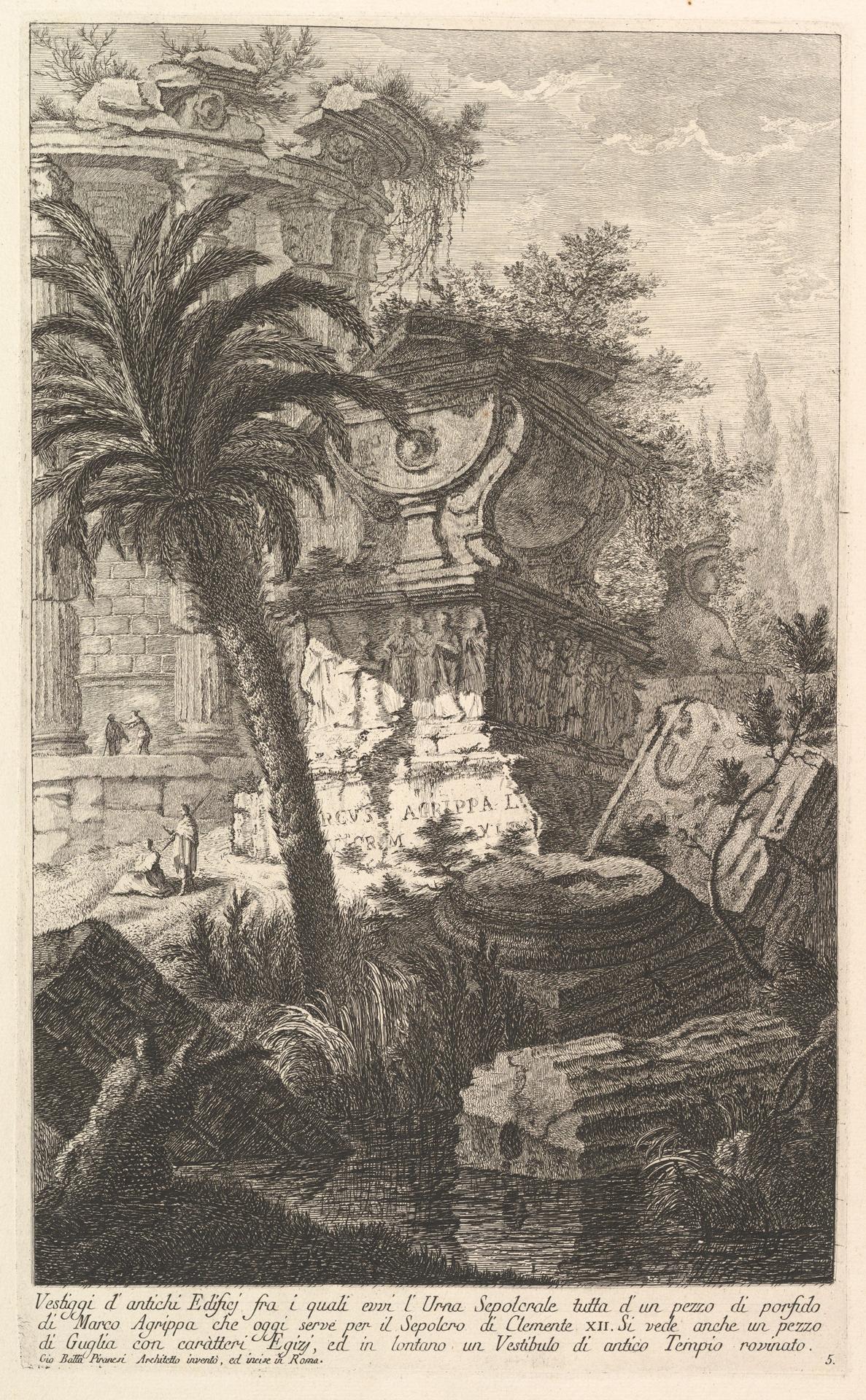
Remains of ancient buldings among which stands the sepulchral urn of Marcus Agrippa made entirely of porphyry, which serves today as the Tomb of Clement XII...
Original title: Remains of ancient buldings among which stands the sepulchral urn of Marcus Agrippa made entirely of porphyry, which serves today as the Tomb of Clement XII... (Vestiggi d'antichi Edifici fra i quali evvi l'Urna Sepolcrale tutta d'un pezzo di...), from "Prima Parte di Architettura, e Prospettive"
kurzbeschreibung
Unlike many contemporary ruin views, this etching by Giovanni Battista Piranesi (ca. 1750) sets an ancient ruin landscape around the porphyry urn of Marcus Agrippa, which dominates the foreground. It belongs to the series 'Prima Parte di Architettura, e Prospettive' and is executed as an etching. The subject brings together ancient architecture and its later use as a Christian tomb.
Description
A symmetrical layout draws the eye to a monumental structure in the foreground that houses the porphyry urn. Inscriptions and sculptural ornament adorn the urn; on the left, palms suggest desert vegetation. Behind, further ruins and columns appear, overgrown with plants. A cloudy sky governs the scene, evoking a somber, melancholy mood. Diffuse light and monochrome gray tones define the print.
Context
The etching was made around 1750, when Piranesi was deeply engaged with Roman antiquity. With the series 'Prima Parte di Architettura, e Prospettive' he issued his first major printed work and established his reputation as an architectural draftsman. The fact that the Agrippa urn served in the eighteenth century as the tomb of Pope Clement XII points to the contemporary practice of reusing ancient monuments in a Christian context.
Impact
Sublimity and melancholy pervade the sheet, as is characteristic of Piranesi. The overgrown ruins and gloomy sky underscore the transience of human grandeur and invite reflection on the past.
Technique
Piranesi used etching to achieve fine lines and shading that capture the texture of stone, plants, and sky. The process allows high fidelity in rendering architectural elements and enhances spatial depth. The plate measures 38.7 × 23.6 cm, the sheet 49.5 × 33.6 cm.
AI-generated description text
Source: Metropolitan Museum of Art · Public Domain (CC0 1.0)