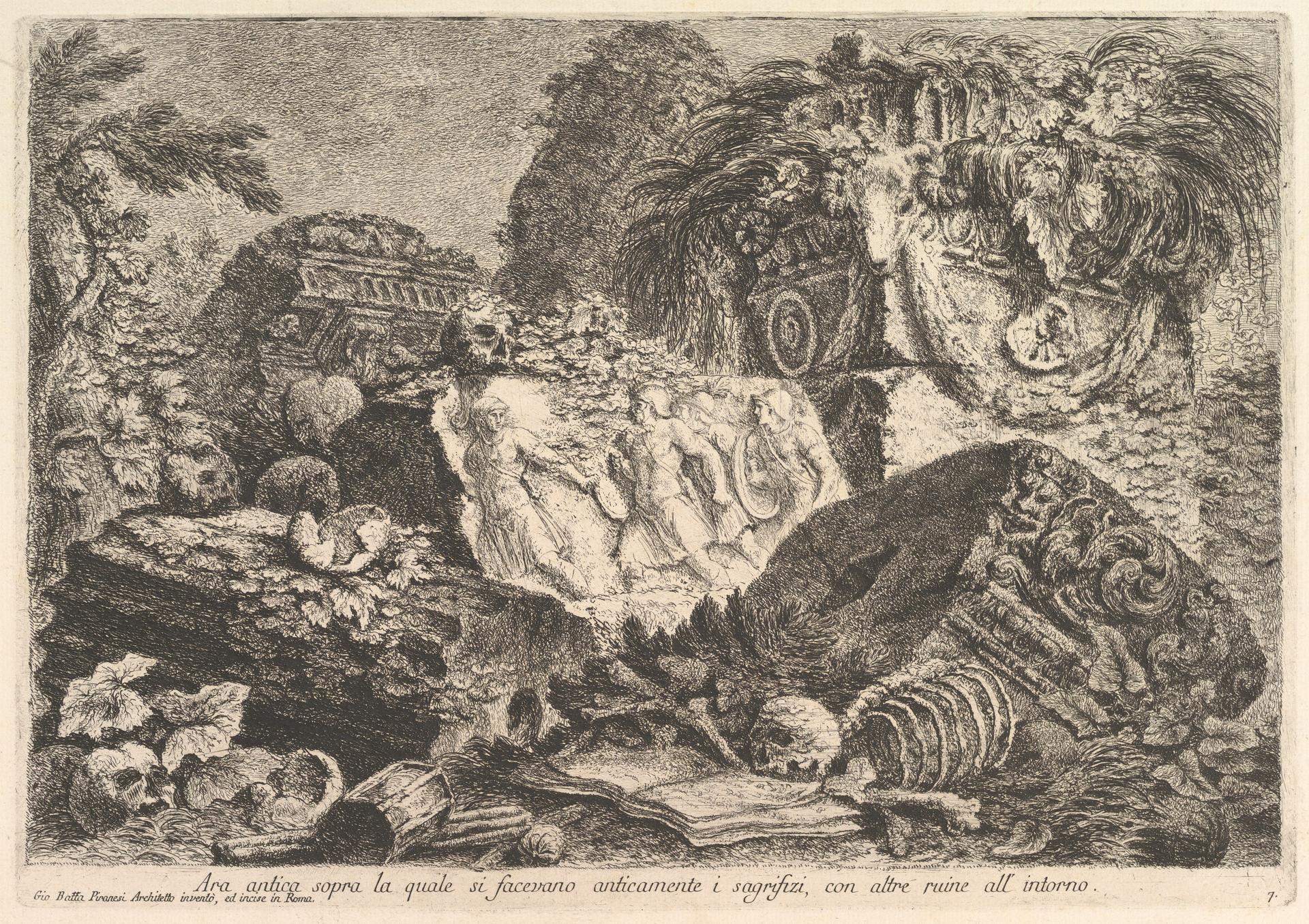
Ancient Altar on which sacrifices were performed in antiquity, surrounded by other ruins (Ara antica sopra la quale si facevano anticamente i sagrifizi, con altre ruine all'intorno), from "Prima Parte di Architettura, e Prospettive"
Original title: Ancient Altar on which sacrifices were performed in antiquity, surrounded by other ruins (Ara antica sopra la quale si facevano anticamente i sagrifizi, con altre ruine all'intorno), from "Prima Parte di Architettura, e Prospettive"
kurzbeschreibung
Around 1750, Giovanni Battista Piranesi created the etching 'Ancient Altar, on which Sacrifices were Offered in Antiquity, Surrounded by Other Ruins'. The print shows an ancient sacrificial altar decorated with reliefs, set within a landscape of ruins, with a pensive figure in the foreground. It comes from the series 'Prima Parte di Architettura, e Prospettive'.
Description
An ancient altar with reliefs depicting figures in classical dress dancing or walking in solemn procession forms the focal point. On the left, a lone person sits on a stone, appearing withdrawn; on the right lies a large weathered block with reliefs. Trees and further ruins fill the background and frame the arrangement. The layout is symmetrically aligned on the altar. Black-and-white print in which light and shadow are created through hatching and fine line work.
Context
In the mid-eighteenth century, Piranesi explored ancient ruins and architectural fantasies in Rome. This etching belongs to the early series 'Prima Parte di Architettura, e Prospettive', first published in 1743, which established his reputation as a master of the architectural veduta. In this series, Piranesi combined real ancient monuments with imaginary reconstructions to emphasize the grandeur of Roman architecture. The audience was educated and interested in architecture and antiquarianism.
Impact
The symmetrical arrangement and the carefully worked reliefs give the print a solemn, almost ritual mood. Contrasting shading creates a dramatic sense of depth and underscores the sublimity of the ruins. The pensive figure in the foreground invites reflection on the transience of ancient cultures.
Technique
The technique is etching, printed in black and white. With fine lines and cross-hatching, Piranesi modeled light and shadow and rendered the surfaces of stone and reliefs. The plate measures 24.2 × 34.9 cm, the sheet 33.7 × 49.3 cm.
AI-generated description text
Source: Metropolitan Museum of Art · Public Domain (CC0 1.0)