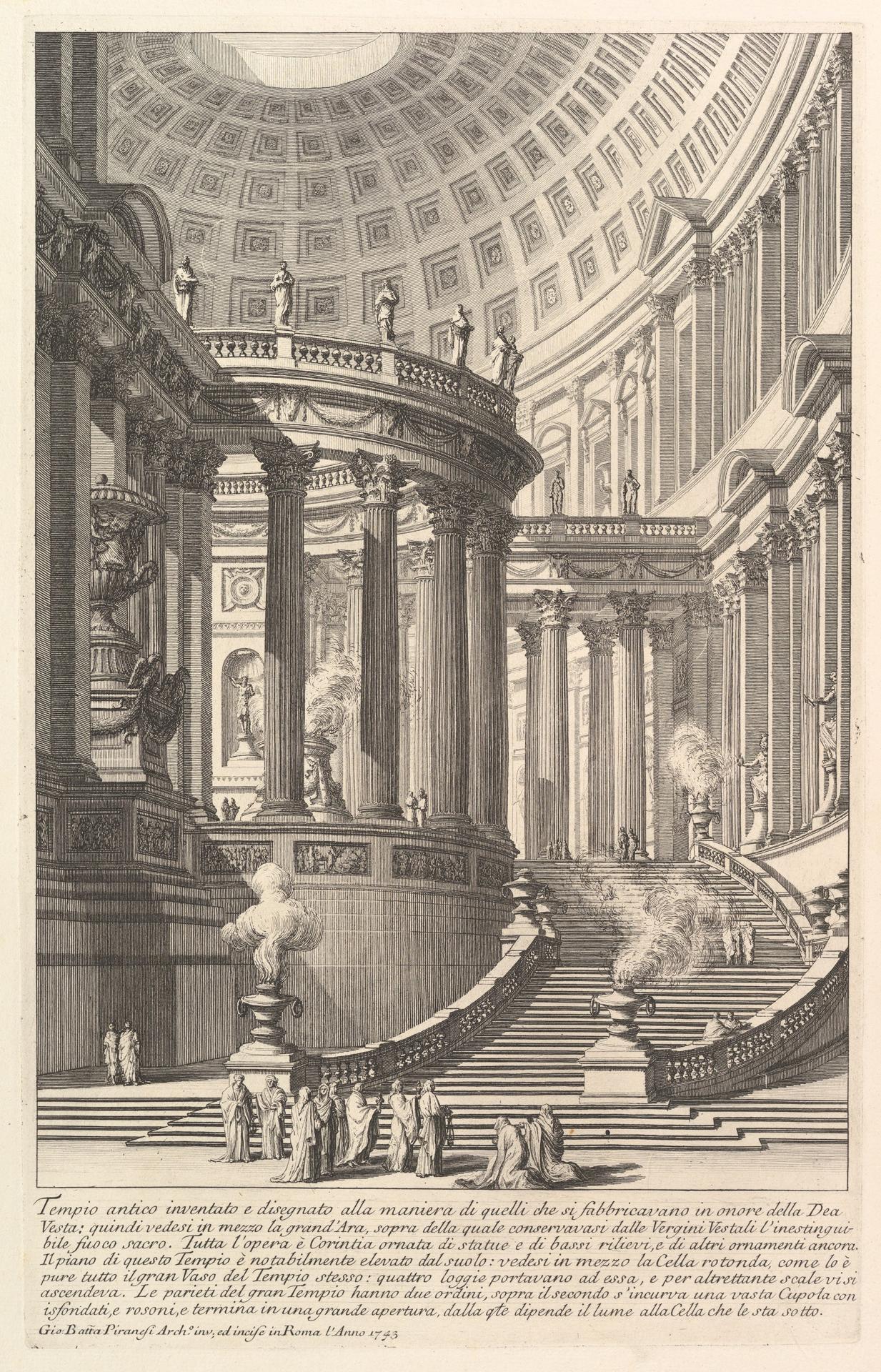
Imaginary Ancient Temple Designed in the Style of Those Built in Honor of the Goddess Vesta
Original title: Imaginery ancient temple designed in the style of those built in honor of the Goddess Vesta... (Tempio antico inventato e disegnato alla maniera di quelli che si fabbricavano in onore della Dea Vesta...), from "Prima Parte di Architettura, e Prospettive"
kurzbeschreibung
Giovanni Battista Piranesi, who rose to fame early in Rome with his architectural fantasies, devotes this print to a freely invented Temple of Vesta. It belongs to the series 'Prima Parte di Architettura, e Prospettive'. The etching, from around 1750, presents a circular temple with a dome, articulated by Corinthian columns and enlivened by figures.
Description
A round temple building opens to view: above several rows of columns a large dome arches, supported by Corinthian columns whose shafts are adorned with reliefs and statues. A staircase climbs from the ground up to the dome. Below, people in ancient dress move about. Light falls from above through the dome and brightens the interior; the tones remain in gray and white.
Context
The etching was made around 1750 in Rome, in an early phase of Piranesi's career devoted entirely to architectural visions. With the series 'Prima Parte di Architettura, e Prospettive' he issued one of his first publications and established his reputation as a master of vedute and capricci. The idealized ancient temple met contemporary interest in Rome's past; yet Piranesi presents an architecture that never existed.
Impact
Clear lines and a strictly symmetrical layout give the print a solemn, monumental quality. Light entering through the dome bathes the scene in a sacred atmosphere and carries the viewer into the world of antiquity.
Technique
For the etching, lines were bitten into a copper plate. Fine hatching and controlled etching depth allow the architecture to be rendered in detail and light effects to be graduated. The printing plate measures 39.8 × 25.3 cm; the sheet format, at 49.4 × 33.6 cm, is somewhat larger.
AI-generated description text
Source: Metropolitan Museum of Art · Public Domain (CC0 1.0)