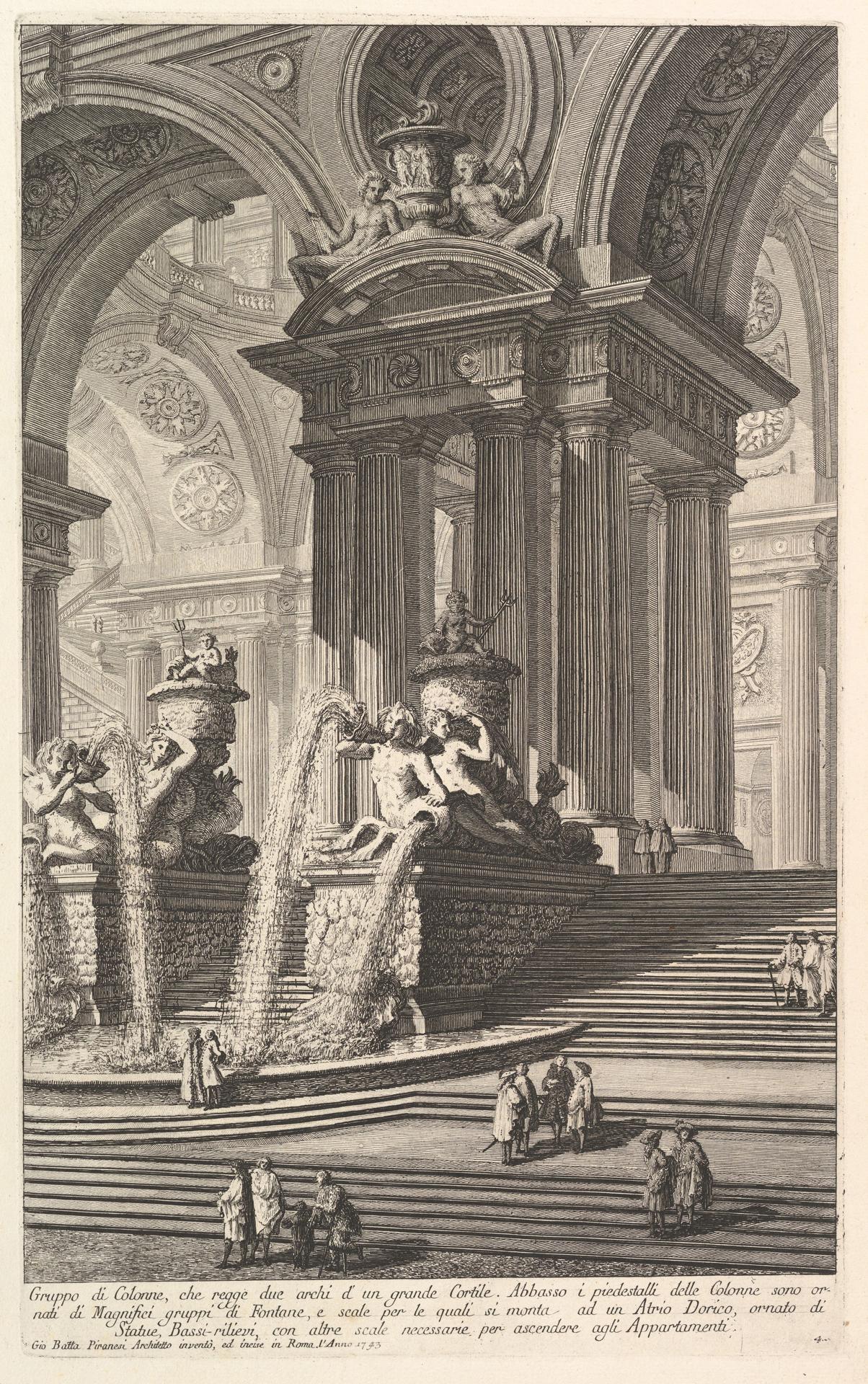
Group of columns which support two arches of a great courtyard... (Gruppo di Colonne, che regge due archi d'un grande Cortile...), from "Prima Parte di Architettura, e Prospettive"
Original title: Group of columns which support two arches of a great courtyard... (Gruppo di Colonne, che regge due archi d'un grande Cortile...), from "Prima Parte di Architettura, e Prospettive"
kurzbeschreibung
Two stone pedestals with seated figures that spray water support the round arches in this etching by Giovanni Battista Piranesi. The sheet belongs to the series Prima Parte di Architettura, e Prospettive, was made around 1750, and presents an exuberant colonnade that encloses a courtyard—an early architectural invention by the artist.
Description
At the front, two massive columns covered in ornament stand supporting two arches; on their bases, figures have taken their places as part of a fountain and shoot water upward. Another complex of columns and arches follows behind, making the depth of the courtyard palpable. Numerous small staffage figures are scattered between the fountains and columns. The black-and-white of the print works with strong contrasts of light and dark that stage the space and bring out the architecture in relief.
Context
The Prima Parte di Architettura, e Prospettive (First Part of Architecture and Perspectives) was Piranesi's first published series of etchings and was created around 1743–1750. In Rome, where he studied ancient ruins and Baroque buildings, the artist worked on these sheets. Real architectural motifs combine with invented, idealized arrangements; the series served as proof of his skills in perspective and printmaking.
Impact
The dense ornamentation and monumental scale evoke a sense of the sublime and theatrical staging. Contrasts of light and dark and the small staffage figures guide the eye into the depth of the image while conveying an almost romantic mood of ruins.
Technique
For this etching, the drawing was engraved into a copper plate and etched with acid. Fine line layers and cross-hatching created shadows and light effects; printing was done on laid paper in an edition aimed at collectors and architects.
AI-generated description text
Source: Metropolitan Museum of Art · Public Domain (CC0 1.0)