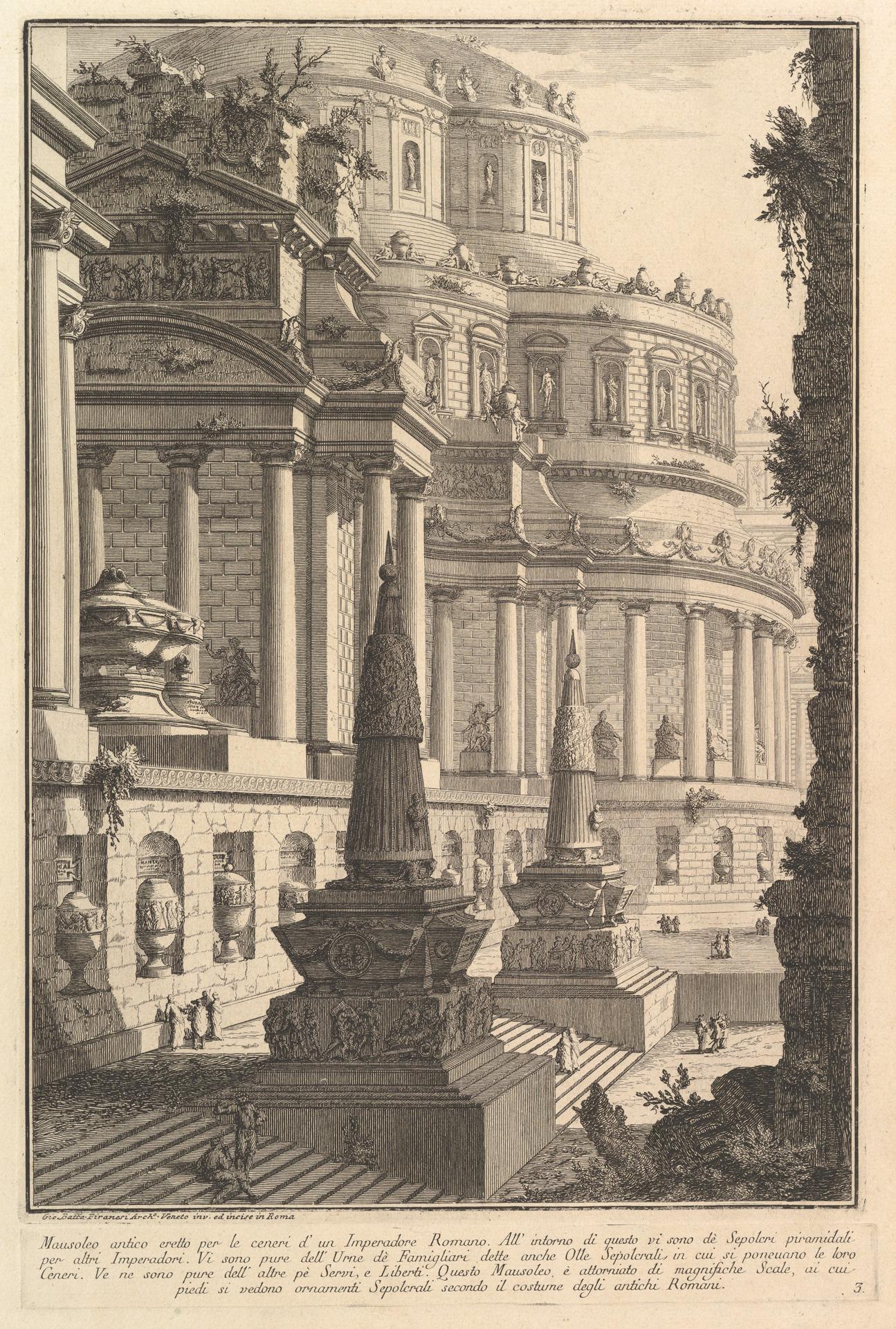
Ancient mausoleum erected for the ashes of a Roman Emperor (Mausoleo antico eretto per le ceneri d'un Imperadore Romano), from "Prima Parte di Architettura, e Prospettive"
Original title: Ancient mausoleum erected for the ashes of a Roman Emperor (Mausoleo antico eretto per le ceneri d'un Imperadore Romano), from "Prima Parte di Architettura, e Prospettive"
kurzbeschreibung
This etching by Giovanni Battista Piranesi, from the series 'Prima Parte di Architettura, e Prospettive', dates from around 1750. It presents an ancient mausoleum built for the ashes of a Roman emperor—an idealized funerary architecture set within a landscape.
Description
A round, multi-storey structure with columns and arches rises, its facade covered with reliefs and sculptures. In front stand two pyramid-shaped columns, also carved with reliefs. A few figures linger near the mausoleum. Trees and rocks surround the complex; another ancient building can be made out in the distance. Light falls from above, emphasizing the shadows and contours of the architecture.
Context
Around 1750 Piranesi published the series 'Prima Parte di Architettura, e Prospettive', featuring etchings that combine Roman antiquity with imaginary views. In those years he studied the ruins of Rome in depth and heightened them in his prints. The series counts among his early architectural capricci and shaped the perception of architecture in the eighteenth century.
Impact
From the first glance, the monumental, sublime mood captivates, carried by the symmetrical arrangement and dramatic lighting. Real architectural forms merge with fictional elements into an atmospheric density that transports the viewer into the ancient world.
Technique
As an etching, the lines were bitten into a copper plate. This process allows fine hatching and a precise rendering of light and shadow. The paper format is larger than the plate mark—a characteristic feature of Piranesi's prints.
AI-generated description text
Source: Metropolitan Museum of Art · Public Domain (CC0 1.0)