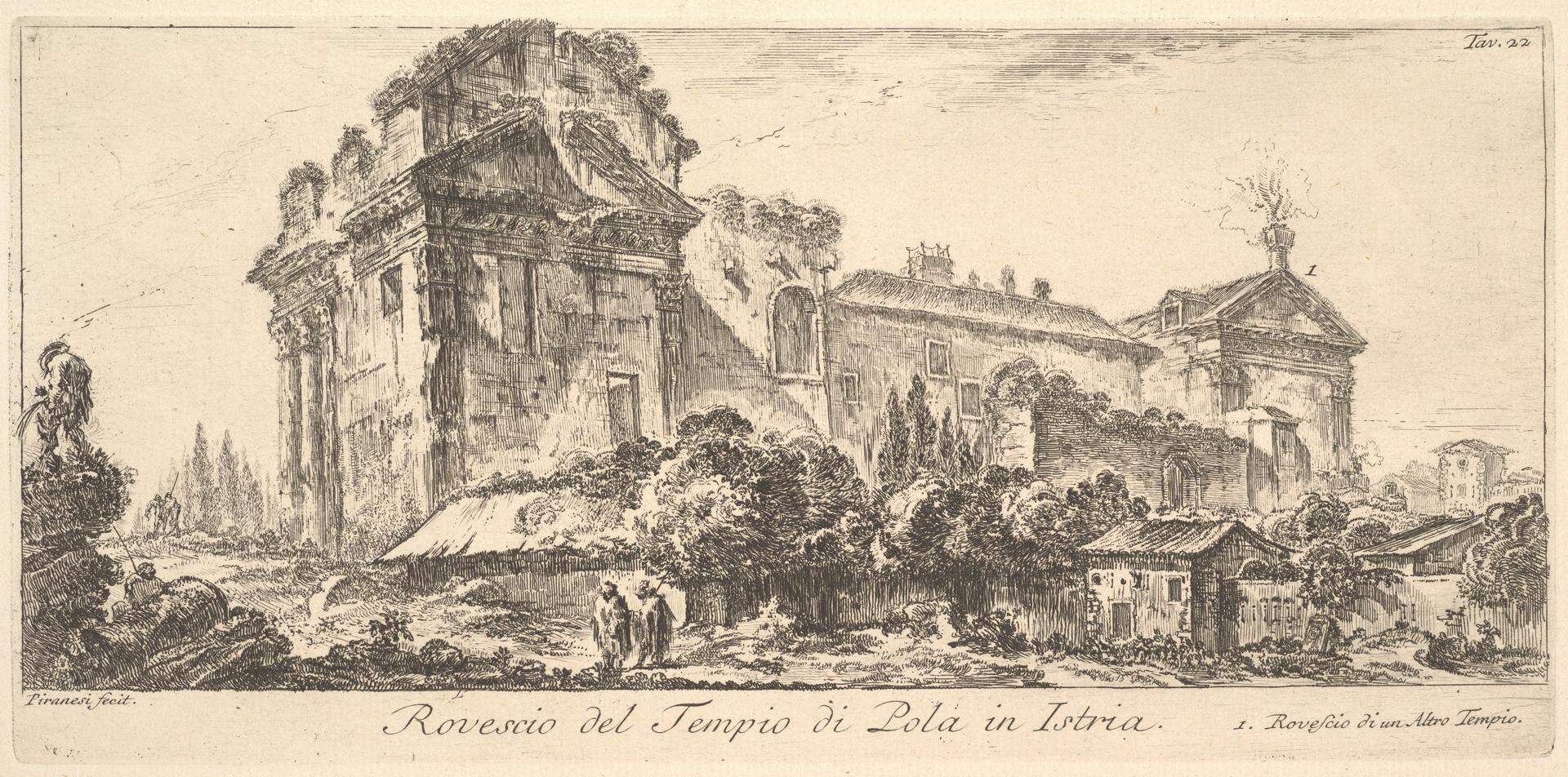
Plate 22: Rear View of the Temple of Pola in Istria. 1. Rear View of another temple. (Rovescio del Tempio di Pola di Istria. 1. Rovescio di un Altro Tempio.), from "Alcune Vedute di Archi Trionfali ed altri monumenti inalzati da Romani parte di quali se veggono in Roma e parte per l'Italia"
Original title: Plate 22: Rear View of the Temple of Pola in Istria. 1. Rear View of another temple. (Rovescio del Tempio di Pola di Istria. 1. Rovescio di un Altro Tempio.), from "Alcune Vedute di Archi Trionfali ed altri monumenti inalzati da Romani parte di quali se veggono in Roma e parte per l'Italia" (Some Views of Triumphal Arches and other monuments erected by the Romans, some of which are in Rome and some elsewhere in Italy)
kurzbeschreibung
Giovanni Battista Piranesi, famed for his architectural etchings, made this sheet around 1748 as part of the series 'Alcune Vedute di Archi Trionfali ed altri monumenti inalzati da Romani'. The etching reproduces the rear of the Roman temple at Pola in Istria. It belongs to a collection of views of Roman triumphal arches and other monuments.
Description
The rear view of the Temple of Pola in Istria appears in a ruined state, with columns and other parts overgrown with plants in places. In the foreground, a few figures stand in a rural setting with trees and shrubs. To the right, a smaller building with a roof is visible, and behind it further structures and trees. The layout is horizontal, with the temple occupying the middle; the light is even, and the rendering is monochrome in black and white.
Context
Piranesi produced this etching for his series 'Alcune Vedute di Archi Trionfali ed altri monumenti inalzati da Romani', published in Rome around 1748. The series documents Roman triumphal arches and monuments, some in Rome and others elsewhere in Italy. The Temple of Pola in Istria (now Croatia) was a Roman temple known as a ruin in the eighteenth century. Piranesi was regarded as a master of precise architectural depictions of ancient buildings.
Impact
The print evokes a romantic mood of ruins typical of the eighteenth century. Decayed architecture and encroaching vegetation combine into a melancholic atmosphere that carries the viewer back in time. Clear lines and rich detail bring out the grandeur of ancient building.
Technique
The work is executed as an etching, an intaglio process in which the drawing is incised into a copper plate bitten with acid. The lines appear fine and precise, characteristic of Piranesi. The plate measures 12.4 × 25.6 cm; the sheet is printed on larger paper of 33.1 × 47.7 cm.
AI-generated description text
Source: Metropolitan Museum of Art · Public Domain (CC0 1.0)