Tendu Devant
Original title: Tendu Devant
kurzbeschreibung
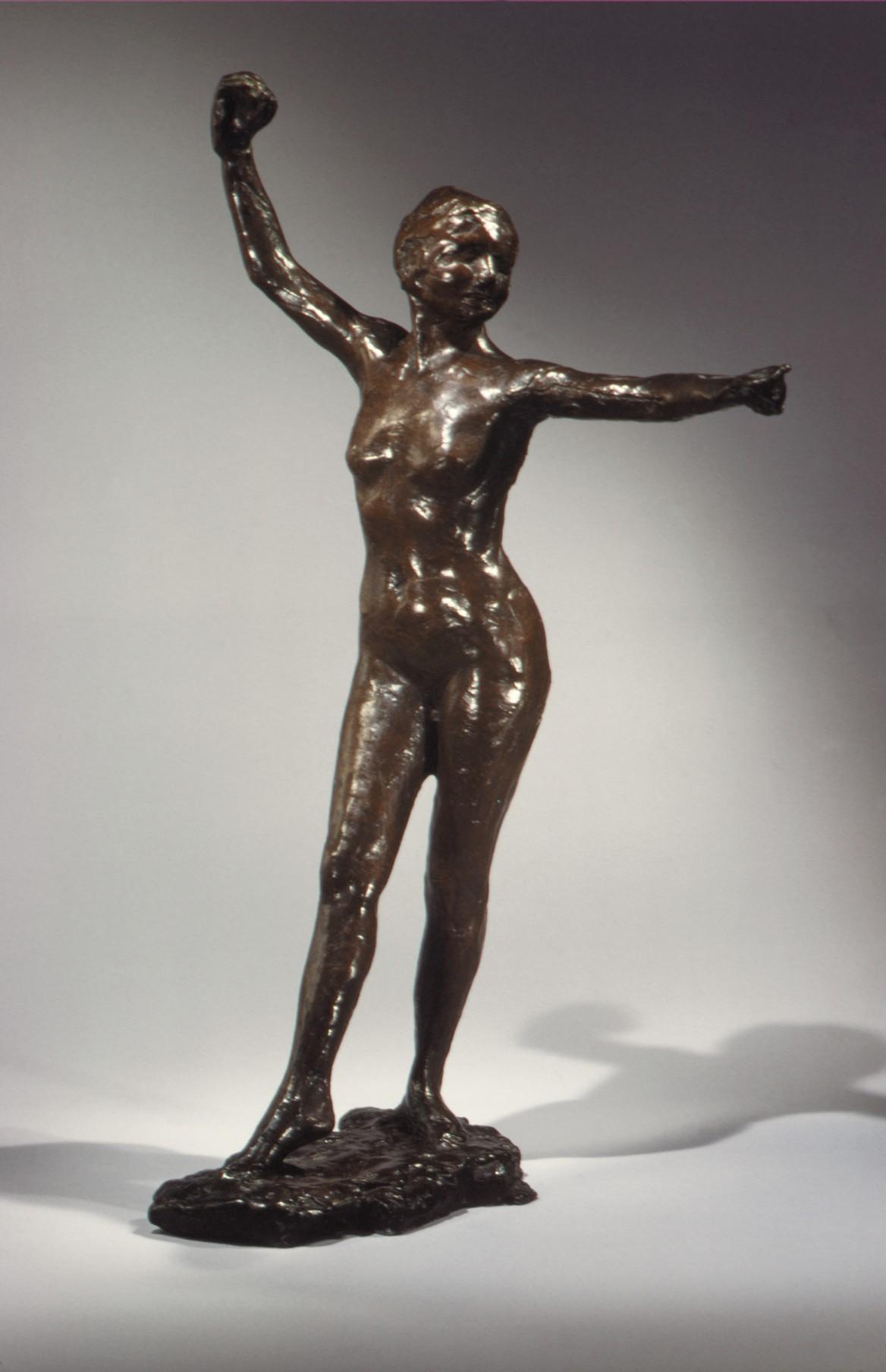
Edgar Degas's bronze figure Tendu devant was modeled in wax, likely before 1890, and cast in 1920. It shows a nude dancer in an extended pose, continuing Degas's lifelong study of the body in motion.
Description
A naked male figure strikes a dance position: his left arm lifts upward, his right arm stretches forward. The figure rests on an irregular, rock-like base that suggests a natural setting. Side light picks out the contours and surface of the bronze, creating sharp shadows. A uniform brown patina covers the entire sculpture.
Context
Probably made in the late 1880s, the work belongs to a period when Degas was deeply engaged with ballet. It is one of a series of wax models that were transferred to bronze only after the artist's death. The 1920 cast was made by the Hébrard foundry, which had acquired the models. A male dancer appears only rarely in Degas's oeuvre.
Impact
The dynamic pose and the uneven ground give the viewer a sense of immediate kinetic energy. The rough surface and the interplay of light and shadow lend the work an expressive, almost impressionistic quality. The eye is encouraged to examine the figure from different angles.
Technique
The sculpture was executed in bronze, with a distinctive patina on its surface. The irregular texture and modeled details point back to the original wax model. It was cast using the lost-wax method, which preserves the fine details of the original modeling.
AI-generated description text
Source: Metropolitan Museum of Art · Public Domain (CC0 1.0)