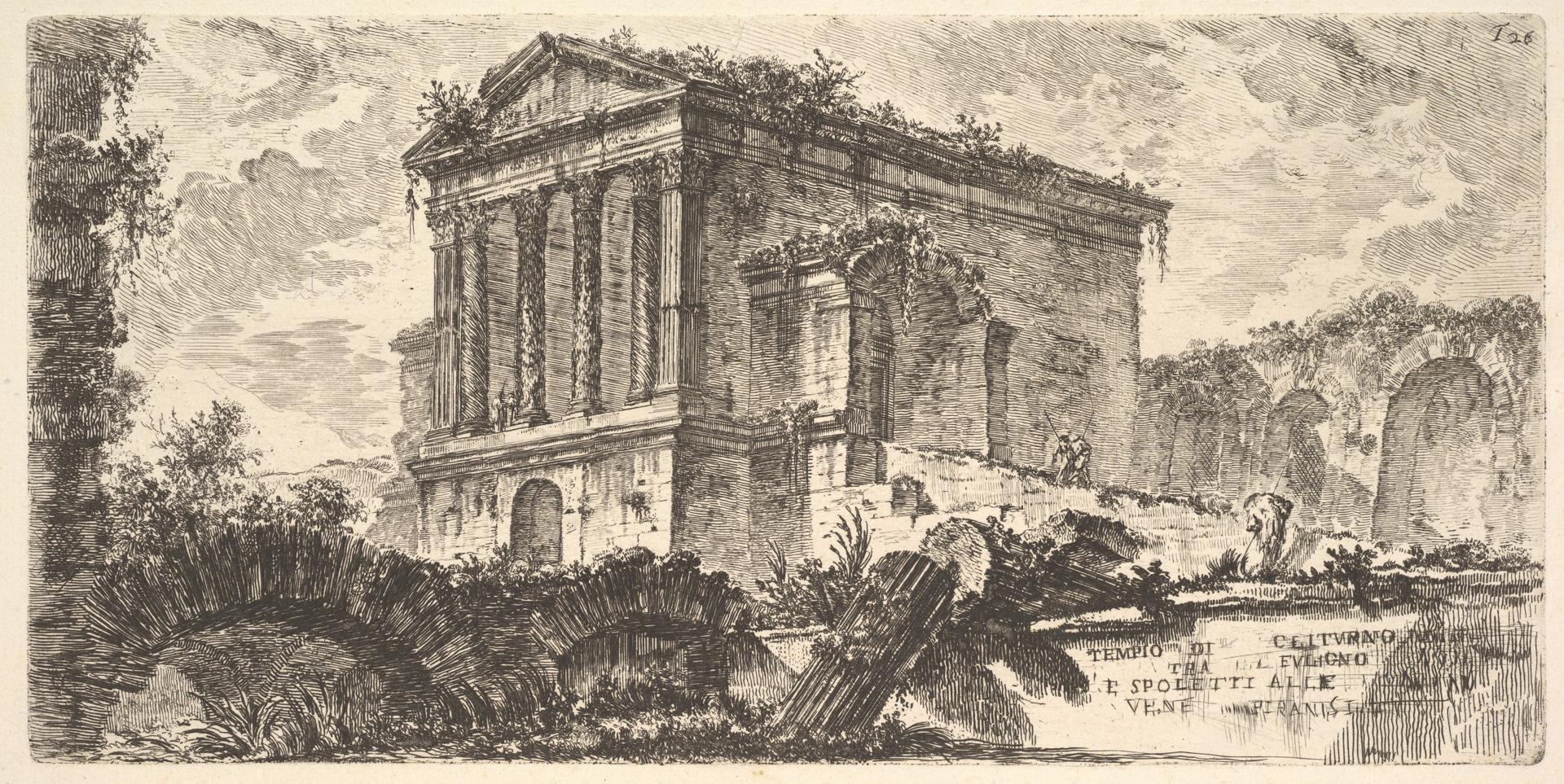
Plate 26: Temple of Clitumnus between Foligno and Spoleto... (Tempio di Clitumno tra Fuligno e Spoletti...), from "Alcune Vedute di Archi Trionfali ed altri monumenti inalzati da Romani parte di quali se veggono in Roma e parte per l'Italia"
Original title: Plate 26: Temple of Clitumnus between Foligno and Spoleto... (Tempio di Clitumno tra Fuligno e Spoletti...), from "Alcune Vedute di Archi Trionfali ed altri monumenti inalzati da Romani parte di quali se veggono in Roma e parte per l'Italia" (Some Views of Triumphal Arches and other monuments erected by the Romans, some of which are in Rome and some elsewhere in Italy)
kurzbeschreibung
Around 1748, Giovanni Battista Piranesi etched the Temple of Clitumnus in Umbria. The print belongs to the series 'Alcune Vedute di Archi Trionfali ed altri monumenti' and measures 13.3 × 27 cm (plate). It presents an architectural view with Ionic columns and partially overgrown vegetation.
Description
A classical Roman building with Ionic columns and a crowning architrave dominates the centre. Vines and shrubs have spread over the masonry, a sign of decay. Behind it, further ancient remains and a landscape of trees and bushes can be made out. The symmetrical arrangement draws the eye to the main structure, which is bathed in diffuse light and thus appears muted. The etching is in black and white, with carefully placed lines and hatching.
Context
The etching was created as part of a series in which Piranesi recorded Roman triumphal arches and other ancient monuments. In the 1740s the artist lived in Rome and devoted himself intensively to Roman architecture. The Temple of Clitumnus was a well-known ancient building in Umbria, visited by travellers on the route between Foligno and Spoleto. With the publication of the series, Piranesi helped spread knowledge of ancient buildings outside Rome.
Impact
Decay and dense vegetation give the print a quiet, almost wistful mood. The precise linework and balanced layout ensure documentary clarity that is also aesthetically appealing. Viewers are encouraged to reflect thoughtfully on ancient heritage.
Technique
For this etching, the lines were bitten into a copper plate and then printed on paper. Fine hatching and gradations of light and dark create a sculptural effect. The plate measures 13.3 × 27 cm, the sheet 32.6 × 48.2 cm.
AI-generated description text
Source: Metropolitan Museum of Art · Public Domain (CC0 1.0)