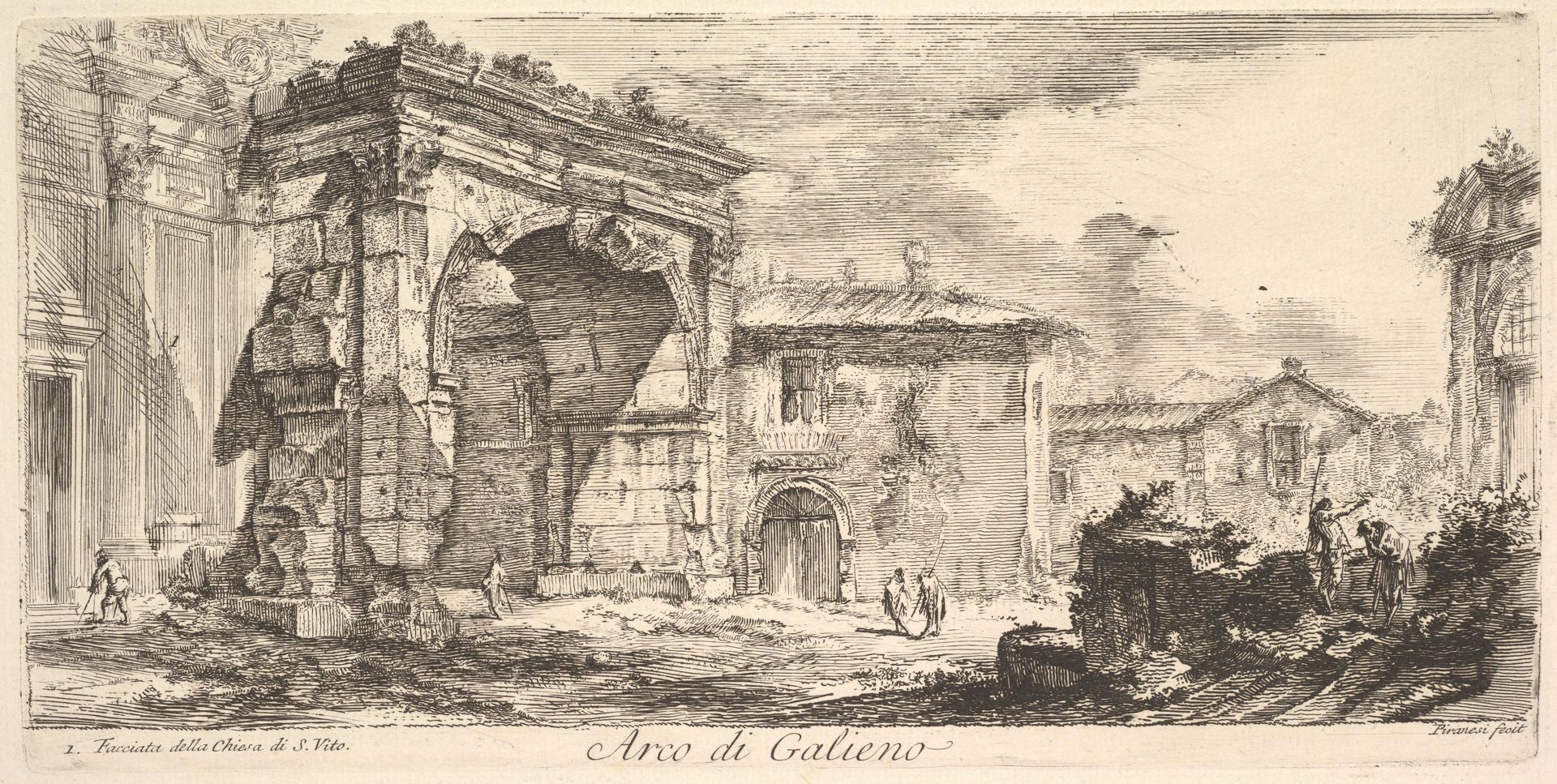
Arch of Galienus. 1. Façade of the Church of S. Vito (Arco di Galieno. 1. Facciata della Chiesa di S. Vito), from "Alcune Vedute di Archi Trionfali ed altri monumenti inalzati da Romani parte di quali se veggono in Roma e parte per l'Italia"
Original title: Arch of Galienus. 1. Façade od the Church of S. Vito (Arco di Galieno. 1. Facciata della Chiesa di S. Vito), from "Alcune Vedute di Archi Trionfali ed altri monumenti inalzati da Romani parte di quali se veggono in Roma e parte per l'Italia"
kurzbeschreibung
Giovanni Battista Piranesi etched this sheet around 1748. It shows the facade of San Vito in Rome, with the ancient Arch of Galerius in front of it. The print belongs to the series 'Alcune Vedute di Archi Trionfali ed altri monumenti', which presents Roman triumphal arches. Ancient architecture and Baroque church building meet, while passers-by enliven the scene.
Description
The triumphal arch of Galerius, with its three passageways and a single column on the right, occupies the foreground. Behind it stands the plain facade of San Vito, with a simple roof and several windows. Two figures walk along a path on the left, and more people are on their way on the right. Buildings and trees close off the background. Fine hatching and lines produce a monochrome view with even light and no strong shadows.
Context
This etching belongs to Piranesi's early series on Roman triumphal arches, published in Rome around 1748. The series recorded ancient monuments and how they were embedded in the city of the time. The Arch of Galerius, also called Arco di Galieno, dates back to the 4th century and was later incorporated into the church of San Vito. Piranesi documented this layering of antiquity and Christian architecture, characteristic of his vedute.
Impact
Even light and the delicate linear graphic give the sheet a calm, factual mood. The ancient arch and the plain church facade stand side by side, creating a tension between past and present. This invites reflection on the durability of architecture.
Technique
With fine lines and hatching, the etching brings out structures and shadows. This method allows precise details, such as the rendering of the arches and the figures. The plate measures 13.3 × 27.2 cm, the sheet 33 × 48.2 cm.
AI-generated description text
Source: Metropolitan Museum of Art · Public Domain (CC0 1.0)