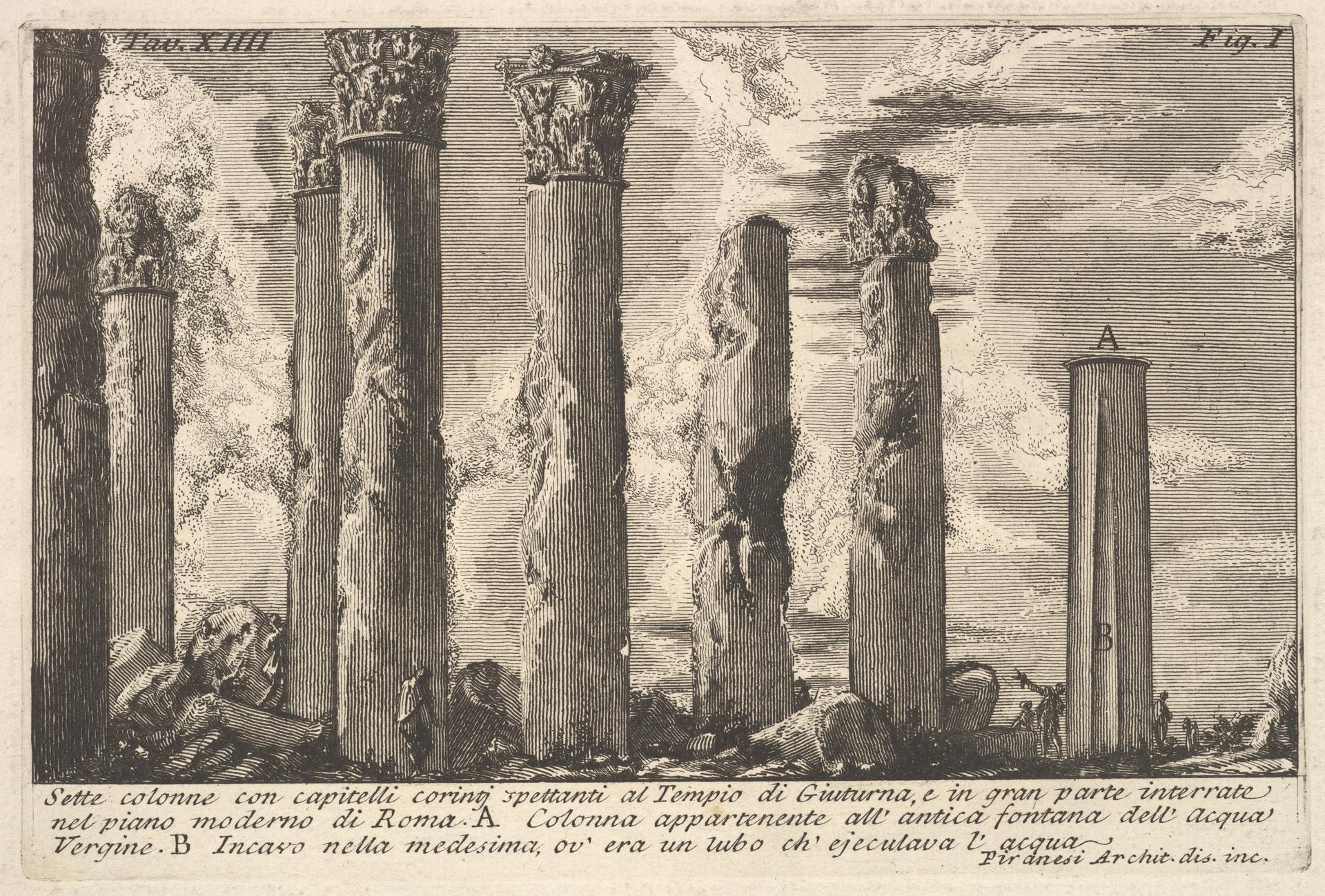
Seven columns of the Temple of Juturna with Corinthian capitals . . . (Sette colonne con capitelli corinti spettanti al Tempio di Giuturna . . .)
Original title: Seven columns of the Temple of Juturna with Corinthian capitals . . . (Sette colonne con capitelli corinti spettanti al Tempio di Giuturna . . .)
kurzbeschreibung
Seven Corinthian columns of the Temple of Juturna in Rome were etched by Giovanni Battista Piranesi in the 18th century. What begins as an architectural study bears clear traces of a ruin landscape: weathered stone architecture, worked into the plate with meticulous detail.
Description
Some of the seven Corinthian columns still stand upright, while others lie toppled or badly damaged on the ground. Trees rise behind them, and a cloudy sky stretches above. Small figures in the foreground indicate scale. The capitals and bases of the columns are clearly discernible. A block of text at the lower margin gives information about the columns and the temple. Fine hatching and graduated contrasts between the columns and the background create the effect of light.
Context
The etching was made in the 18th century, during a period of intensive archaeological documentation of Roman antiquities. The Temple of Juturna, a Roman cult site, belonged to the Forum Romanum. Piranesi was known for his precise architectural views, which he often combined with a romantic fondness for ruins. This sheet belongs to a series on ancient Roman buildings.
Impact
Calm and a faint touch of melancholy emanate from the print, as was customary for 18th-century ruin depictions. The accurate rendering of the columns and the high-contrast sky yield an objective aesthetic that is by no means dry.
Technique
The sheet was made as an etching, an intaglio process: the drawing is scratched into a wax layer on a copper plate and then etched. This allows light and shadow to be reproduced precisely with fine lines and hatching. The print is on paper, measuring 10 3/16 × 15 13/16 inches (25.9 × 40.2 cm).
AI-generated description text
Source: Metropolitan Museum of Art · Public Domain (CC0 1.0)