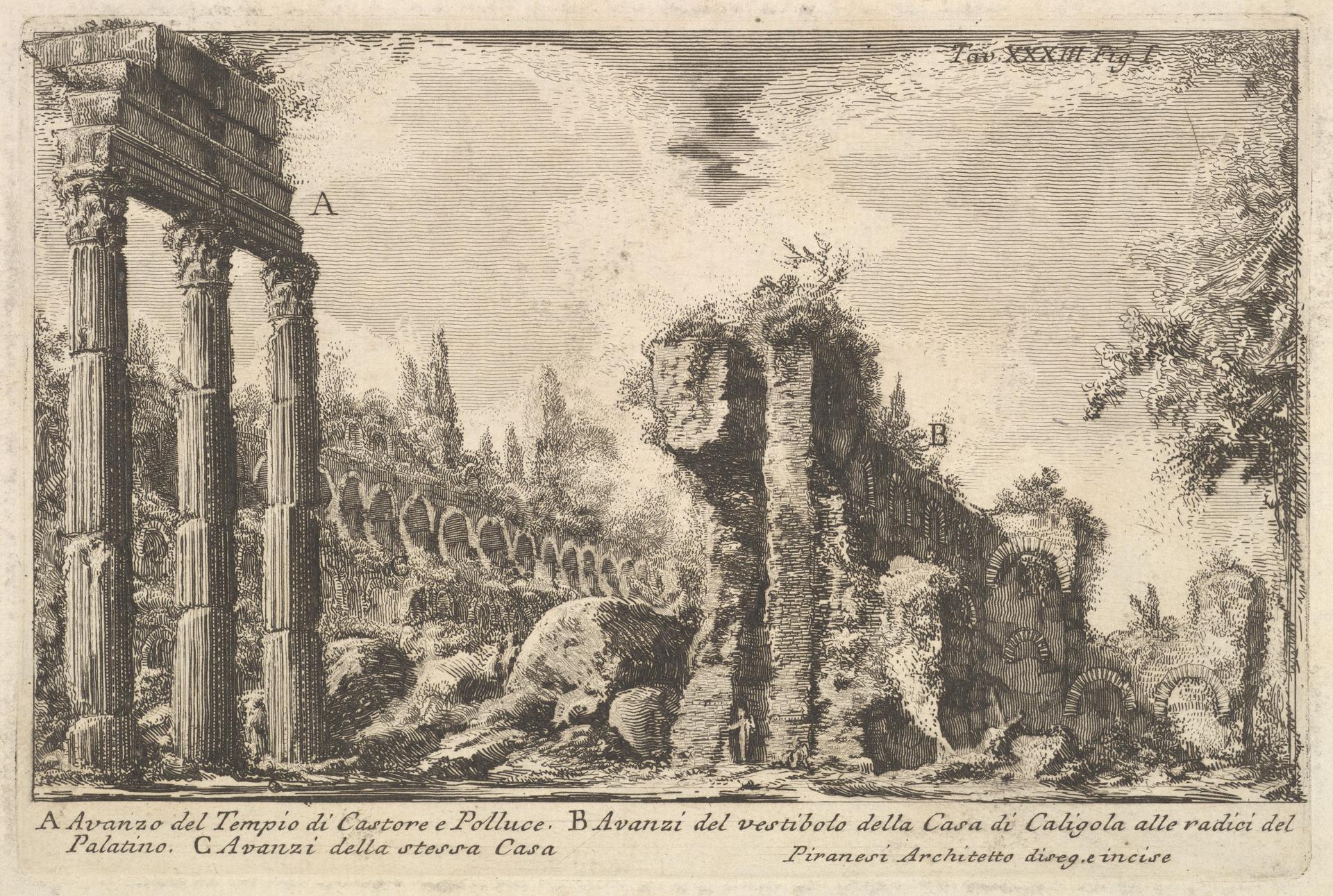
Remains of the Temple of Castor and Pollux . . . ( Avanzo del Tempio di Castore e Polluce . . .)
Original title: Remains of the Temple of Castor and Pollux . . . ( Avanzo del Tempio di Castore e Polluce . . .)
kurzbeschreibung
In the 18th century, Giovanni Battista Piranesi etched the remains of the Temple of Castor and Pollux. The print shows the still-standing columns and fragments of wall, overgrown with plants. Behind them stretches a ruined aqueduct.
Description
The viewer's gaze is first drawn to the ruins in the foreground, which spread out horizontally. The aqueduct with its arches is staggered in the background. Bushes and trees frame the ancient structures and embed them in a natural setting. Rendered in black and white, the sheet uses varied hatching to bring out the surfaces and details of the stone. The organic vegetation stands in tension with the strict architecture.
Context
The etching was made in the 18th century and belongs to Piranesi's vedute, with which he recorded Roman antiquities. The artist was known for his precise depictions of ancient buildings, which often emphasized romantic decay. Within a series, he documented the remains of Roman architecture to highlight their historical value.
Impact
Melancholy and transience define the mood of the sheet. The contrast between precise architectural drawing and rampant vegetation creates a romantic aesthetic that carries the viewer back to past times. Decay is experienced not as an end but as a transition into nature.
Technique
The etching was printed on paper; the plate measures 13.2 × 19.5 cm, the sheet 20.3 × 29.7 cm. The etching process allowed for fine lines and shading that reproduce the texture of the ruins and plants. The monochrome execution underlines the graphic quality of the line drawing.
AI-generated description text
Source: Metropolitan Museum of Art · Public Domain (CC0 1.0)