Remains of the Temple of Cybele (Avanzi del Tempio di Cibele)
Original title: Remains of the Temple of Cybele (Avanzi del Tempio di Cibele)
kurzbeschreibung
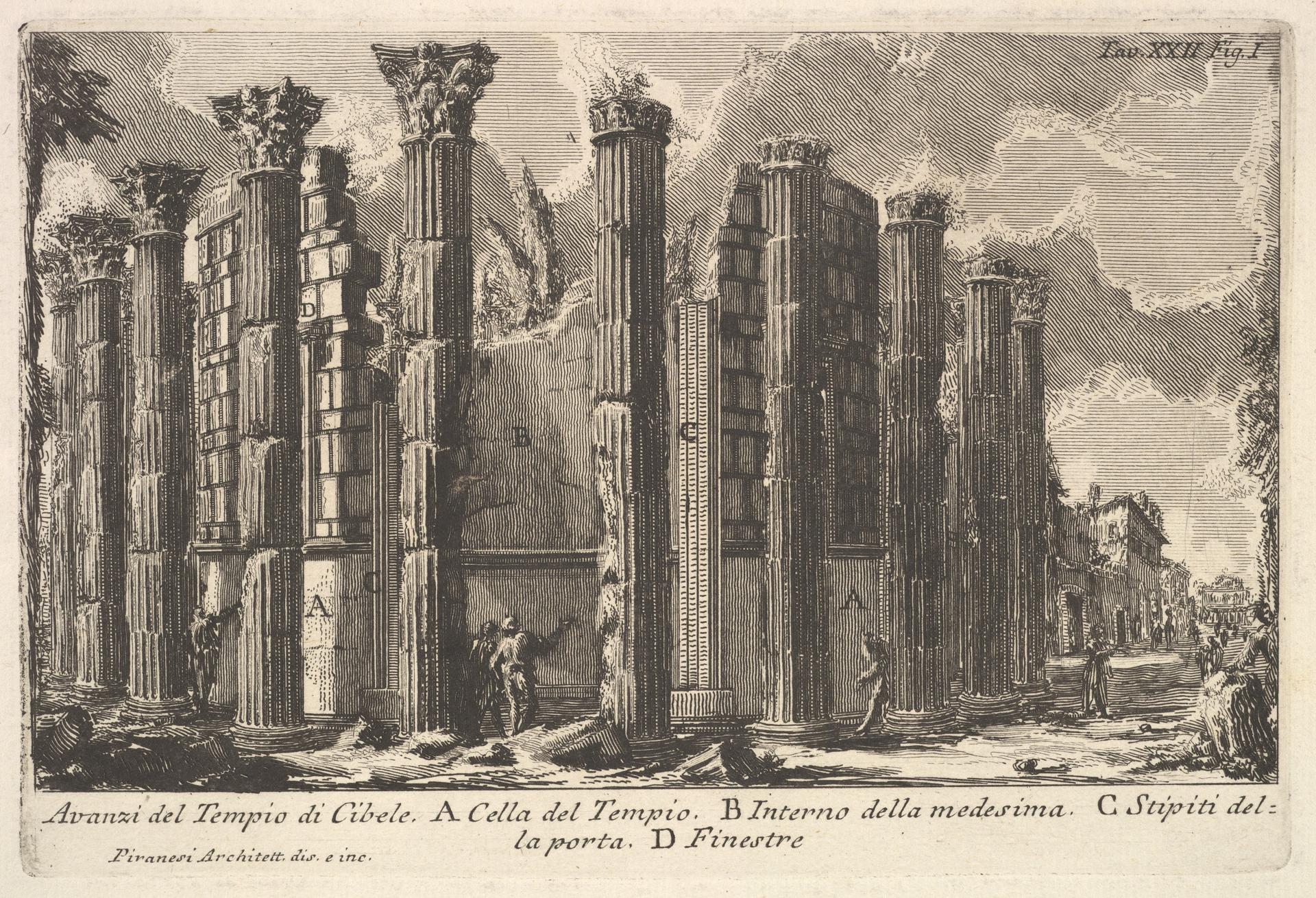
Giovanni Battista Piranesi's etching "Überreste des Tempels der Cybele" dates from the 18th century. It presents the ruins of an ancient temple with partly collapsed Corinthian columns, along with figures who have come to look at them. The plate is worked as a fine etching in monochrome.
Description
Several Corinthian columns dominate the foreground, some broken and reduced to scattered fragments. The capitals are elaborately worked; a few shafts still stand whole while others are badly damaged. People move among the ruins and observe the scene. Beyond them a road with trees and city buildings can be made out. Light falls from above, picking out the structure of the columns and the detail of the capitals.
Context
The etching was made in the 18th century, at a time when European interest in antiquity and its ruins was growing. Piranesi was known for his vedute and capricci depicting Roman antiquities. The exact circumstances of its making are not documented; the work belongs to his series of views of ancient buildings.
Impact
A melancholy air of decay runs through the image, reinforced by the broken columns and the sparse scattering of figures. The delicate linework and the attention given to architectural detail give it a precise yet atmospheric presence.
Technique
An etching, this print is characterised by fine lines and hatching. The support is paper, and the process allows light and shadow to be rendered in detail. The monochrome palette is typical of the technique.
AI-generated description text
Source: Metropolitan Museum of Art · Public Domain (CC0 1.0)