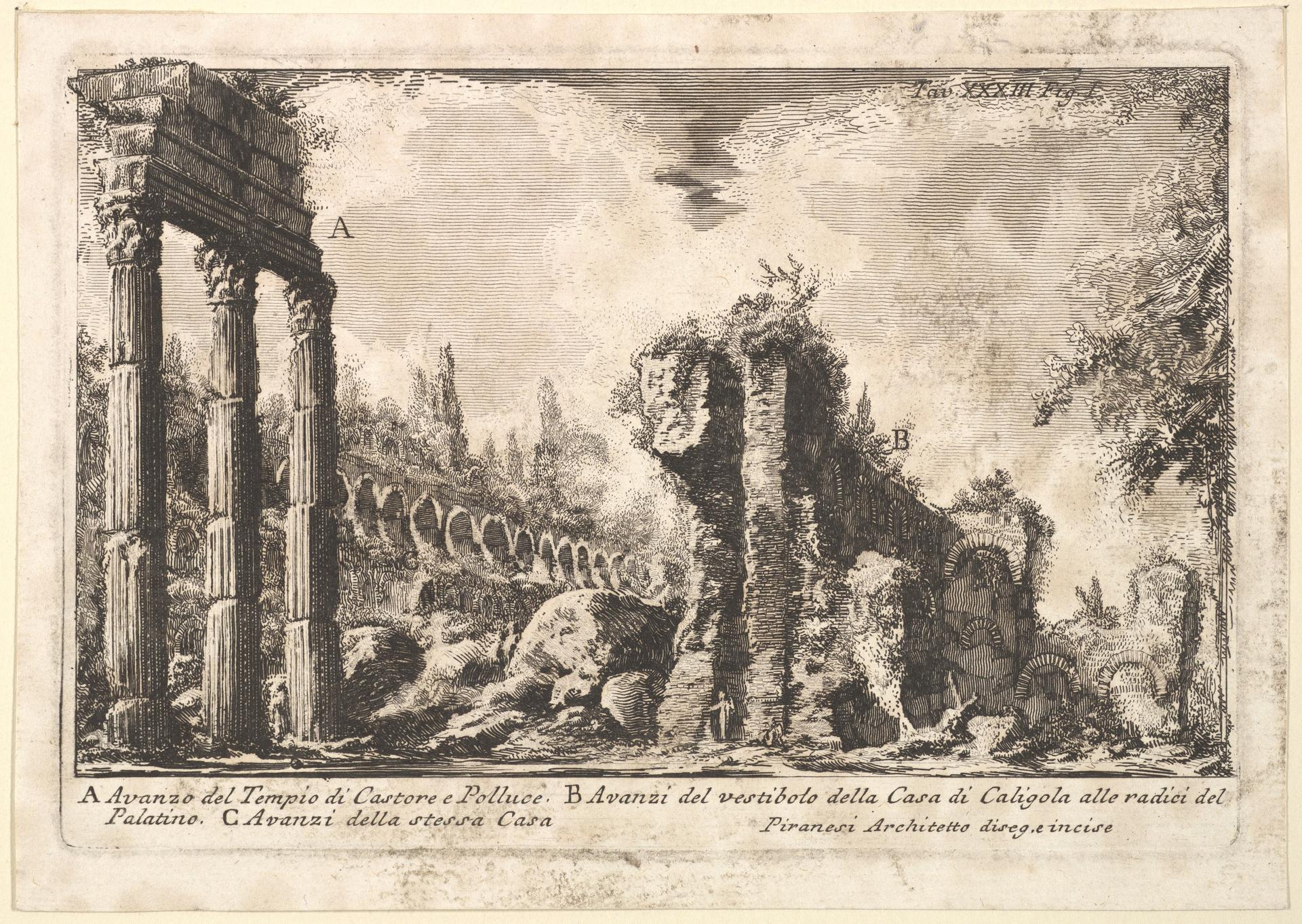
Remains of the Temple of Castor and Pollux . . . (Avanzo del Tempio di Castore e Polluce . . .)
Original title: Remains of the Temple of Castor and Pollux . . . (Avanzo del Tempio di Castore e Polluce . . .)
kurzbeschreibung
The remains of the Temple of Castor and Pollux on the Palatine in Rome appear in an eighteenth-century etching by Giovanni Battista Piranesi. Beside the ancient column stumps stands the vestibule of the Casa di Caligola, both set within a landscape of trees. The sheet belongs to the series of architectural vedute with which Piranesi recorded the antiquities of Rome.
Description
The ruined Temple of Castor and Pollux (A) and the vestibule of the Casa di Caligola (B) dominate the foreground, with trees and shrubs spreading between them. Arches of an aqueduct run through the woodland of the distance, making the depth of the space perceptible. Black and white throughout, the sheet is held in a dense, exact linear rendering of columns and walls. The layout feels balanced; the ruins carry the nearer zone while the aqueduct structures the rear. Soft, diffuse light emerges from the fine hatching of the etching technique.
Context
The etching was made in the eighteenth century, when the antiquities of Rome were studied with great archaeological zeal. Piranesi was known for his vedute, in which he documented ancient buildings and often added reconstructive elements. The letters A and B marking the ruins in the title follow the systematic recording customary in his publications. The sheet bears witness to the contemporary interest in Rome's architectural history, further stirred by the excavations on the Palatine.
Impact
Because the monumental ruins are embedded in a natural setting, the sheet gives off a quiet, reflective mood. Precise linework and a balanced arrangement lend it a clear, sober aesthetic. From the contrast between the massive ancient remains and the lush vegetation around them grows a haunting image of transience.
Technique
The print was made as an etching: the drawing was transferred to a metal plate, which was then bitten with acid. Varying depths of etching and hatching produce the fine lines and shadows and open up a graduated range of tones. It was printed on paper; the plate dimensions of 13.3 × 19.5 cm allow a compact, richly detailed rendering.
AI-generated description text
Source: Metropolitan Museum of Art · Public Domain (CC0 1.0)