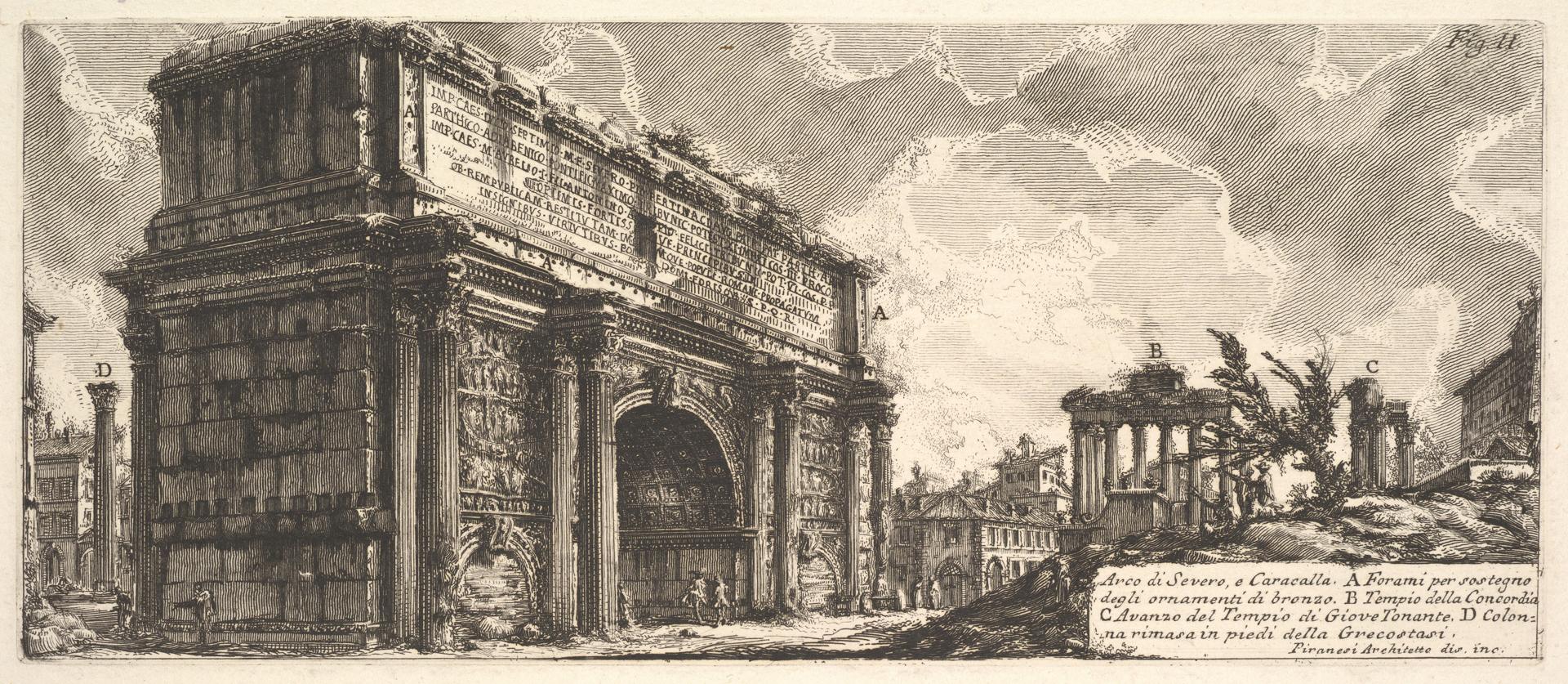
The Arch of Septimius Severus (Arco di Severo, e Caracalla)
Original title: The Arch of Septimius Severus (Arco di Severo, e Caracalla)
kurzbeschreibung
Unlike many vedute of its day, this etching from around 1756 by Giovanni Battista Piranesi places the Arch of Septimius Severus in Rome at the very centre. The sheet belongs to the series 'Vedute di Roma' and is executed as an etching. The subject is the ancient structure with its columns and inscriptions, set before the Forum Romanum.
Description
A symmetrical layout governs the print: up front, the monumental arch, with its carefully worked columns and inscription panels, takes up most of the space. Two pairs of columns frame the central passage. Further ancient ruins and columns of the Forum Romanum appear behind it. The monochrome image works with various shades of grey that arise from the ink's hatching. Light falls from above, accentuating shadows and the surface texture of the architecture. At the bottom are captions and the artist's signature.
Context
The etching was made as part of Piranesi's 'Vedute di Roma', a series of views of Roman buildings published from 1748 onwards. With this series he sought to capture the grandeur of ancient architecture and bring it to a wide audience. The Arch of Septimius Severus, erected in 203 AD, is among the best-preserved monuments of the Forum Romanum. Piranesi had lived in Rome since 1740 and devoted himself to the close study of ancient ruins.
Impact
A solemn monumentality emanates from this etching, carried by precise linework and a clear articulation of the architecture. The handling of light creates a dramatic sense of depth and gives the structure plasticity. The image inspires admiration for ancient engineering and invites close attention to its details.
Technique
This work is an etching: the lines were bitten into a copper plate with acid. Piranesi used fine and bold hatching to model light and shadow. The printing plate measures 11.5 × 27.2 cm, the sheet 18.8 × 32.9 cm; this suggests a fine impression on laid paper.
AI-generated description text
Source: Metropolitan Museum of Art · Public Domain (CC0 1.0)