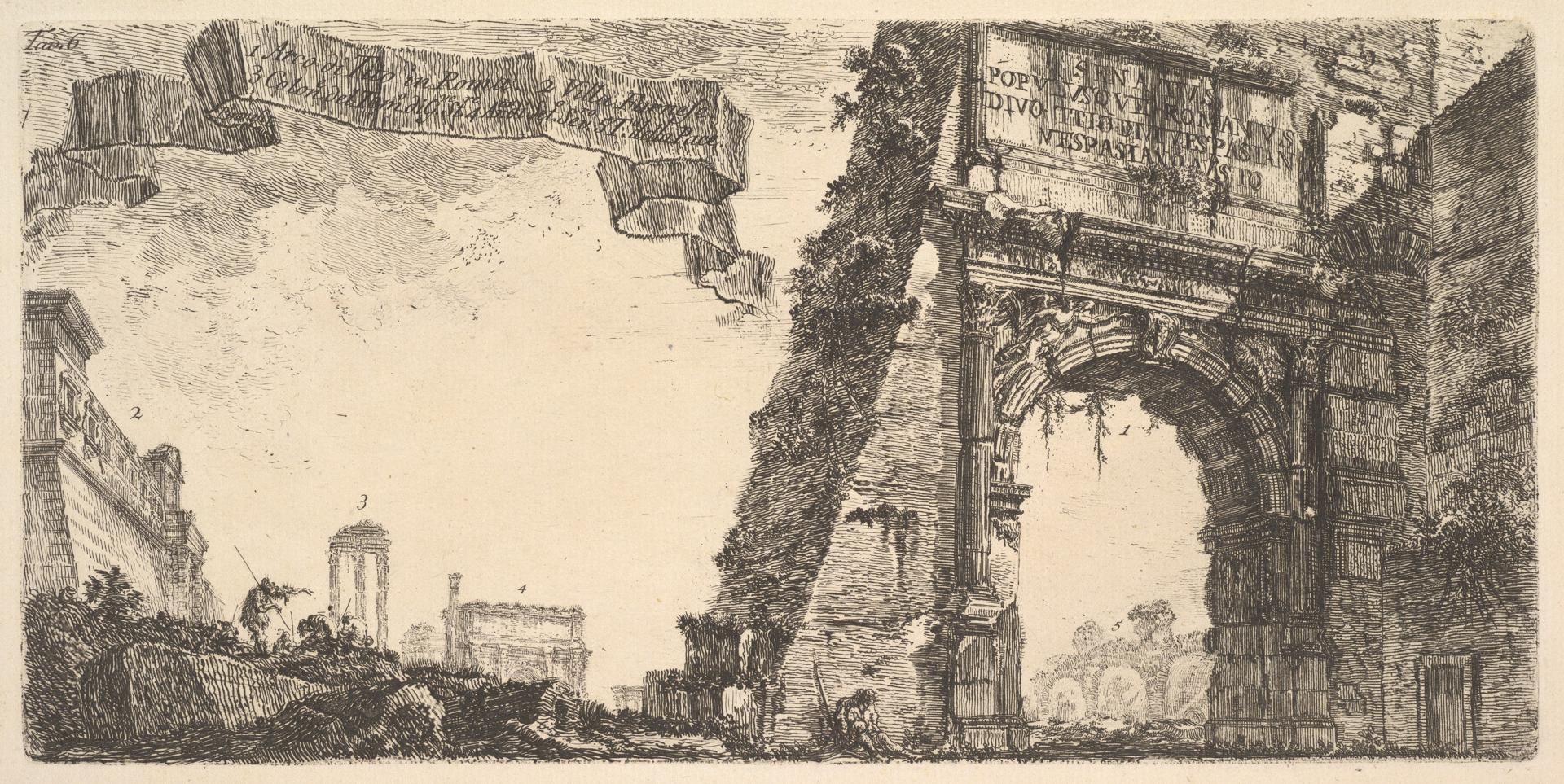
Plate 6: 1. Arch of Titus. 2. Villa Farnese. 3. Columns of the Temple of Jupiter Stator (the Supporter). 4. Arch of Septimus Severus. 5. Temple of Peace.
Original title: Plate 6: 1. Arch of Titus. 2. Villa Farnese. 3. Columns of the Temple of Jupiter Stator (the Supporter). 4. Arch of Septimus Severus. 5. Temple of Peace. (1. Arco di Tito in Roma. 2. Villa Farnese. 2. Colon.e. del Tem.o di G.ve St.re. 4. Ar.co di Set.o...), from "Antichità Romane de' Tempi della Repubblica, e de' primi Imperatori"
kurzbeschreibung
Giovanni Battista Piranesi made this etching around 1748 as part of his series 'Antichità Romane de' Tempi della Repubblica, e de' primi Imperatori'. The sheet gathers several ancient Roman buildings in a landscape format. The Arch of Titus stands at the right foreground, while other ruins are arranged to the left and in the background. The work was executed as an etching.
Description
At the right foreground rises the Arch of Titus, with its inscriptions and typical arched architecture. To its left appear parts of the Villa Farnese and the columns of the Temple of Jupiter Stator. Farther back, the Arch of Septimius Severus and remains of the Temple of Peace close the view. The layout is broad, with the Arch of Titus dominating the right side and the other buildings stepping back to the left. Black-and-white hatching and cross-hatching bring out the surfaces and structures of the architecture.
Context
The etching belongs to Piranesi's series on the antiquities of Rome, published between 1748 and 1750. At that time many of the depicted buildings survived as ruins or were just being rediscovered. With the series Piranesi aimed to demonstrate the monumentality of Roman architecture and to record archaeological details. He combined scholarly accuracy with artistic drama.
Impact
The print reads like a learned display plate that makes architectural history vivid. The factual rendering of the buildings and the calm, precise linework convey the impression of a documentary record. The sequential arrangement of the ruins creates spatial depth that transports the viewer back to antiquity.
Technique
For the etching, the drawing was incised into a copper plate and bitten with acid. Fine lines and hatching produce graduated gray tones and shadows that accurately reproduce the architectural details. The plate measures about 12.9 × 26.3 cm, while the sheet format is larger at 32.3 × 48.1 cm, as was usual for prints of this period.
AI-generated description text
Source: Metropolitan Museum of Art · Public Domain (CC0 1.0)