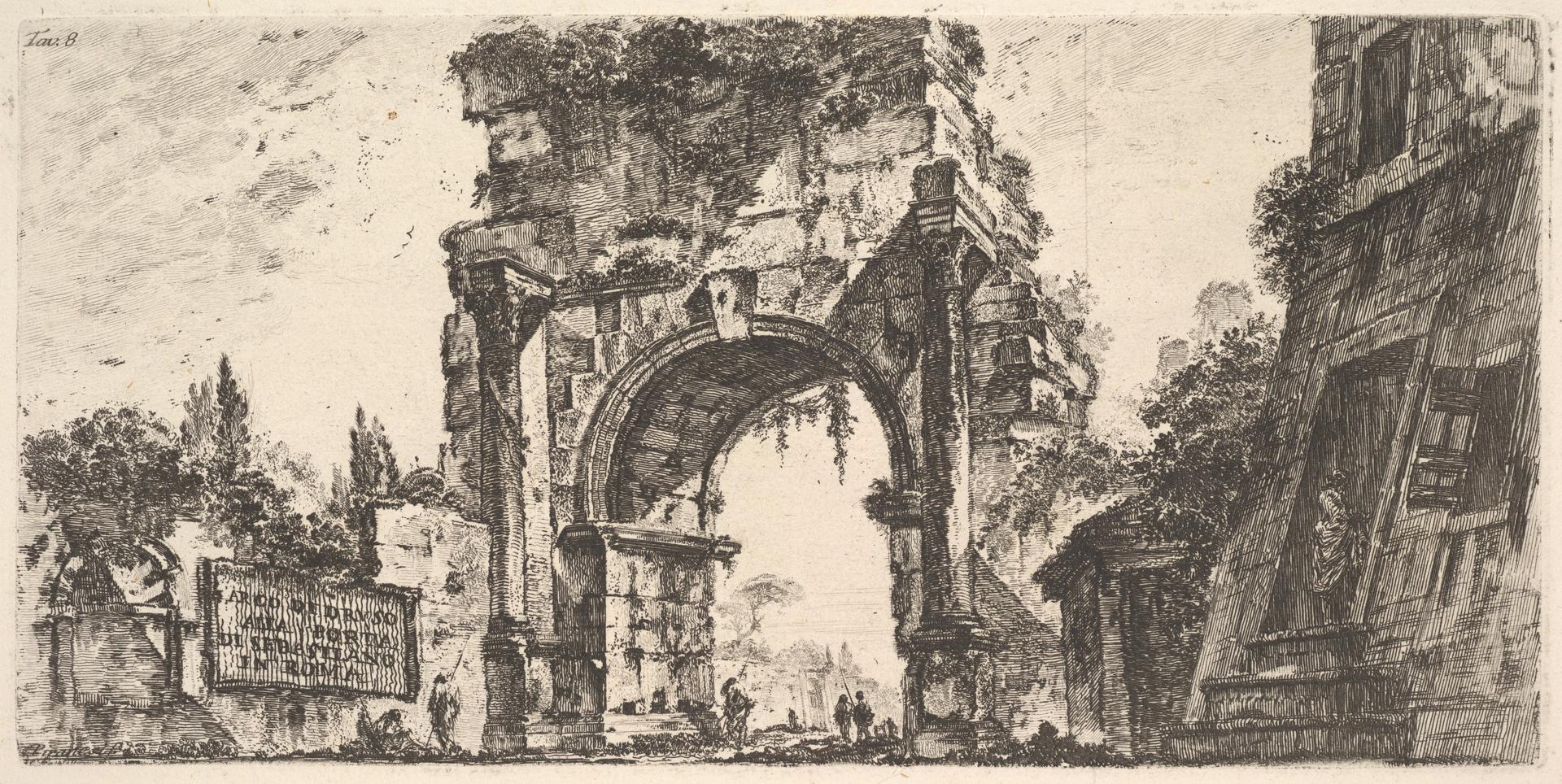
Plate 8: Arch of Drusus at the Porta S. Sebastiano in Rome (Arco di Druso alla Porta di Sebastiano in Roma), from "Antichità Romane de' Tempi della Repubblica, e de' primi Imperatori"
Original title: Plate 8: Arch of Drusus at the Porta S. Sebastiano in Rome (Arco di Druso alla Porta di Sebastiano in Roma), from "Antichità Romane de' Tempi della Repubblica, e de' primi Imperatori"
kurzbeschreibung
Around 1748, Giovanni Battista Piranesi etched the ancient Arch of Drusus at the Porta San Sebastiano in Rome. The print belongs to the series 'Antichità Romane de' Tempi della Repubblica, e de' primi Imperatori' and was made as an etching.
Description
A monumental triumphal arch with hefty columns and capitals dominates the sheet. Vegetation has spread over the structure, a sign of its decay. A sign along the left edge reads 'ARCH OF DRUSUS / PORTA S. SEBASTIANO / ROME'. Behind it, buildings and trees come into view, hinting at the urban surroundings. A few figures at the left edge suggest passers-by or visitors.
Context
The etching was created as part of Piranesi's series on Roman antiquities, published between 1748 and 1750 and dealing with buildings from the Republic and the early imperial period. Originally the Arch of Drusus was part of the Aurelian Wall and was later connected to the Porta San Sebastiano. Piranesi recorded the structure as it appeared to him: ruined and overgrown.
Impact
Architectural precision meets a mood of decay. Diffuse light falls across the stone and brings out its texture, lending the old building a certain dignity. The symmetrical layout draws the eye to the monument in the middle and emphasizes its historical weight.
Technique
For this etching, the lines were incised into a copper plate, which was then bitten by acid. The black-and-white execution allows a precise rendering of stone surfaces and architectural details. The plate measures 13.2 × 26.9 cm, printed on a sheet of 33.2 × 47.7 cm.
AI-generated description text
Source: Metropolitan Museum of Art · Public Domain (CC0 1.0)