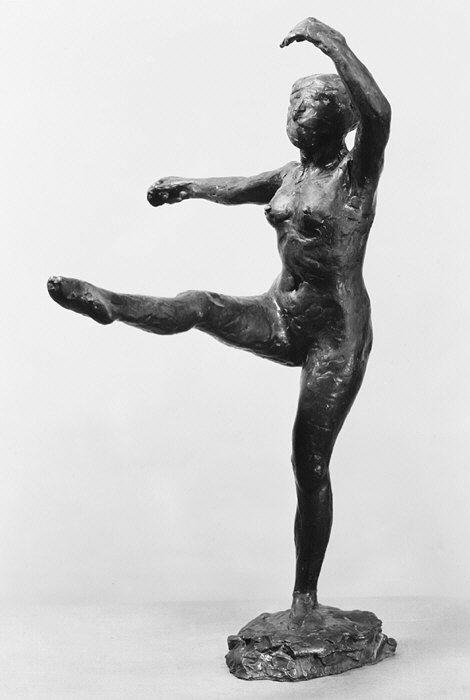
Arabesque Devant (modeled probably before 1890, cast 1920, Met-Objekt 404)
Original title: Arabesque Devant
kurzbeschreibung
Edgar Degas's bronze statue 'Arabesque Devant' was modeled in wax probably before 1890 and cast in bronze in 1920. It shows a nude dancer in a wide arabesque. The work belongs to Degas's intense engagement with ballet and captures the fleeting nature of dance movement in durable metal.
Description
A nude dancer stands on an irregular, rough base. Her left leg is raised high and slightly bent, her right arm extended upward with the back of the hand facing up. The right arm is gently curved, giving the pose a natural ease. The figure has a slender, toned body and is shown without clothing. A plain, neutral background makes the dancer stand out clearly.
Context
Degas made numerous sculptures of dancers, many of which were only cast in bronze after his death. This model too was likely created before 1890; the cast was made in 1920, after the artist's death. The painter and sculptor devoted himself with great persistence to ballet, in paintings as well as sculptures. The arabesque is one of the classic positions of dance and appears several times in his oeuvre.
Impact
The bronze radiates a distinct tension: the moment of movement seems arrested. The slender, muscular body and the precisely formed pose create an interplay of grace and strength. Because the surrounding space remains neutral, all attention is directed to the dancer and her expressive posture.
Technique
The work was cast in bronze, the material Degas intended for translating his wax models. The surface appears even and without noticeable texture, indicating a smooth cast. The irregular, rough base contrasts with this and highlights the figure's smooth appearance.
AI-generated description text
Source: Metropolitan Museum of Art · Public Domain (CC0 1.0)