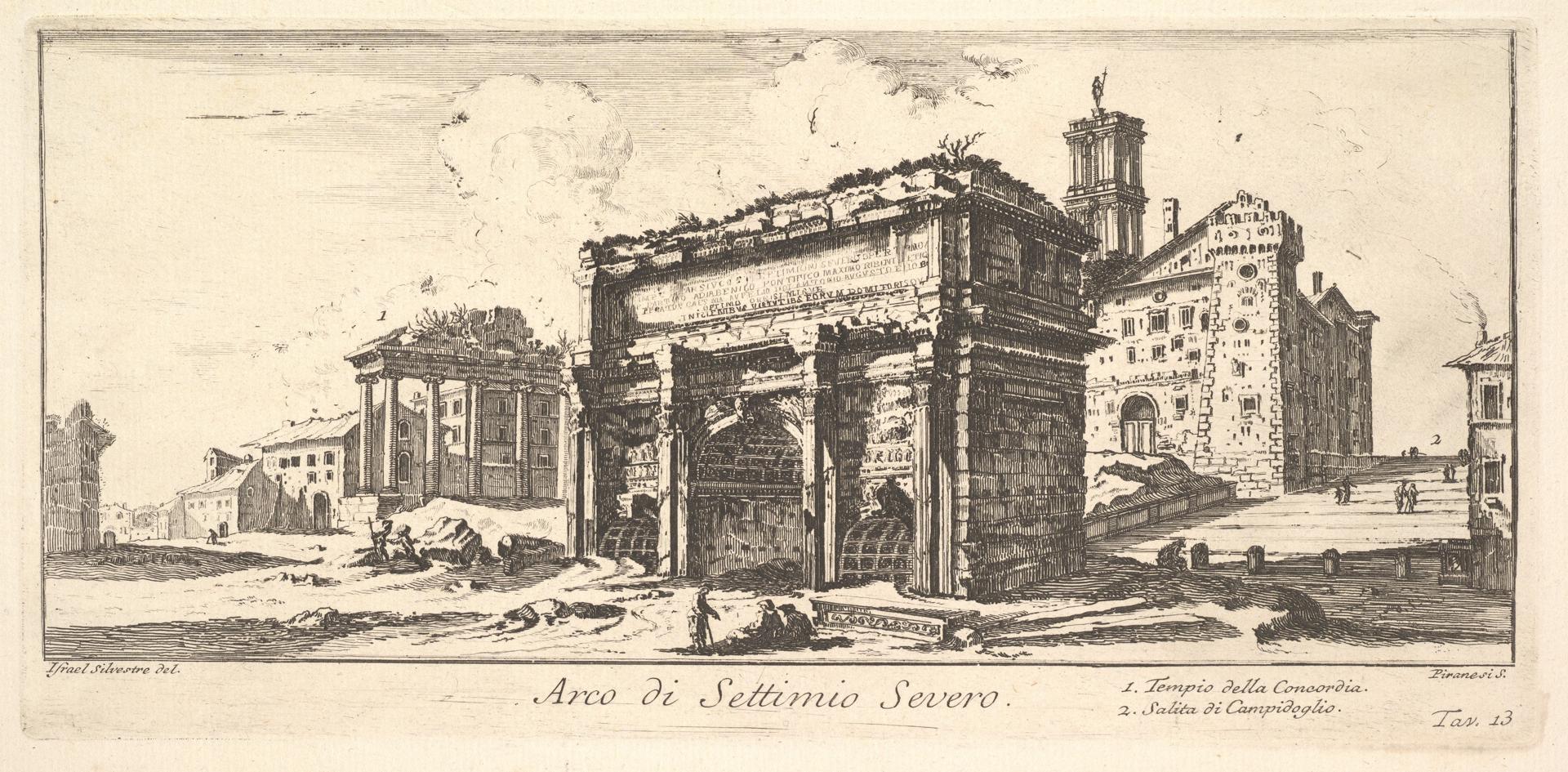
Plate 13: Arch of Settimius Severus 1. Temple of Concord. 2. Ascent to the Capitoline Hill (Arco di Settimio Severo. 1. Tempio della Concordia. 2. Salita di Campidoglio.), from "Antichità Romane de' Tempi della Repubblica, e de' primi Imperatori"
Original title: Plate 13: Arch of Settimius Severus 1. Temple of Concord. 2. Ascent to the Capitoline Hill (Arco di Settimio Severo. 1. Tempio della Concordia. 2. Salita di Campidoglio.), from "Antichità Romane de' Tempi della Repubblica, e de' primi Imperatori"
kurzbeschreibung
Giovanni Battista Piranesi etched the Arch of Septimius Severus, the Temple of Concordia, and the ascent to the Capitoline around 1748. The print belongs to the series Antichità Romane de' Tempi della Repubblica, e de' primi Imperatori and is executed as an etching.
Description
Four columns support the Arch of Septimius Severus, which dominates the foreground. To the left, the columns of the Temple of Concordia appear, while on the right a broad staircase leads up to the Capitoline. Behind, further buildings and ruins are suggested, including a columned temple and a tower. The rendering stays in even black and white without strong shadows, as is typical of an etching. The layout is symmetrical and places the arch at the center.
Context
Piranesi made this etching as part of a series documenting Roman antiquities from the Republican and early Imperial periods. He created it during a phase of intensive archaeological exploration of Rome, in which he played a major role. His views were meant to preserve the grandeur of ancient architecture and to convey it to a wide audience. The series had a lasting influence on the European perception of Roman antiquity.
Impact
Precise lines and a clear, almost documentary rendering of the buildings distinguish the print. The symmetrical arrangement gives it a calm, monumental presence that emphasizes the sublimity of the ancient ruins. Viewing it invites close attention to the architectural details.
Technique
In etching, the drawing is incised into a copper plate and bitten with acid. The lines are fine and detailed, allowing high precision in the rendering of architecture. An even tonality results from the uniform printing of the plate, without strong contrasts.
AI-generated description text
Source: Metropolitan Museum of Art · Public Domain (CC0 1.0)