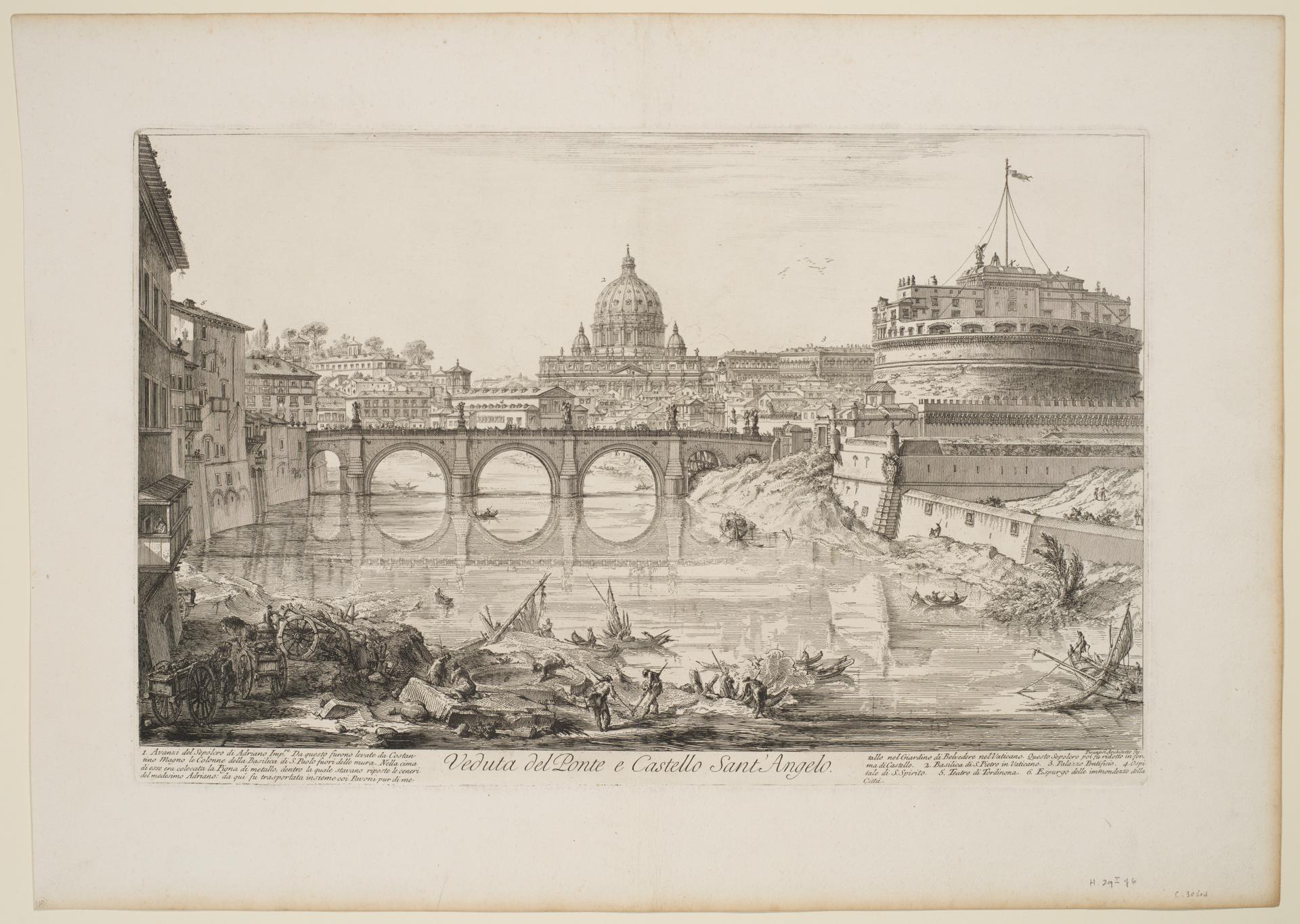
The Bridge and Castel S. Angelo (Veduta del Ponte e Castello Sant'Angelo)
Original title: The Bridge and Castel S. Angelo (Veduta del Ponte e Castello Sant'Angelo
kurzbeschreibung
Unlike many purely architectural views of Rome, this etching by Giovanni Battista Piranesi from around 1754 combines the Ponte Sant'Angelo with the Castello Sant'Angelo into a lively urban scene. It belongs to a series of etchings in which Piranesi recorded both ancient and contemporary buildings of the city.
Description
On the right, the massive Castel Sant'Angelo rises, while the multi-arched Ponte Sant'Angelo spans the river in the foreground. Behind the complex, the dome of St. Peter's Basilica outlines the Roman skyline. Figures lounge and stand on the bank, and more people populate the river and the bridge. An even, bright light bathes the entire view, characteristic of Piranesi's factual vedute.
Context
The etching was made during Piranesi's early years in Rome, when he focused entirely on depicting ancient and Baroque architecture. It is situated in the context of his well-known collection 'Vedute di Roma', which he began publishing in the 1740s. Castel Sant'Angelo, once the mausoleum of Emperor Hadrian, served as a papal fortress in the 18th century and was considered one of the city's most distinctive landmarks.
Impact
Documentary precision and a calm, balanced layout combine here to draw the viewer directly into the atmosphere of the city. The even lighting and clear linework give the print a factual, almost architectural aesthetic typical of Piranesi's vedute.
Technique
For this etching, the drawing was incised into a copper plate and then bitten with acid. Through varied hatching and finely graded lines, architectural details and figure scenes could be rendered precisely. Printing was done in black on paper, which accounts for the monochrome effect of the print.
AI-generated description text
Source: Metropolitan Museum of Art · Public Domain (CC0 1.0)