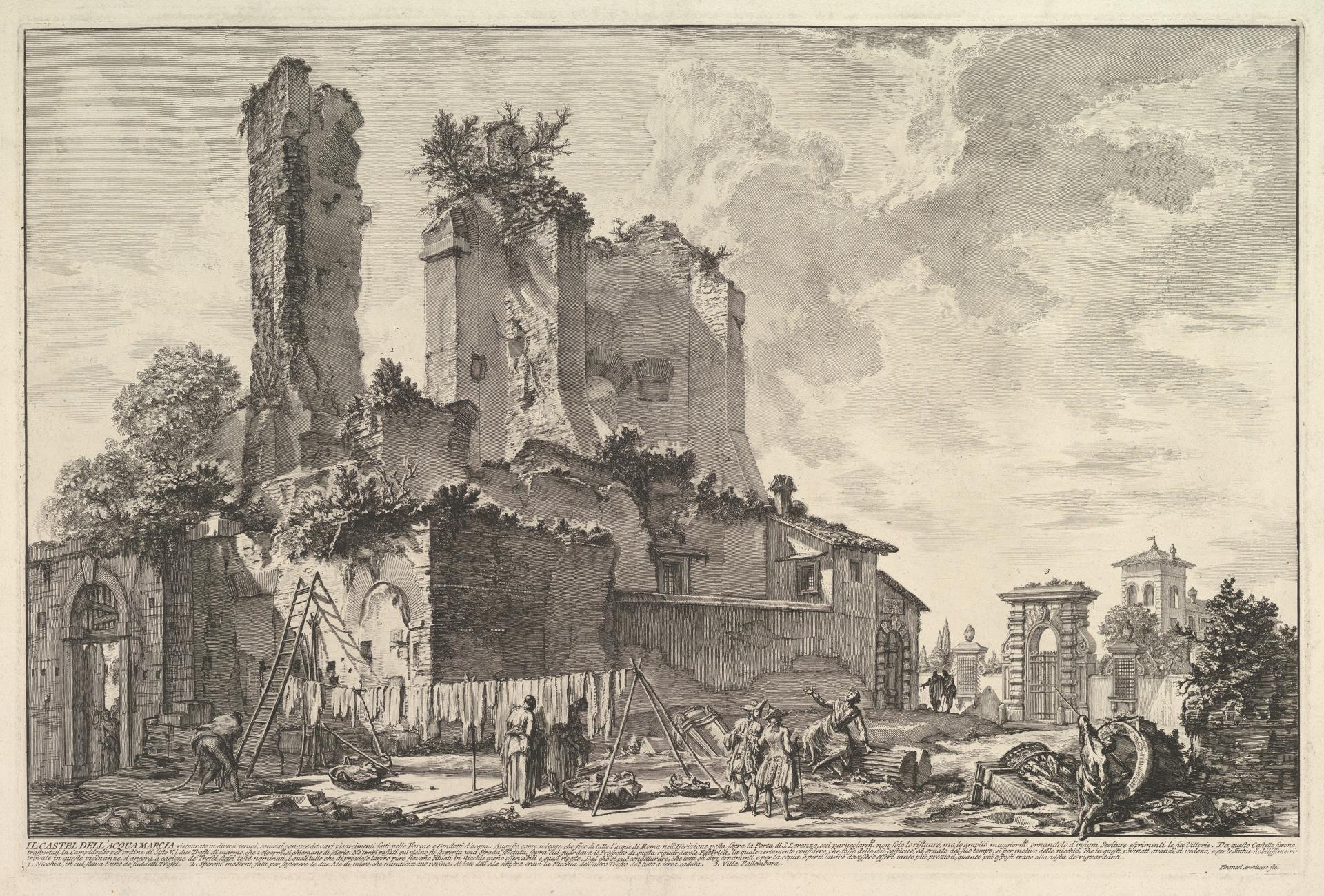
The Fontana dell'Aqua Giulia (Vedute dell'avanzo del Castello dell'Aqua Giulia)
Original title: The Fontana dell'Aqua Giulia (Vedute dell avanzo del Castello del'Aqua Giulia)
kurzbeschreibung
Giovanni Battista Piranesi made this etching around 1753, and it sets before the viewer the remains of the Castello dell'Acqua Giulia in Rome. Crumbling fragments of the ancient waterworks meet the everyday life of people and animals in the eighteenth century in this image.
Description
Ruined walls and towers, overgrown with plants, dominate the foreground and form the heart of the picture's arrangement. Near the ruins several figures and donkeys can be made out, while a sedan chair and other objects hint at building work. Behind them further buildings and trees come into view; a cloudy sky lends the mood a sombre note. The symmetrical layout draws the eye to the ruins, rendered in the delicate greys of an etching.
Context
The sheet belongs to Piranesi's series of vedute, with which he recorded Roman antiquities and the views of his own day. The Castello dell'Acqua Giulia was a defensive structure from the age of the aqueducts and was regarded in the eighteenth century as a picturesque ruin. Here Piranesi joined archaeological interest with a romantic sense of the transience of buildings.
Impact
A melancholy atmosphere emanates from the etching, heightened by the cloudy light and the overgrown ruins. Because people and animals are included, the scene gains a lively everyday quality; the contrast between ancient grandeur and present decay thus stands out clearly.
Technique
The etching rests on a drawing scratched through a wax layer on the copper plate, which is then bitten with acid. Fine lines and precise shading bring out textures and effects of light in rich detail. The greys of the printing ink determine the overall impression of the sheet.
AI-generated description text
Source: Metropolitan Museum of Art · Public Domain (CC0 1.0)