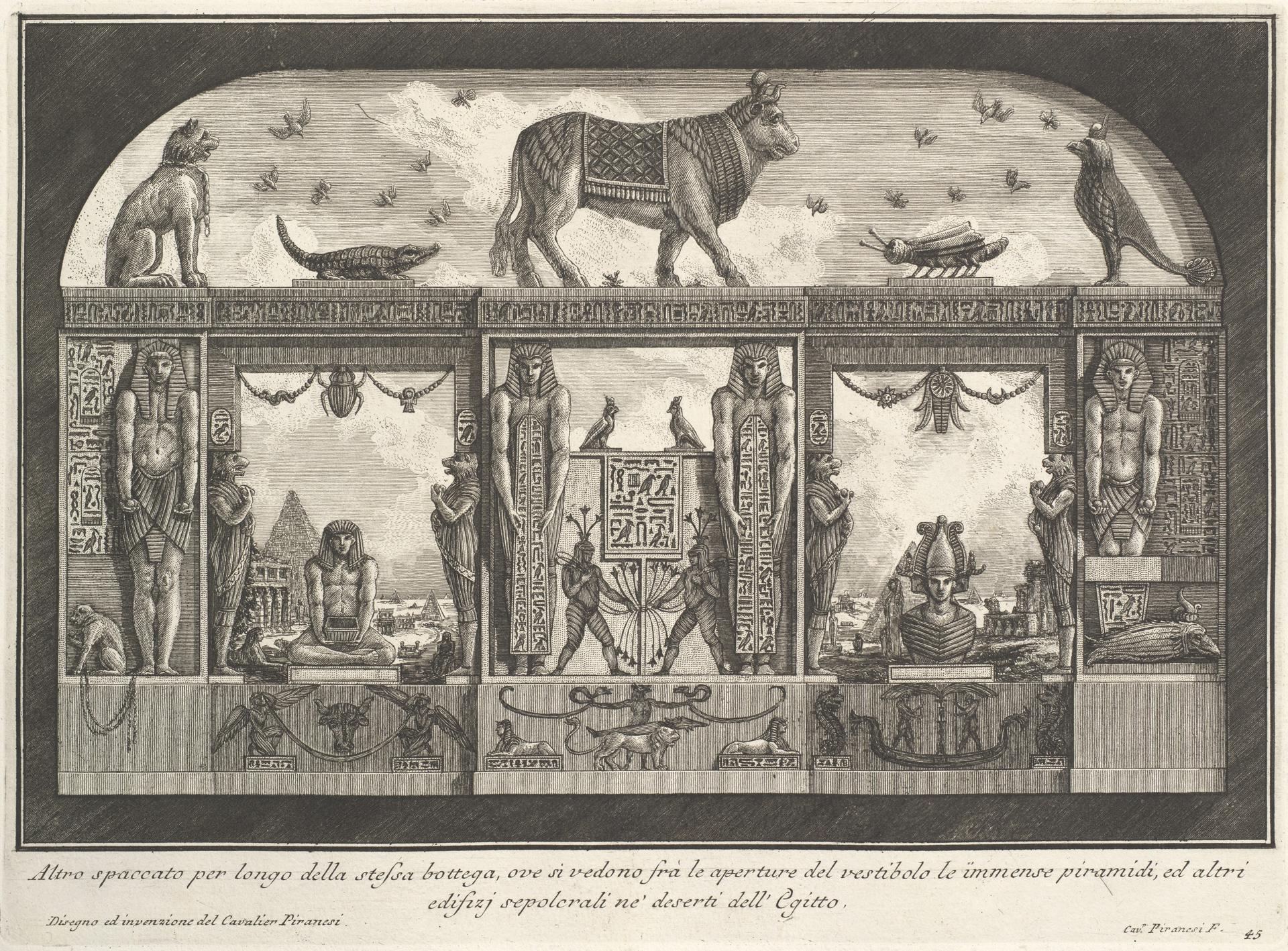
Diverse Maniere d'adornare i cammini ed ogni altra parte degli edifizi desunte dall'architettura Egizia, Etrusca, e Greca con un Ragionamento Apologetico in defesa dell'Architettura Egizia, e Toscana, opera del Cavaliere Giambattista Piranesi Architetto
Original title: Diverse Maniere d'adornare i cammini ed ogni altra parte degli edifizi desunte dall'architettura Egizia, Etrusca, e Greca con un Ragionamento Apologetico in defesa dell'Architettura Egizia, e Toscana, opera del Cavaliere Giambattista Piranesi Architetto (Diverse Ways of ornamenting chimneypieces and all other parts of houses taken from Egyptian, Etruscan, and Grecian architecture with an Apologia in defense of the Egyptian and Tuscan architecture, the work of Cavaliere Giambattista Piranesi)
kurzbeschreibung
Giovanni Battista Piranesi published this print in 1769 as part of his publication 'Diverse Maniere d'adornare i cammini'. The etching presents a symmetrical architectural model that combines Egyptian, Etruscan and Greek forms. Within the series it serves as an example of alternative possibilities for interior decoration.
Description
The layout follows a strict symmetry and is divided into three horizontal zones. At the top, a semicircular field with a winged creature holds the central position, surrounded by other animal figures and plant motifs. Below, columns with reliefs that unite both pharaonic and Greek elements are lined up; on them stand figures in Egyptian dress with typical headgear. The columns themselves bear hieroglyphs and ornamental decoration, while in the lower section similar columns and reliefs are repeated. The entire motif remains monochrome in black and white.
Context
Piranesi created the print in 1769 in Rome, where he worked as an architect and engraver. The publication in which it appeared deals with the furnishing of fireplaces and other building parts and counters the accusation that Greek architecture was merely imitated. Piranesi held the view that Egyptian and Tuscan (Etruscan) building art represented independent and equal traditions. The volume understood itself as a contribution to the architectural debate of the time over the primacy of Greek over Roman art.
Impact
The symmetrical arrangement and the dense sequence of ornaments give the print a solemn, almost monumental presence. The combination of different cultural motifs appears deliberately eclectic and underscores the richness of ancient formal language. Through the clear black-and-white graphic treatment, the view gains a graphic precision that highlights the architectural details.
Technique
The work is an etching, for which the drawing was engraved into a copper plate etched with acid. The fine lines and hatching allow a detailed reproduction of the ornaments and reliefs. The print is in portrait format and measures approximately 56 x 41.5 cm (sheet size).
AI-generated description text
Source: Metropolitan Museum of Art · Public Domain (CC0 1.0)