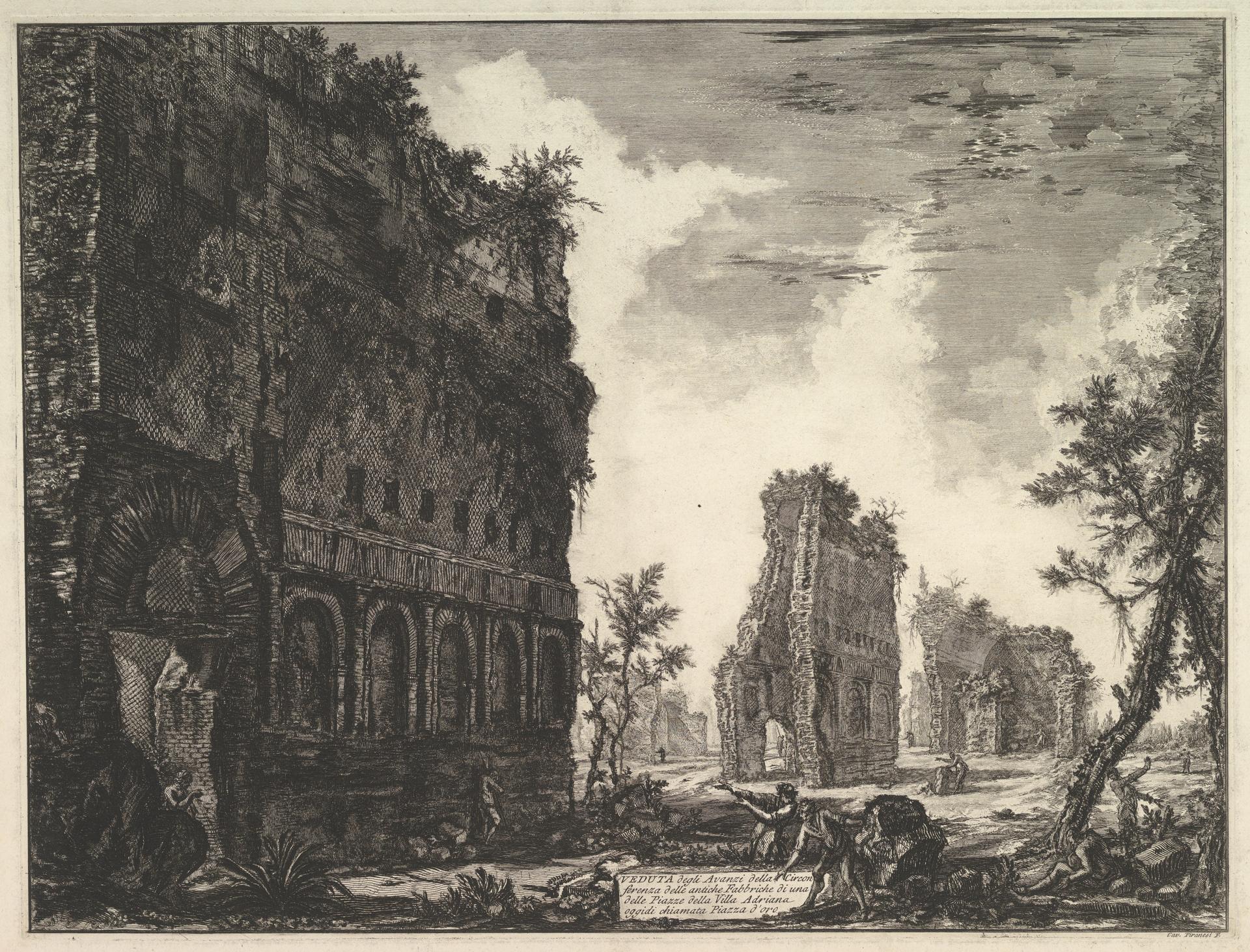
Hadrian's Villa: The Piazza d'Oro (Piazza of Gold) (Veduta degli Avanzi della Circonferenza delle antiche Fabbriche di una delle Piazze della Villa Adriana oggidi chiamata Piazza d'oro) (ca. 1776, Met-Objekt 4027)
Original title: Hadrian's Villa: The Piazza d'Oro (Piazza of Gold) (Veduta degli Avanzi della Circonferenza delle antiche Fabbriche di una delle Piazze della Villa Adriana oggidi chiamata Piazza d'oro)
kurzbeschreibung
A broad field of ruins framed by arches leads the eye straight to the Piazza d'Oro of Hadrian's Villa near Tivoli. Giovanni Battista Piranesi etched this site around 1776 as part of his series of views of ancient buildings. The print pairs a precise record of decay with a landscape mood that is distinctly picturesque.
Description
Several round arches and surviving columns dominate the foreground. To the left, a larger structure with a wide arched opening recedes into depth; on the right stands a smaller building, half its roof missing, its colonnade still rising. Beyond, more stretches of wall fade among the trees that surround the deserted place. A cloudy sky casts soft light over the complex, and the print's graded gray tones bring out the depth and texture of the masonry.
Context
The Piazza d'Oro once formed the luxurious heart of Hadrian's Villa, built in the 2nd century AD. Piranesi included this etching in his series of vedute devoted to ancient buildings in and around Rome. When he recorded the ruin, interest in antiquity was surging thanks to excavations and publications. His audience was educated readers with a taste for Roman history.
Impact
Over the empty arches and the high sky hangs a quiet, wistful mood. The carefully observed architecture merges with the landscape into an image that is at once exact and aesthetically attuned.
Technique
In etching, the drawing is scratched into a wax layer on a copper plate, and the exposed metal is then bitten by acid. Fine lines and hatching create the grays and shadows that give the ruins their volume. Piranesi used his lines with control and precision to capture both architectural detail and the fall of light.
AI-generated description text
Source: Metropolitan Museum of Art · Public Domain (CC0 1.0)