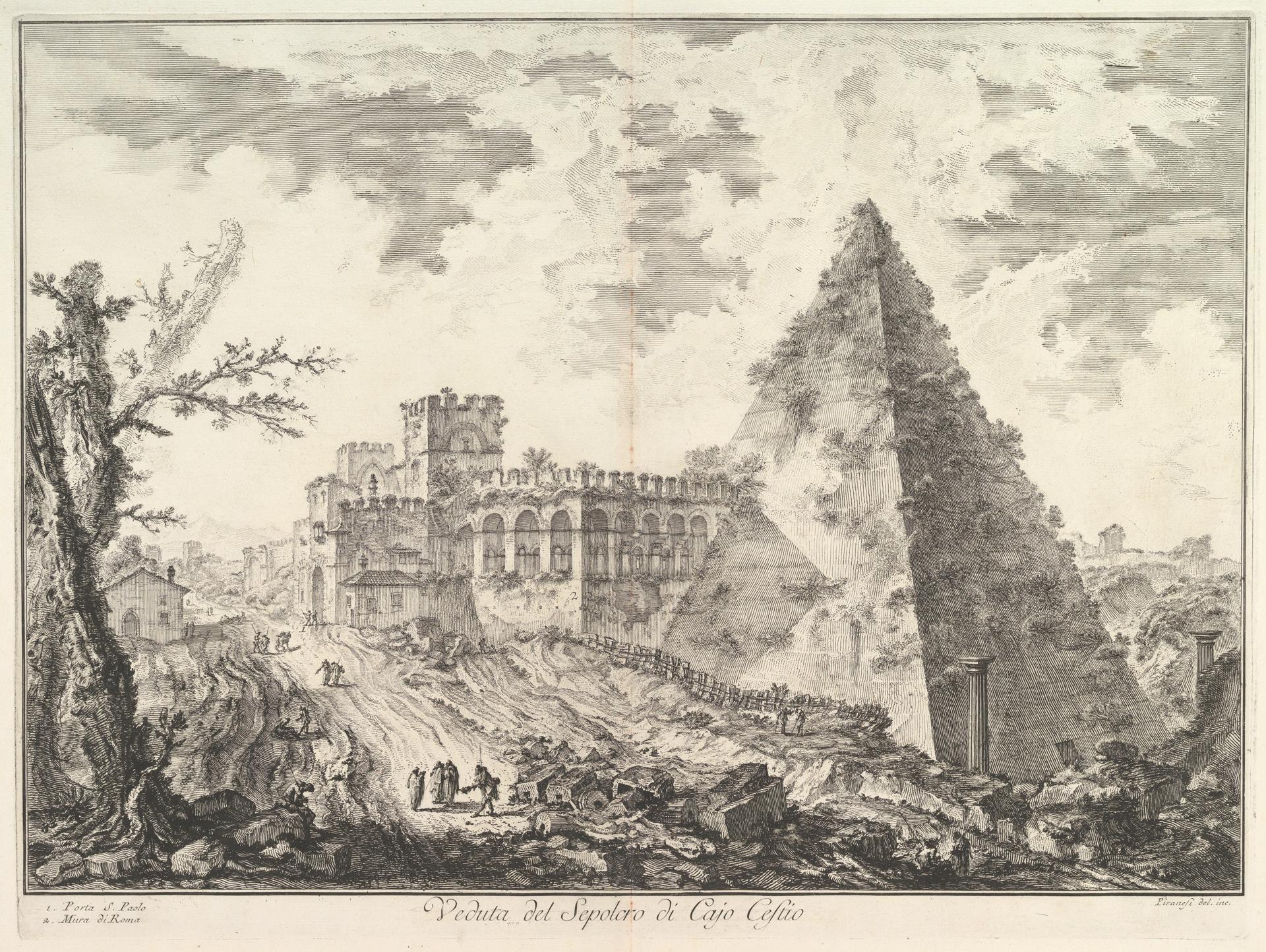
The Pyramid of Caius Cestius, with the Porta S. Paolo and adjoining road (Veduta del Sepolcro di Cajo Cestio), from "Vedute di Roma"
Original title: The Pyramid of Caius Cestius, with the Porta S. Paolo and adjoining road (Veduta del Sepolcro di Cajo Cestio), from "Vedute di Roma"
kurzbeschreibung
Giovanni Battista Piranesi made this etching around 1755. It shows the Pyramid of Caius Cestius in Rome, with the Porta San Paolo beside it and the road running past. The print belongs to the series 'Vedute di Roma' and is executed as an etching.
Description
The eye is drawn at once to the massive Pyramid of Caius Cestius, ringed by trees and shrubs. To one side a building with several arcades adjoins it, enclosing a walled yard. Further structures and a cloud-filled sky complete the view. Everything is rendered in black and white, dominated by greys and whites typical of etchings from this period. Architecture and nature enter into a dialogue.
Context
The 'Vedute di Roma' is a series of views of Roman buildings that began appearing in the 1740s. The Pyramid of Caius Cestius is an ancient tomb from the 1st century BC, later incorporated into the Aurelian Walls. Piranesi recorded Roman antiquities with great precision in order to preserve their historical significance. At that time Rome attracted artists and travellers engaged with the ancient sites.
Impact
Calm and almost monumental, the view works through the clear rendering of the pyramid and its surroundings. Ancient architecture and natural vegetation combine into an atmospheric mood. The viewer is prompted to follow details and perspective closely.
Technique
For the etching Piranesi scratched the drawing into a wax layer on a copper plate and then bit it with acid. Fine lines and hatching produce graduated grey values. This process allowed the precise rendering of architecture and landscape that is characteristic of Piranesi.
AI-generated description text
Source: Metropolitan Museum of Art · Public Domain (CC0 1.0)