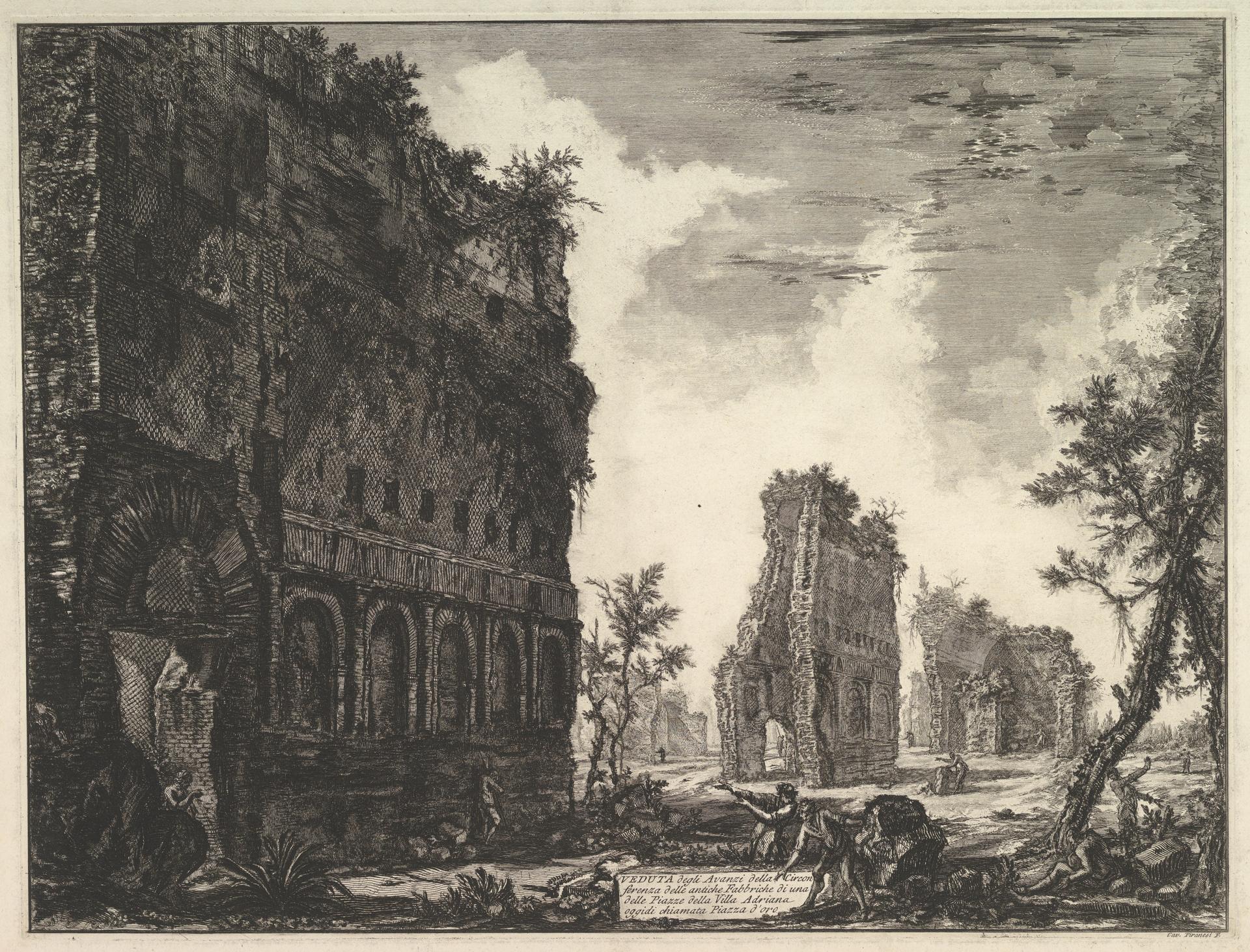
Hadrian's Villa: The Piazza d'Oro (Piazza of Gold) (Veduta degli Avanzi della Circonferenza delle antiche Fabbriche di una delle Piazze della Villa Adriana oggidi chiamata Piazza d'oro) (ca. 1776, Met-Objekt 4024)
Original title: Hadrian's Villa: The Piazza d'Oro (Piazza of Gold) (Veduta degli Avanzi della Circonferenza delle antiche Fabbriche di una delle Piazze della Villa Adriana oggidi chiamata Piazza d'oro)
kurzbeschreibung
Giovanni Battista Piranesi devoted this etching, made around 1776, to the remains of the Piazza d'Oro at Hadrian's Villa near Tivoli. The landscape-format sheet measures 47.3 x 62.2 cm and belongs to a series of views in which the artist recorded the ancient buildings of Rome and its surroundings.
Description
Ruinous columns and arches of a Roman structure dominate the foreground and hold the centre of the sheet. To the left rises a larger, also crumbling colonnaded building. Trees and shrubs frame the architecture and extend into the distance, where further ruins and vegetation can be made out. Light falling from above bathes everything in a muted mood, deepened further by the grey tone of the etching.
Context
In the second half of the eighteenth century, the exploration and documentation of Italy's ancient sites reached a peak, and it was in this period that Piranesi created this veduta. Hadrian's Villa, a sprawling palace complex of the second century AD, attracted artists and scholars alike. In his prints Piranesi combined archaeological precision with picturesque staging to bring out the grandeur of antiquity. This etching belongs to a series focusing on the buildings of the villa and was published in Rome.
Impact
Overgrown ruins and diffuse light create a calm, melancholy atmosphere. The precise rendering of the architecture hints at the site's former scale, while the vegetation stresses its decay. The sheet reads as a lamenting tribute to the transience of ancient architecture.
Technique
The etching was printed on paper; its characteristic fine lines and hatching are clearly visible. Piranesi used the etching process to capture architectural details precisely and to render light effects with nuance. The grey tones emerge during printing, when ink held in the plate's recessed lines is transferred to the paper.
AI-generated description text
Source: Metropolitan Museum of Art · Public Domain (CC0 1.0)